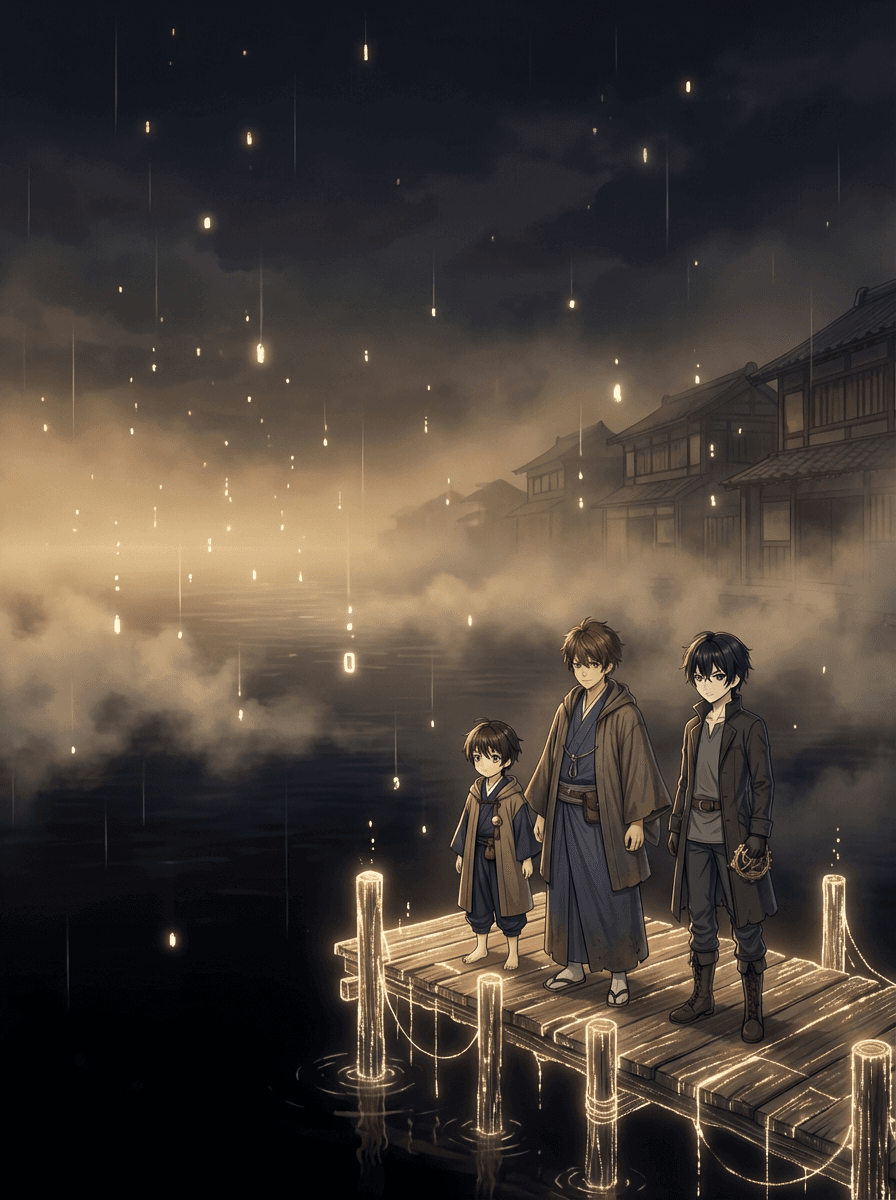
The day after the battle, the control room was silent.
The terminals stayed dark. Only the main console glowed faintly, now in steady-state monitoring.
Kuon finished the essential maintenance and sank deep into his chair. Asahi kept watch in the corridor. Koyoi worked on organizing the ledger.
Around noon, a small procession arrived from the direction of the shrines. They were the people who tended to the gods of rain, rivers, and wind. Their offerings were simple; their songs, brief.
"It’s not exactly a flashy festival, is it?"
At Koyoi’s remark, the old woman leading the group smiled.
"It is a day of rest. For the gods, and for the people."
A day of rest for the gods. On this day, no new prayers were added. It was a day simply to report one's status and return home.
Koyoi and the others joined the line, offering their reports in turn.
Koyoi reported on the handover of the Warden’s hut and the ledger. Asahi reported on the tactical use of the chipped sword. Kuon reported on the expiration of deletion privileges and the opening of the Regeneration Courtyard.
No one applauded. No one raised their voice.
The old woman simply nodded and rang a small bell once.
"That is enough. Rest today."
Asahi gave a wry smile. "We’re not very good at that, are we? Resting."
For once, Kuon agreed. "Neither am I."
Koyoi brewed hot water for the three of them. The tea wasn't strong, and the sweetness was faint. Yet, as it slipped down their throats, their bodies seemed to unspool. Toma sat a short distance away, drinking from the same pot; trust wasn’t fully established yet, but he had come close enough to share their water.
By evening, the wind blew gently. Through the control room window, clouds had finally returned to the sky, reclaiming their shapes.
Koyoi made a brief entry in the ledger:
Rest is not a full stop. It is maintenance for the sake of continuation.
This day of rest wasn’t only for the gods. It was a recovery protocol, essential even for the humans who continued to fight. Since they had begun this cycle of reflection, the nature of their journey had shifted. Before, they ended each day merely wondering if things had "gone well." Now, they recorded the "why" of their success and identified exactly where coincidence had lent a hand.
They had learned that in this era of Cascading Collapse, the most effective tool was turning luck into procedure.
Every time Koyoi opened the ledger, he found himself searching for the familiar creases where the previous owner had placed the bookmark. But rather than standing still at the point of loss, he chose to fill the blanks. A blank space was proof of an absence, but it was also room for handover. By honestly recording that someone was gone, he could decide what needed to remain. The work was painful, but to the extent he could put that pain into words, their movements the next morning became more precise.
Kuon refined a format to simultaneously handle the precision of the catalogs and the uncertainty of the field. He separated columns for "Immediate Conclusions" from those for "Pending Items." It was a major shift; he codified the idea that "Pending" was not a sign of weakness, but a technique to avoid the accidents born of false certainty. This "Pending" column proved most effective in the very places where previous Observers had destroyed everything by making "Fixed Reality" their only virtue.
Asahi made sure his records of swordplay weren't lost to vague, sensory language. The placement of the feet, the width of the interval, the beat where tension is released, the height of the gaze—he recorded these difficult-to-verbalize physical techniques in short, repetitive phrases. As a result, his options grew even with a broken blade, and the need to rely on desperate, all-or-nothing strikes diminished. By prioritizing "preserving" over "winning," the survival rate of the party climbed steadily.
That night, gathered before the campfire, the three of them decided on a single line to pass forward. The discussion was brief, and the conclusion was, as always, simple. But it was the simple sentences that proved most useful in the field. Flashy slogans might lift the spirit, but protocols saved lives.
The line they chose would be carved into wooden tags by morning and tied to gates, shelters, and railway sidings.
Finally, Koyoi added a small note in the margin of the ledger:
"What we learn here is used not to blame someone for their delay, but to absorb that delay for them."
Beside that sentence, Kuon added the date and their current coordinates. Asahi nodded silently, threading a cord through the hole in the wooden tag.
The next morning, the tag swayed in the wind, coming to rest at an angle where it could be read. Seeing it, the three decided to measure their day not by whether they succeeded, but by whether they could continue.
Not just breaking the chain of collapse, but maintaining the path so that people could walk it—that quiet, grueling work was the true essence of their journey. They confirmed this with each other, using the same words.
They decided to leave one unresolved issue in the records. A record that makes everything look solved only misleads the next person in charge. Showing the unresolved as unresolved was not a mark of defeat, but a sign of a handover.
Koyoi made a small mark at the edge of the page, creating a column for re-verification the following day. Kuon defined the meaning of that mark, and Asahi re-hung the wooden tag in the field at a height where the mark could be easily seen. By repeating these three simple steps, the recurrence of the same failures dropped visibly.
The records didn't have to be perfect. They just had to be left in a way that wouldn't confuse the next person who touched them. Having confirmed this agreement, the three began walking toward the next sector.
Dividing the responsibilities for supplies and recording also stabilized the latter half of their journey. When judgment, transport, and recording are concentrated in one person, a delay in decision-making is inevitable. Instead, they switched to a protocol of re-declaring their roles before moving and briefly cross-checking the results after.
This procedure wasn't flashy, but it quickened their initial response in the next crisis. And above all, it meant that even if one of them was lost, the remaining two could keep the minimum systems running.
The strength required to continue the journey was not the power of a single breakthrough, but a design that functioned even when someone was missing. This was the truth they now shared.