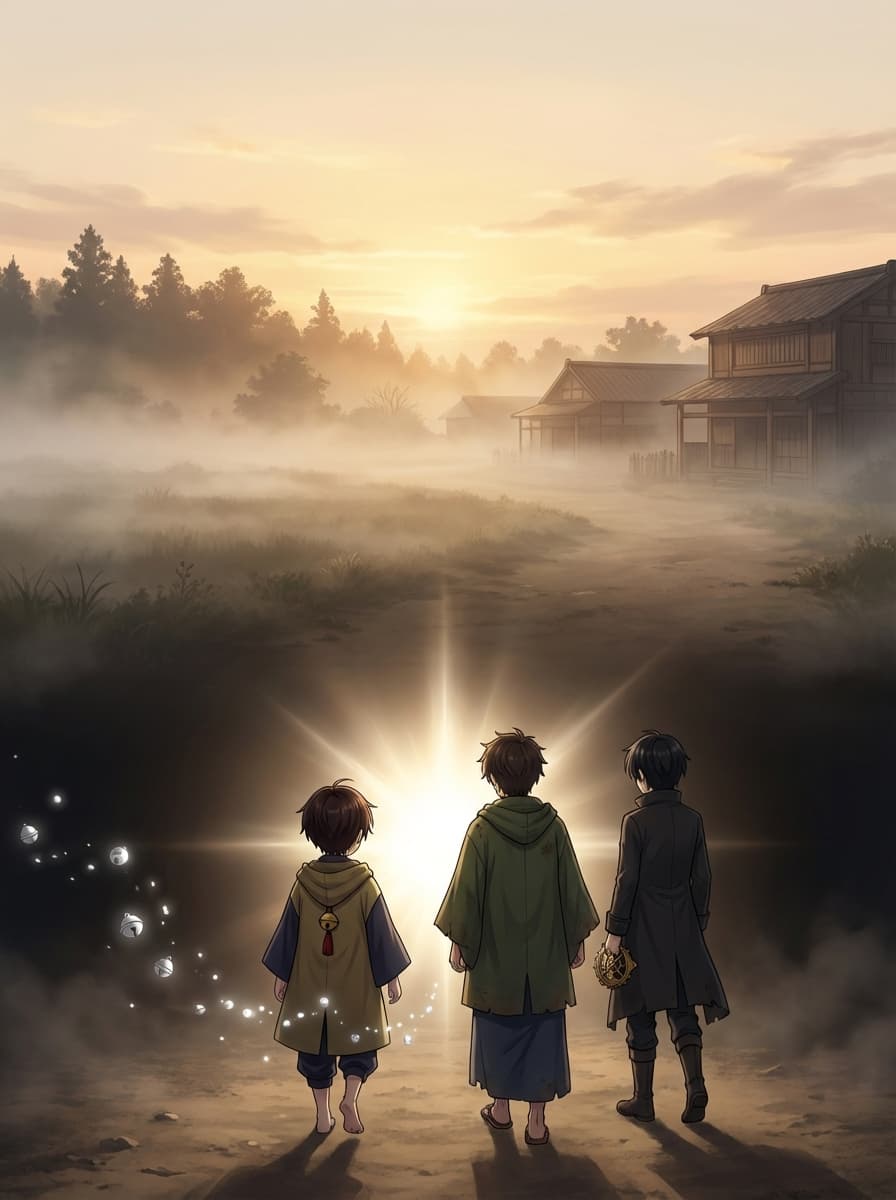
Koyoi woke first.
Outside the control room, the sky was a thin, pale gray. The wind was weak, and the world was hushed. It was a quiet morning.
He boiled water and opened the ledger. Usually, Shiori would be sitting across from him, having already penned the very first line.
But she wasn't there today.
A morning without Shiori.
Koyoi stared at the blank first line for a long time. He didn't know what to write.
Asahi eventually woke up and walked over, rolling his shoulders. "You’ve got a heavy look on your face," he said.
Koyoi gave a strained smile. "Without Shiori here, I’m slow to start."
Asahi pulled out a chair and sat across from him. "Slow is fine. Speed was her job. You’re the one in charge of accuracy."
Kuon emerged next and placed a catalog on the desk. "On days when the start is slow, begin with the date. That is the procedure."
Koyoi nodded and wrote the date. Next, the weather. Then, their current location.
As he began to write, his hands gradually grew warm.
“Deletion-permission expiration status: unchanged.” “Regeneration Courtyard: water increased from two drops to four.” “Pamphlet distribution: dispatched northeast via the Guardians.”
He lined up the facts. The emotions would follow later.
While gnawing on a piece of hardtack for breakfast, Asahi spoke up quietly. "I have a feeling Shiori is somewhere out there, writing just like this."
"I agree," Kuon replied softly. "A person who leaves behind a procedure for writing does not simply discard that practice."
At the bottom of the page, Koyoi added a postscript:
“Absence is a loss, not an emptiness.”
Outside the window, a messenger from the Guardians passed by. They had come to collect the new pamphlets. Koyoi tucked a single slip of paper into the envelope.
“To Shiori. If you find this, please pick up where I left off.”
He didn’t know who would deliver it. It might never arrive. Still, he sent it. As long as there was any chance it might reach her, the record had to be sent.
Mornings without Shiori were quiet and a little painful. But the work continued. Koyoi knew that moving forward was, in itself, the shortest path to seeing her again.
Before closing the ledger, Koyoi wrote one final line.
“Continue.”
It was the same word he had written yesterday, but the script was a little stronger today.
Since they had begun this repetition, their journey had gradually changed. Before, they would end the day judging only whether things had "gone well." Now, they recorded the "why" of their success and identified exactly where they had been saved by coincidence.
They had learned that in this era of "Chain Collapse," turning coincidence into a method was the most effective tool they had.
Every time Koyoi opened the ledger, he found himself looking for Shiori’s habits. But instead of stopping where he searched, he chose to fill the blanks. A blank space was proof of absence, but it was also room for a handover. By honestly recording that someone was missing, he could decide what needed to be left behind for them. The process was painful, but the more he put that pain into words, the more precise their movements became the following morning.
Kuon had refined a format to handle both the accuracy of the catalog and the uncertainty of the field. By separating the columns for "Immediate Conclusions" and "Pending Items," he reduced accidents caused by false certainty. He explicitly defined "Pending" not as a weakness, but as a technical safeguard to avoid misjudgment. This "Pending" column proved most effective in places where previous observers had destroyed everything by forcing a "fixed" state as if it were the only truth.
Asahi stopped recording sword techniques with vague, sensory words. The placement of feet, the width of the interval, the beat at which tension releases, the height of the gaze—the physical skills that were hardest to verbalize were the ones he recorded repeatedly in short, punchy terms. As a result, even with a chipped sword, his options increased, and he relied less on desperate, all-or-nothing strikes. His management of combat, which prioritized "preserving" over "winning," steadily pushed up the party's chances of survival.
That night, the three of them sat before the campfire and decided on the "next line" to pass on. The discussion was short, the conclusion always modest. But the more modest the sentence, the more useful it was in the field. Flashy slogans might lift the heart, but procedures saved lives. The line they chose would become a wooden tag by the next morning, tied to gates, shelters, and railway sidings.
Finally, Koyoi added a small note in the margin of the ledger:
“What we learn here is not for blaming someone's delay, but for absorbing it.”
Beside that sentence, Kuon added the date and location. Asahi nodded silently and threaded a cord through the hole in a wooden tag.
The next morning, the tag swayed in the wind, coming to rest at an angle where it could be read. Seeing this, the three of them decided to measure the day not by whether they had succeeded, but by whether they could continue.
To not just break the chain of collapse, but to maintain the path so that others could follow it—the three of them confirmed, in the same words, that this quiet, long task was the heart of their journey.
They decided to leave one thing unresolved. A record that makes everything look "settled" only misleads the next person to handle it. Showing the unresolved as it is was not a mark of defeat, but a sign of a handover.
Koyoi made a small mark at the edge of the ledger, creating a column for re-confirmation the following day. Kuon defined the meaning of that mark, and Asahi hung the wooden tag in the field where it would be most visible. By simply continuing these three modest steps, repeat failures dropped noticeably.
The record didn’t have to be perfect. It just had to be left in a way that wouldn’t confuse the next person to touch it.
Having confirmed this agreement, the three of them began walking toward the next sector.