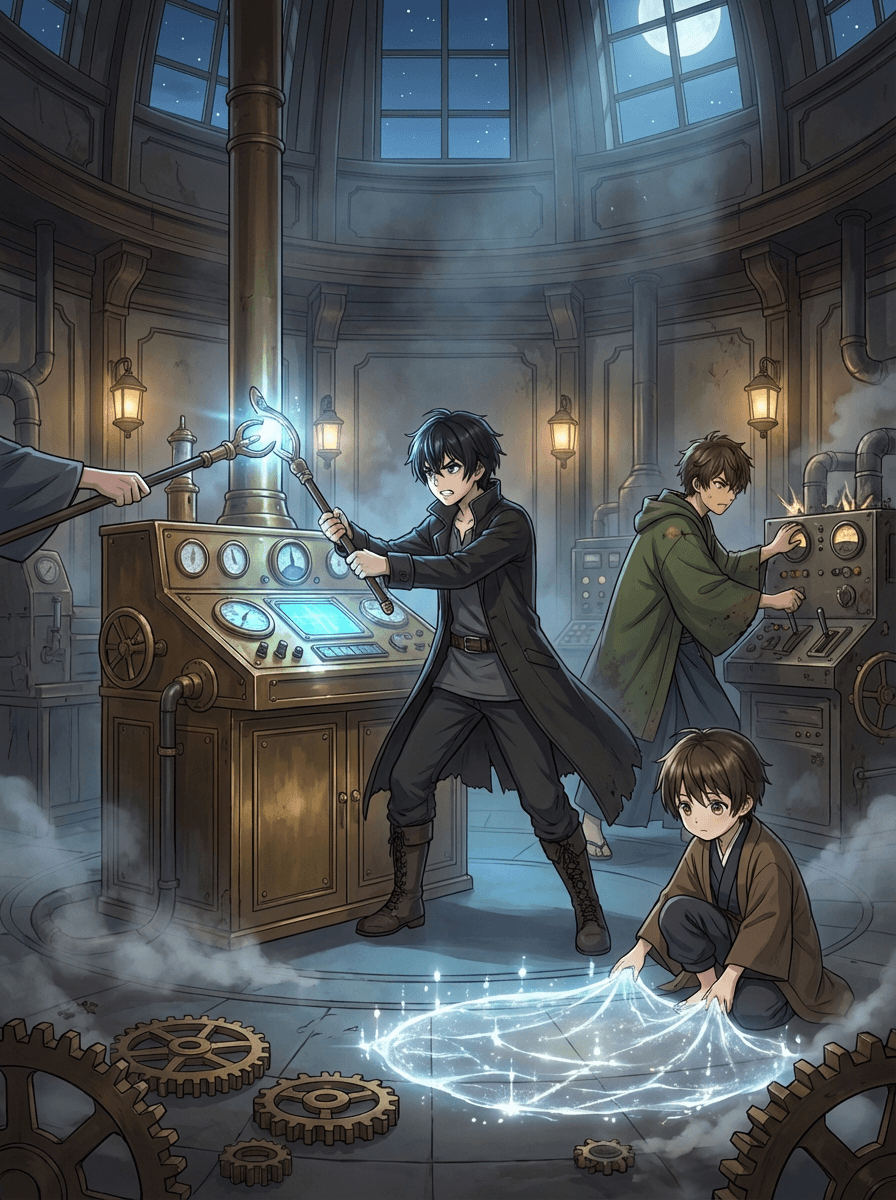
The final stand took place in the old control room.
Six terminals lined the circular chamber. At the center stood the master console for simultaneous refixation. The main Observer force was already in place.
The woman standing at the front declared her intent.
"Squad Leader Rei. This area is now sealed by administrative order."
Kuon took a step forward.
"Sealing it might delay the collapse, but it only makes the loss permanent. We’re done making that choice."
Rei looked back with cold, indifferent eyes.
"Do you really think you’re in a position to choose? Sentiment in the field only serves to break the entire system."
Asahi drew his sword halfway.
"The only thing 'breaking' is the system you've spent so long pretending not to see."
The negotiation ended quickly. At Rei’s signal, the six terminals hummed to life.
Ninety seconds remained until simultaneous refixation.
Kuon shouted.
"Move according to your roles! Koyoi, temperature delay. Asahi, disable terminals two and four. I’m taking the master console!"
Koyoi manifested his Shizuku, spreading a thin film of temperature across the floor. The synchronization pulse of the terminals lagged by half a beat.
Following his training, Asahi didn't cut; he broke their centers of gravity. He struck terminal two with his hilt and used a dagger to sever the power coupling of terminal four.
Kuon lunged for the master console, forcing the authentication wheel into a reverse rotation.
Rei blocked him with her short staff. Sparks flew.
Touma, his hands finally freed from his restraints, dove between them and parried the angle of Rei’s staff.
"Now, Kuon!"
The authentication wheel clicked out of place. The display on the master console shifted from red to yellow.
Thirty seconds remaining.
Rei pressed on regardless.
"Do not stop this! If you stop it now, the system will become unmanageable!"
Koyoi answered her head-on.
"Even if it’s unmanageable, those of us still living can rebuild it. If you delete it, it’s gone forever."
Kuon entered the final key.
`DELETE AUTHORITY: REVOKED`
The refixation sequence on the master console ground to a halt. The lights on the terminals flickered out one by one.
Silence.
Rei lowered her staff and let out a long, heavy breath.
"...Don't think this is the end."
Kuon nodded.
"It’s not the end. That’s why we stopped it."
Asahi sheathed his sword.
"The last resistance is over. Next comes the final reconstruction."
Touma slumped to the floor and closed his eyes. Only the trembling of his shoulders betrayed the weight of the battle they had just fought.
Koyoi placed a slip of paper on the entrance to the control room.
‘Deletion Authority: Expired’
The Observers' final resistance broke here. It wasn't just force that broke them—it was the very way they chose to see the world.
Since they had begun this cycle, their journey had gradually changed. Previously, they would end their days simply wondering if things had "gone well." Now, they recorded their progress by distinguishing "why it worked" from "where they were saved by chance."
In an age of cascading collapse, they learned to turn chance into procedure.
Every time Koyoi opened his ledger, he found himself looking for the crease in the bookmark. But instead of stopping where he searched, he chose to fill in the blanks. A blank space proved someone was missing, but it also left room for handover. He would write honestly about who was no longer there, and because of that, he would decide what needed to be left behind. The work was painful, but for each pain they put into words, the next morning’s movements became more precise.
Kuon established a format for handling the precision of the inventory alongside the uncertainty of the field. By separating columns for "urgent conclusions" and "items held pending," accidents caused by false certainty decreased. It was a significant breakthrough to codify that "pending" was not a weakness, but a technique to avoid misjudgment. In the places the Observers had destroyed by making "refixation" their only justice, these pending columns proved most effective.
Asahi made sure his combat records weren't relegated to mere sensory descriptions. The placement of feet, the width of the interval, the beat at which to relax tension, the height of the gaze—he recorded the hardest-to-describe physical techniques using short, repetitive terms. As a result, even with a chipped sword, his options increased, and he relied less on desperate, all-or-nothing strikes. His management of the blade, which prioritized "preserving" over "winning," boosted the survival rate of his comrades.
That night, before the campfire, the three of them decided on the single line they would pass on next. The discussion was brief, and the conclusion was, as always, plain. But the plainest sentences were the most useful in the field. Flashy slogans lift the spirit, but procedures save lives. The line chosen here would become a wooden tag by morning, tied to gates, shelters, and railway sidings.
Finally, Koyoi added a small note in the margin of the ledger. "The things we learned here shall not be used to blame someone for their delay, but to absorb that delay for them."
Beside that sentence, Kuon added the date and their current location. Asahi nodded silently and threaded a cord through the hole in the wooden tag.
The next morning, the tag swayed in the wind, coming to rest at an angle where it could be read. Seeing this, the three of them decided to measure their day not by whether it went well, but by whether they could keep going. To not only break the chain of collapse, but to maintain the path so that others could walk it. That quiet, long labor was the true heart of their journey.
They decided to leave one unresolved issue behind. A record that makes everything look solved only misleads the next person in charge. Showing the unresolved as unresolved was not a mark of defeat, but a mark of handover.
Koyoi made a small mark on the edge of the ledger, creating a column for re-confirmation the following day. Kuon defined the meaning of that mark, and Asahi re-hung the wooden tag in a position where it could be read on-site. By simply continuing these three plain steps, the recurrence of the same failures decreased visibly.
The records didn't have to be perfect. They just had to be left in a way that the next person to touch them wouldn't lose their way. Having confirmed that agreement, the three of them began walking toward the next sector.