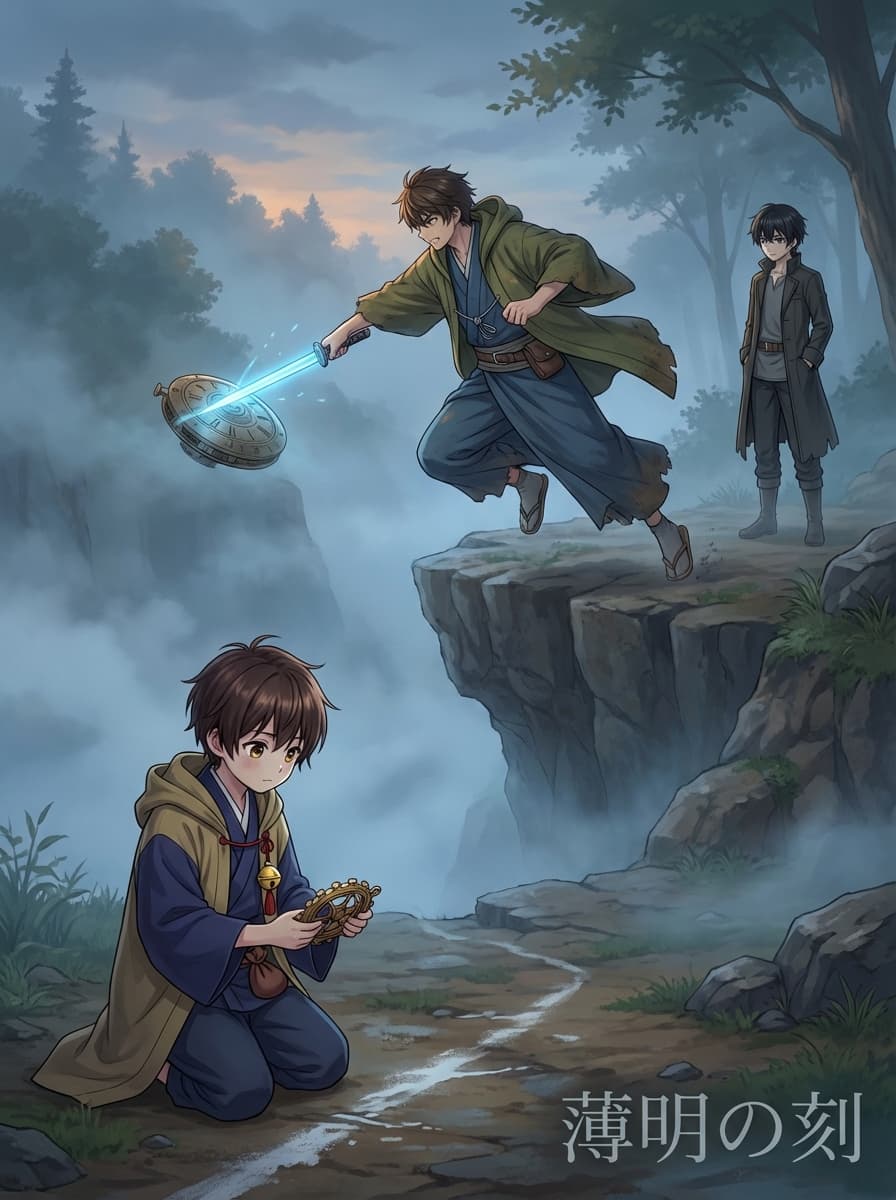
Half an hour after leaving the shelter, a dull buzzing echoed through the sky.
It wasn't a bird. It wasn't a windmill. It was a cold, rhythmic, mechanical drone.
Kuon’s expression shifted instantly.
“A new weapon from the Observers. A tracking Name-Shaving Blade.”
Asahi glared at the sky. Through the mist, three disc-shaped crafts appeared, hovering with thin light blades suspended from their bellies.
“You don’t use those against people,” Asahi spat.
“Originally, they were meant for pruning the record layers,” Kuon replied. “They’ve been repurposed for anti-personnel use.”
The crafts descended to a low altitude, their light blades skimming the ground. The lines they carved into the sand were instantly bleached white.
Koyoi gasped.
“The names of the places they touch… they’re vanishing.”
Kuon issued orders immediately.
“Don’t move in straight lines. Scatter in curves. Asahi, aim for the base of the blades!”
Asahi sprinted toward a cluster of rocks by the cliffside, leaping high to strike one of the crafts. Even with a chipped sword, he could do damage if he reached the joints. The light blade tilted, its angle skewed, and it plunged uselessly into the earth.
Koyoi opened his pouch, using the chill of his droplets to slow the progression of the bleached lines. He couldn't stop them completely, but he could buy enough time for them to escape.
Kuon tore a thin strip from a page of the Catalog and tossed it into the wind. The scrap was sucked into a craft’s intake, causing its rotors to sputter and stall.
One craft, then a second, lost altitude. The remaining one circled above, recalibrating its aim.
Asahi screamed.
“Here it comes! Get down!”
The light blade swept forward in a straight line. Koyoi threw himself to the ground, pulling Kuon down with him. The blade grazed the tips of his hair before burying itself in a rock behind them.
The characters carved into the stone bleached out all at once. An ancient signpost was gone.
Kuon gritted his teeth.
“Just as I thought. It’s prioritizing geographical information. Their strategy is to erase routes and isolate us.”
Asahi charged the final craft. The footing was treacherous, but he seized a split-second opening and struck the rotor axis with the spine of his sword.
A sharp metallic snap. The craft tilted and plummeted beyond the dunes.
Silence returned; the buzzing was gone.
Koyoi steadied his ragged breathing.
“They’ll be back, won't they?”
Kuon nodded.
“They will. That’s why we’re going to make this our standard response.”
The three of them recovered the wreckage, stripping it of usable parts: the rotation axes, the light blade control fragments, and the identification tags.
Kuon summarized the lesson.
“Next time, we block the intake first. Don’t take them head-on.”
Asahi looked at his chipped blade and laughed.
“Before this sword breaks, we’ll just have to add more steps to our routine. Fine by me.”
Koyoi took a piece of charcoal and wrote in bold strokes across the bleached surface of the rock:
‘Don’t watch the sky. Protect your feet.’
Even in an age of high-tech weaponry, the thing they relied on most in the end was a short message left at the scene.
Since they had begun this cycle of record-keeping, their journey had slowly changed. Before, they would end each day simply judging whether things had "gone well" or not. Now, they recorded the "why"—separating the reasons for success from the moments they were saved by pure luck.
They had learned that in the era of the Chain Collapse, turning luck into procedure was the most effective way to survive.
Every time Koyoi opened his notebook, his fingers instinctively searched for the familiar crease of a missing bookmark. But instead of stopping to mourn, he chose to fill the empty spaces. A blank space was proof of an absence, but it was also room for a handover. He wrote honestly about who was no longer there, and because of that, he decided what needed to be left behind. The process was painful, but the more he put that pain into words, the more precise their movements became the following morning.
Kuon developed a format to handle both the accuracy of the Catalog and the uncertainty of the field. By separating columns for "urgent conclusions" and "Pending observations," they reduced accidents caused by false certainty. His explicit note that "Pending" was not a sign of weakness, but a technique to avoid misjudgment, was a breakthrough. In places where the Observers had destroyed reality by enforcing "Fixed Status" as the only virtue, these Pending columns proved incredibly effective.
Asahi made sure not to let his combat records drift into vague, sensory language. Foot placement, the width of the gap, the beat at which to relax his strength, the height of his gaze. He took physical techniques that were difficult to verbalize and hammered them into short, repeatable phrases. As a result, even with a chipped sword, his options increased, and he relied less on desperate, all-or-nothing strikes. By prioritizing "preservation" over "winning," he steadily pushed up the survival rate of the group.
That night, in front of the campfire, the three of them decided on the single line they would leave for the next person. The discussion was brief, and the conclusion was, as always, plain. But the plainer the text, the more useful it was in the field. Flashy slogans might lift the spirit, but procedures saved lives. The line they chose would be carved into a wooden tag by morning and tied to a gate, a shelter, or a railway siding.
Finally, Koyoi added a small note in the margin of his notebook. “The things we learn here are not to be used for blaming someone's delay, but to absorb the delay and adapt.”
Beside that sentence, Kuon added the date and their current location. Asahi nodded silently and threaded a cord through the hole in the wooden tag.
The next morning, the tag swayed in the wind, settling at an angle where it was easy to read. Looking at it, the three of them decided to measure the day not by whether they succeeded, but by whether they could keep going. They weren't just breaking the chain; they were making sure the path stayed passable for those who followed. That quiet, grueling work was the true heart of their journey—they confirmed this to one another with the same words.
They decided to leave one thing unresolved. A record that makes everything look solved only leads the next person into a trap. Showing the unsolved as unsolved wasn't a mark of defeat—it was a sign of a proper handover.
Koyoi made a small mark at the edge of the notebook, creating a column to re-check the entry the following day. Kuon defined the meaning of that mark, and Asahi re-hung the wooden tag in the field where it could be seen clearly. By simply continuing these three humble steps, the recurrence of the same mistakes began to vanish before their eyes.
The record didn't have to be perfect. It just had to be left in a way that the next person to touch it wouldn't lose their way. Once that agreement was settled, the three of them began walking toward the next sector.