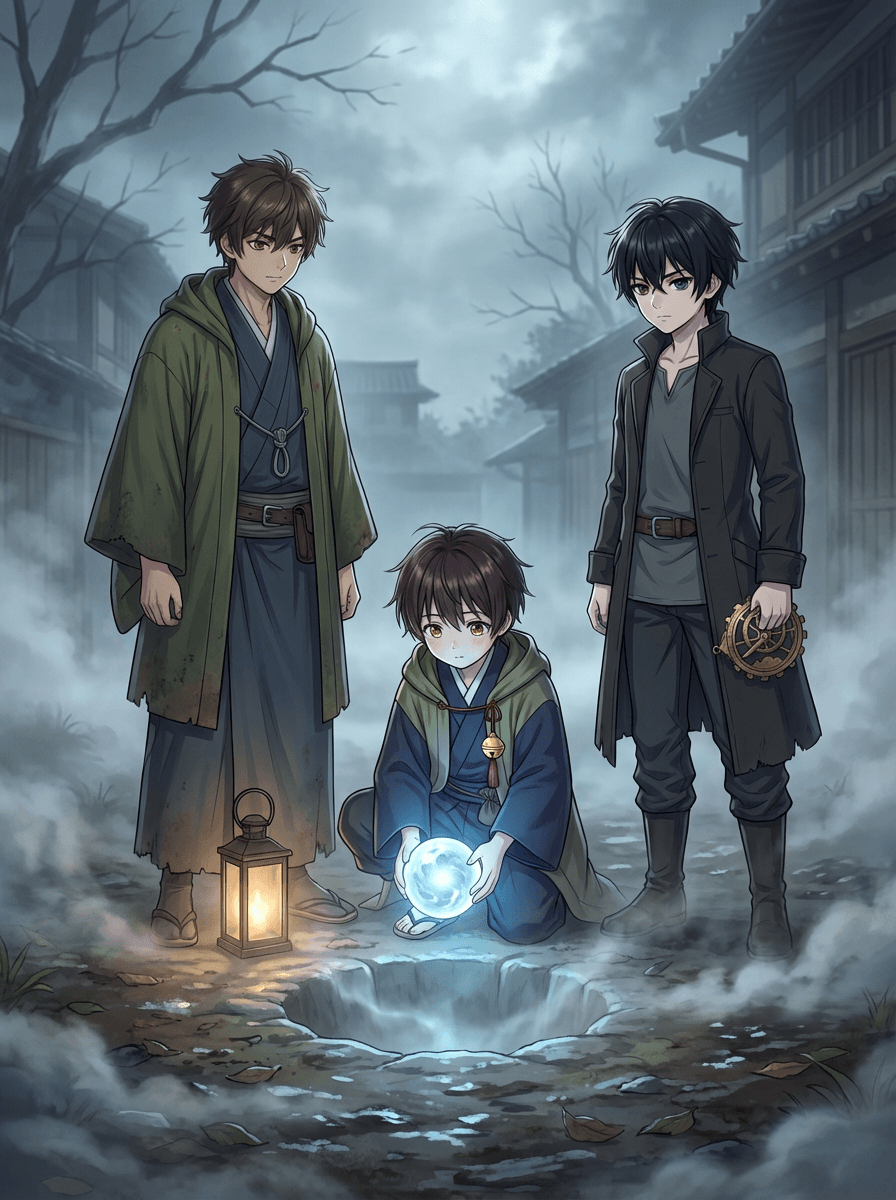
On the night after they finished clearing the wreckage of the war machines, Kuon fell into an uncharacteristic silence.
On the other side of the campfire, he was staring at the same page of his notebook, over and over again. Koyoi eventually spoke up.
"What is it?"
Kuon hesitated for a moment before answering.
"Yae’s predictions are starting to come true."
Asahi stopped mid-swing, the axe resting on the log he was splitting.
"Which warning?"
Kuon turned the notebook to show them the page.
“Should the Observers commit to weaponization, the next stage will be the imitation of civilian protocols.”
"Meaning?" Koyoi asked.
"They’re going to steal our recording methods, our evacuation routes, and our protocols for guarding the Margins. Then, they’ll turn them against us."
An ember popped in the fire. Silence settled over the trio.
"That’s as bad as it gets," Asahi said, his voice low. "Our best intentions turned into traps."
Kuon nodded. "Yae was always terrified of this. That’s why she kept telling us: don’t share too much."
Koyoi hugged Shiori’s notebook to his chest, lost in thought. "But if we hide too much, the people on the ground will die. If we don’t publish the protocols, there are people we simply won’t be able to save."
Kuon gave a bitter smile. "That dilemma was exactly what Yae feared. There probably isn't a single 'right' answer."
Asahi tossed another log onto the fire. "Then we just split the scope. We don't put every protocol into a single book. We only give each site exactly what they need for their specific situation."
Koyoi’s eyes brightened. "Split the protocols?"
Kuon nodded in agreement. "I like it. If we deconstruct them, we can contain the damage even if they’re stolen."
That night, the three of them restructured their record-duplication policy.
Evacuation stayed with evacuation. Repair stayed with repair. The protocols for linking sections would be passed on only through word of mouth.
Shiori’s original notebook would remain the master copy, while the distribution versions would be split into specialized booklets.
Before dawn, Koyoi wrote the titles on the covers of the new pamphlets:
‘Wind.’ ‘Gate.’ ‘Evacuation.’
Asahi let out a short laugh. "If Yae saw this, she’d find something to complain about even while she was praising us."
Kuon stared quietly into the dying fire. "The anxiety won't go away. But stopping because of fear isn't an option. We move forward by refining the process as we go."
Koyoi nodded. Anxiety wasn’t a brake; it was data they could steer by.
By the time the fire went out, three separate booklets were complete. It was their first concrete answer to the fears Yae had left behind.
Since they had begun this cycle of constant refinement, their journey had shifted. Before, they used to end each day simply judging whether things had "gone well" or not. Now, they recorded the why—distinguishing between what worked by design and where they had been saved by pure luck.
They had realized that in an age of cascading collapse, the most effective weapon was turning coincidence into a repeatable protocol.
Every time Koyoi opened the notebook, he found himself searching for the traces of Shiori’s handwriting, her little habits. But instead of stopping where Shiori had left off, Koyoi chose to fill the blanks. A blank space was proof of an absence, but it was also room for a legacy to be inherited. By being honest about who was no longer there, they could decide exactly what needed to be left behind. The process was painful, but by putting that pain into words, their movements the following morning became that much more precise.
Kuon developed a format to simultaneously handle the accuracy of their catalogs and the uncertainty of the field. By creating separate columns for "Immediate Decisions" and "Pending Matters," he reduced accidents caused by false certainty. He even codified the idea that "Pending" wasn't a sign of weakness, but a technical necessity to avoid misjudgment. This "Pending" column proved most effective in places where the Observers had tried to force "Stability" as the only virtue, only to end up breaking everything.
Asahi made sure his records of sword techniques weren't just based on intuition. He broke them down into words: foot placement, fighting distance, the moment tension releases, the height of the gaze. The more difficult a physical sensation was to describe, the more he reinforced it with short, repetitive notes. As a result, even with a chipped blade, his options increased, and the need to rely on desperate, all-or-nothing strikes diminished. By prioritizing "Preservation" over "Winning," he noticeably boosted the group's survival rate.
That night, sitting before the fire, they decided on the next line to be shared. The discussion was short, and the conclusion was, as always, humble. But the humbler the sentence, the more useful it was in the field. Flashy slogans might lift the spirit, but protocols saved lives. The line they chose would be carved into wooden tags the next morning and tied to gates, shelters, and railway sidings.
Finally, Koyoi added a small note in the margin of the master notebook: “The things we learn here are not to be used to blame someone for their delay, but to help us absorb the impact of that delay.”
Beside the sentence, Kuon added the date and their current location. Asahi nodded silently and threaded a cord through the hole in a wooden tag.
The next morning, the tag swayed in the wind, coming to rest at an angle where it could be easily read. Watching it, the three of them decided that today, they wouldn't measure success by whether things went perfectly, but by whether they could keep going.
To not just break the chain of collapse, but to maintain the path so that those who followed could walk it—they confirmed, in their own shared words, that this quiet, grueling work was the true essence of their journey.
They also decided to leave one unresolved problem visible. A record that makes everything look solved only misleads the next person in charge. Leaving unresolved items visible isn't a badge of defeat—it’s a handoff.
Koyoi made a small mark at the edge of the page, creating a column for "Reconfirm Tomorrow." Kuon defined the meaning of that mark, and Asahi re-hung the wooden tag in the field to a position where the mark could be clearly seen. By simply continuing these three humble steps, the recurrence of the same failures dropped noticeably.
The records didn't have to be perfect. They just had to be left in a way that the next person to touch them wouldn't lose their way.
Having confirmed this agreement, the three of them began walking toward the next sector.