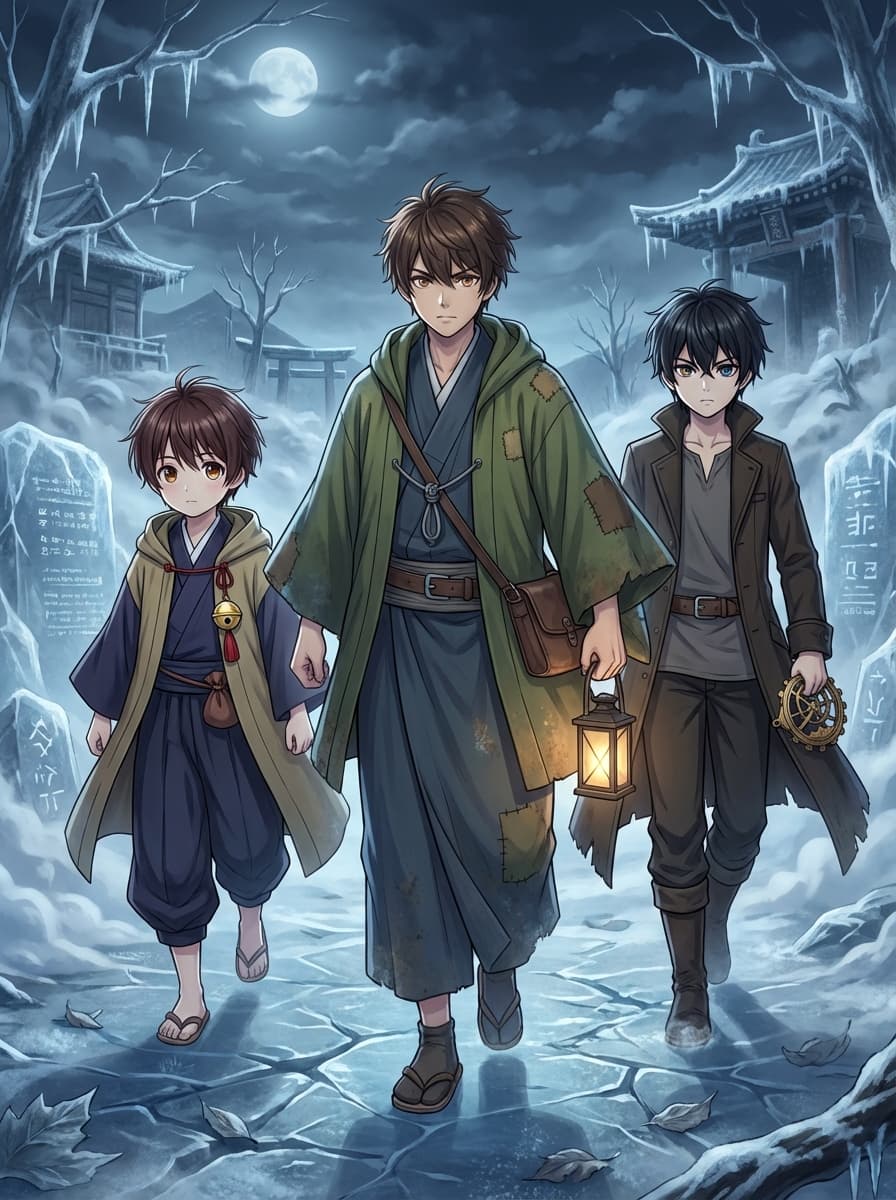
Beyond the stone steps, they discovered a bunker hollowed out from the cliffside.
The entrance was low, but the interior was surprisingly spacious. Soot stains marked the walls, blanket fibers clung to the floor, and an empty water jar sat in the corner.
"A Shadow Shelter."
Kuon shone his light on an inscription etched into the wall.
Do not call out names. Only count the numbers.
Koyoi read the words silently. Those few short characters told the story of everything that had happened in this place.
Asahi stood by the entrance, ears strained for any sound. "The pursuers seem distant now. We can rest here for the night."
The three moved deeper into the bunker, lighting only the dimmest of lamps. Koyoi opened Shiori’s journal and began organizing the route they had taken so far.
Kuon drew a line across a blank space in the ledger. "This is where the link broke. This is where it reconnects. Next we map what lies between."
Asahi cracked a piece of dry bread with his dagger and handed a portion to each of them. "You can argue the logic after you eat. Hunger dulls the judgment."
A short while later, a pebble skittered at the entrance. Asahi stood up instantly. "Who’s there?"
A child’s voice answered. "…Can we come in? The wind outside… it hurts."
Koyoi was the first to move. Standing at the entrance were two children, likely siblings. Their clothes were caked in sand, and their lips were bone-dry.
Kuon immediately crafted two numbered tags. He didn’t ask for names. He followed the rules of the bunker. "Number four, number five. There is still room inside."
The siblings drank lukewarm water and huddled under blankets. The younger brother whispered softly. "Are we not supposed to say our names?"
Koyoi answered gently. "We just don't say them here. It’s not so that we forget them."
In the middle of the night, the ring of metal echoed in the distance. A patrol was scouring the area. Kuon dimmed the light even further and signaled to the group. Silence. They synced their breathing and stayed silent.
The patrol passed the entrance and eventually faded away.
At dawn, the siblings prepared to leave first. Koyoi handed the older sister a scrap of paper torn from the journal, marked with a simple cipher indicating the bunker’s location. "If you’re ever in trouble, look for this same mark. It’s a path someone left behind for us."
The girl bowed deeply. "Thank you. Next time, we’ll be the ones to leave the mark."
A shelter wasn't just a hole for hiding. It was a temporary archive for the protocols that needed to be passed on. Before leaving the bunker, the three added a single line beneath the wall's inscription:
Keep the lights at half. Share the rations.
The Shadow Shelter continued to carry someone through to morning.
Since they had begun this cycle, their journey had gradually changed. Before, they used to end each day simply by asking if things had "gone well." Now, they categorized their records: Why did it work? Where had they been saved by mere chance?
They had learned that in this era of "Cascading Ruin," the most effective tool was turning coincidence into a procedure.
Whenever Koyoi opened the journal, he found himself looking for Shiori’s handwriting quirks. But he didn't stop there; he chose to fill the blanks. A blank space was proof of absence, but it was also room for succession. By honestly recording that someone was gone, they could decide what needed to be left in their stead. The process was painful, but the more they put that pain into words, the more precise their movements became the following morning.
Kuon refined a format to handle the accuracy of the manifest alongside the uncertainty of the field. He separated the columns into "Immediate Decisions" and "Pending Items." It was a significant shift—defining "Pending" not as weakness, but as a technical safeguard against misjudgment. This "Pending" column proved most effective in places where previous Observers had destroyed everything by prioritizing "Fixing" as the only virtue.
Asahi made sure his records of swordplay weren't limited to mere intuition. Foot placement, the width of the interval, the beat of relaxation, the height of the gaze—he repeatedly documented physical techniques that were difficult to put into words. As a result, even with a chipped blade, his options increased, and the need to rely on desperate, all-or-nothing strikes decreased. By prioritizing "Preserving" over "Winning," he had tangibly raised the group’s chances of survival.
That night, before the campfire, the three decided on the next line to pass on. The discussion was brief; the conclusion, as always, was modest. But the most modest instructions were often the most useful in the field. Flashy slogans might lift the spirit, but procedures saved lives. The line they chose would become a wooden tag by morning, tied to a gate, a shelter, or a railway track.
Finally, Koyoi added a small note to the margin of the journal. “The things we learn here are not to be used to blame someone for being slow, but to absorb the delay of another.”
Beside that sentence, Kuon added the date and their current location. Asahi nodded silently and threaded a cord through the hole in the wooden tag.
The next morning, the tag swayed in the wind, settling at a readable angle. Seeing it, the three decided to measure their day not by whether they had succeeded, but by whether they could continue. Not just breaking the chain of disaster, but maintaining the path beyond it so people could pass through. That quiet, long-term labor was the true essence of their journey.
They decided to leave one entry unfinished. A record that makes everything look completely solved can mislead the next person. Showing the unresolved as unresolved is not a sign of defeat, but a sign of handover.
Koyoi made a small mark in the margin of the ledger and created a column to reconfirm it the following day. Kuon defined the meaning of that mark, and Asahi re-hung the wooden tag at the site where the mark could be easily read. By simply continuing these three modest steps, the recurrence of the same failures began to decrease visibly.
Records didn't have to be perfect. They just had to be left in a way that the next person wouldn't lose their way. Having confirmed this agreement, the three began walking toward the next sector.