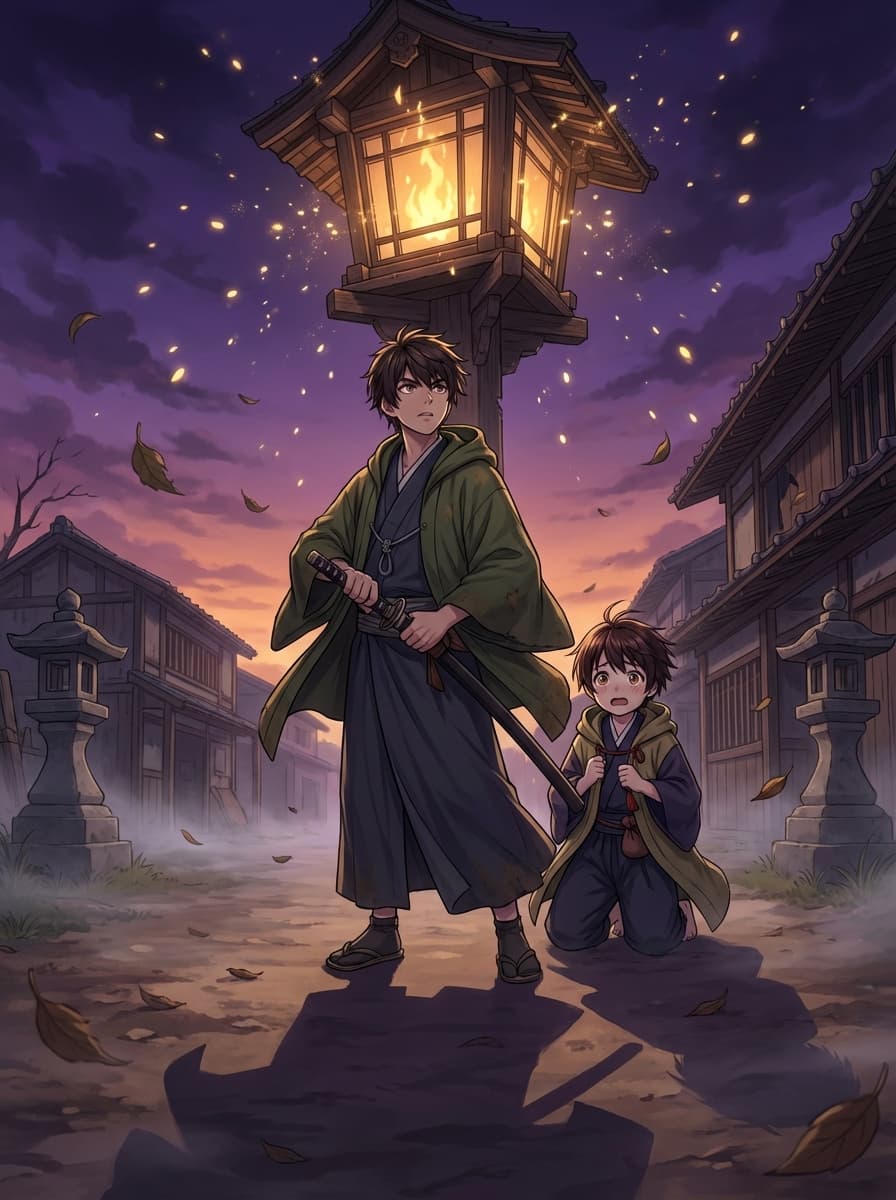
Emerging from the corridor, the path of sand stretched out before them in a straight, unwavering line.
No buildings lined the way. There were only rows of dunes and the low, constant moan of the wind. Footprints vanished almost as soon as they were made.
"The maps don't work here," Koyoi said.
Kuon closed the Index. "In this place, field conditions take priority over records."
Asahi took the lead, navigating by the direction of the wind alone. The sand was fine and dry, yet surprisingly heavy. It found its way into their boots, pooling around their ankles.
After an hour of travel, an old signpost appeared. The characters had been eroded away, leaving only a carved arrow.
It pointed to the right.
Asahi came to a halt. "The crosswind on the right is too strong. This sign is old."
Kuon nodded in agreement. "A correct answer for the past, perhaps. That doesn't make it the answer for now."
Koyoi opened his bookmarked notebook. On the page dedicated to the Sand Road, there was a brief notation:
“Trust the scent of the wind over the signpost.”
Koyoi focused his senses. The wind from the right smelled of iron. The wind from the front carried the scent of dry wheat.
"Straight ahead," he said. "There’s a living scent straight ahead."
They continued forward. After a while, they found the remains of a well in the shadow of a dune. It was no longer in use, but the rim bore fresh scuff marks from a rope.
"People have been through here," Asahi noted.
Continuing further, cobblestones began to peek through the sand. It was the old road leading toward Churyo.
Kuon let out a quiet, knowing smile. "That was the right call. 'Scent over signpost' was correct."
By evening, a sandstorm rose. The world turned a blinding white in an instant.
Koyoi wrapped his drawstring bag in cloth and lowered his face. Asahi lashed their waist-belts together, tethering them so they wouldn't drift apart. Kuon crouched low on the leeward side, cradling the Index to his chest.
The storm was brief. When it passed, new lines had been etched into the surface of the sand. Like natural rails, they stretched toward the direction of Churyo.
Looking at those lines, Koyoi whispered, "The paths vanish, but the wind that wants to become a path remains."
Asahi chuckled. "Stop talking like a poet. If we can walk on it, that’s good enough for me."
Kuon added a short postscript to the records:
‘Sand Road: Signposts unreliable. Prioritize scent of wind.’
They began walking along the lines. The path of sand was harsh, but once you learned how to navigate it, it was passable.
Since they had started this cycle of trial and error, their journey had gradually changed. Previously, they would end the day simply judging whether things had "gone well" or not. Now, they recorded the "why" of their success and the "where" of their lucky breaks separately.
They had realized that in this era of Sequential Collapse, the most effective tool was turning coincidence into procedure.
Whenever Koyoi opened his notebook, he found himself looking for the habits of the one who had left the bookmark. But instead of stopping where they had left off, he chose to fill in the blanks. An empty space was proof of an absence, but it was also room for inheritance. By honestly recording that someone was gone, he could decide what to leave behind in their place. It hurt, but the more precisely he named that pain, the more precise their movements were the next morning.
Kuon refined a format to simultaneously handle the precision of the Index and the uncertainty of the field. By separating the columns for "Immediate Conclusion" and "Pending," accidents caused by false certainty decreased. It was a significant step to explicitly state that "Pending" was not a sign of weakness, but a technical skill to avoid misjudgment. This column was most effective in places where an "Observer" had caused ruin by treating "Fixation" as the ultimate form of justice.
Asahi made sure not to record his sword techniques using vague, sensory words. The placement of feet, the distance of the engagement, the moment to release tension, the height of the gaze. The more difficult a physical skill was to put into words, the more he recorded it using short, repetitive terms. As a result, even with a chipped blade, his options increased, and he relied less on desperate, all-or-nothing strikes. By prioritizing what could be passed on over winning, he steadily pushed up the survival rate of his companions.
That night, before the campfire, they decided on the single line they would pass on next. The discussion was short, and the conclusion was, as always, plain. But the plainer the sentence, the more useful it was in the field. Flashy slogans could lift the spirits, but procedures saved lives. The line they chose would become a wooden tag by morning, tied to a gate, a shelter, or a roadside.
Finally, Koyoi added a small note in the margin of his notebook: "The things we learn here are not to be used to blame someone for being late, but to absorb the delay of another."
Next to that sentence, Kuon added the date and their current location. Asahi nodded silently and threaded a cord through the hole in the wooden tag.
The next morning, the tag fluttered in the wind, coming to rest at an angle where it could be easily read. Seeing it, they decided to measure their day not by whether they succeeded, but by whether they could continue. They sought not just to break the chain of collapse, but to maintain the path so that others could follow. That quiet, long-term labor was the heart of their journey; they silently agreed.
They decided to leave one thing unresolved. A record that makes everything look settled can lead the next person into a trap. Showing the unresolved as it is was not a mark of defeat, but a mark of handover.
Koyoi made a small mark at the edge of the notebook, creating a column to re-confirm the next day. Kuon defined the meaning of that mark, and Asahi re-hung the wooden tag at the site where the mark could be read. By simply continuing these three plain steps, repeat mistakes dropped noticeably.
Records don't have to be perfect. They just need to be left in a way that the next person to touch them won't lose their way.
After confirming this, they set out for the next sector.