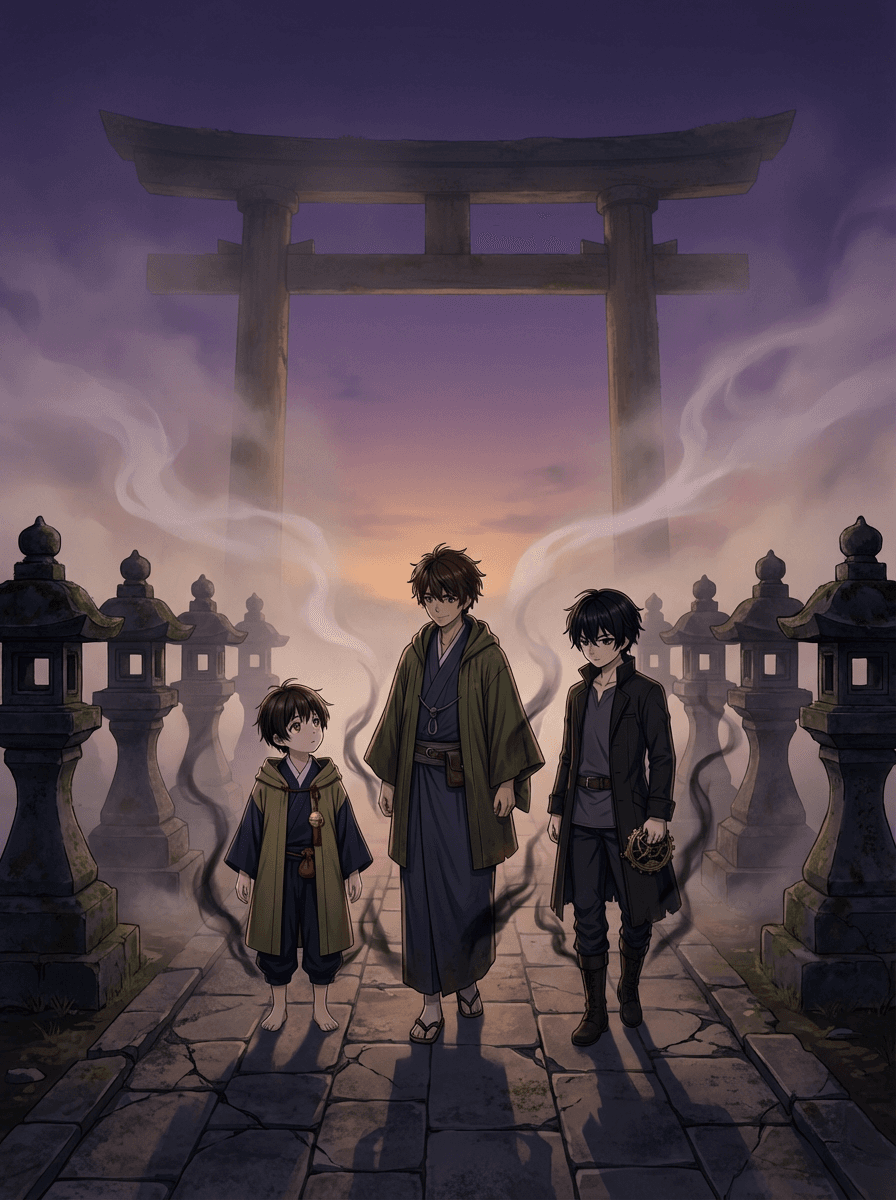
Beyond the gate lay a forecourt, buried in sand.
Stone pillars stood in rows to the left and right, leading toward a massive door at the far end. There was no keyhole. Instead, faint characters rippled across its surface like waves.
‘The Gate to Churyo’
Koyoi looked back at the transcription in his journal. Just as the note “Beyond where three lights have failed” suggested, only three of the lanterns in the courtyard remained dark.
Kuon stepped toward the door.
“The outer gate is open, but this is the inner threshold. One final authentication is required to enter Churyo itself.”
Asahi scanned their surroundings, alert. “Authentication? Is it another Observer-spec lock?”
“No,” Kuon replied. “Older. This one belongs to the land itself.”
Three circles materialized on the stone surface of the door: *Temperature, Sound, and Name.
Kuon read the requirements aloud. “Three elements. They must match simultaneously to trigger the release.”
Koyoi took the Droplet in his hand and touched it to the Temperature circle. It began to glow with a pale light.
Asahi struck a stone pillar with the back of his blade, creating a steady, rhythmic beat. The Sound circle pulsed in response.
Then came the circle for Name.
The three of them fell silent. Choosing what name to offer was no simple matter.
Finally, Koyoi spoke. “Not a personal name. Let’s input our purpose. We didn’t come here to seize Churyo, but to return it to what it was.”
Kuon nodded and placed a finger on the Name circle. “Let’s use ‘Restoration.’”
Their voices overlapped as they spoke the word in unison.
“Restoration.”
The circle shifted to a deep blue. The seams of the door shuddered, shedding sand as they finally groaned open.
Beyond lay a dark corridor. It was cold, but not stagnant; it smelled of earth and dry paper.
“It’s a place that’s alive,” Asahi said quietly.
Kuon left a small mark on the corridor floor: Authentication Word: Restoration.
Koyoi added the same word to his journal.
Passing through the gate wasn’t the goal. What they would give back once they were inside—that was the question they were about to face.
They lit a single lantern and stepped into the corridor.
Since they had begun this cycle, their journey had slowly begun to change. Before, they would end each day simply judging whether things had "worked out." Now, they recorded the "why" behind their successes and distinguished them from the moments where they were merely saved by luck.
They had learned that in the Age of Cascading Ruin, the most effective tool was the ability to turn coincidence into procedure.
Every time Koyoi opened his journal, his fingers instinctively sought the familiar crease of the bookmark. But instead of stopping there to mourn, he chose to fill the blank pages. A blank space was proof of an absence, but it was also room for inheritance. To write honestly about who was no longer there, and to decide what must be left behind because of it. The work was painful, but by putting that pain into words, their movements the next morning became that much more precise.
Kuon refined a format that could simultaneously handle the precision of an inventory and the uncertainty of the field. He created separate columns for "decisions that must be made quickly" and "open issues to carry forward." This significantly reduced accidents caused by false certainty. He explicitly documented that "pending" was not a sign of weakness, but a technical necessity to avoid misjudgment. In places broken by Observers who valued Fixed Reality above all else, these pending columns proved invaluable.
Asahi made sure his records of swordplay weren't limited to mere sensory descriptions. Foot placement, the width of the interval, the rhythm of release, the height of his gaze. The more difficult a physical technique was to verbalize, the more he recorded it using short, repetitive terms. As a result, even with a chipped blade, his options increased and the need to rely on desperate strikes decreased. By prioritizing "preserving" over simply "winning," the survival rate of the group climbed steadily.
That night, gathered around the campfire, they decided on the "next line" to pass on. The discussions were short, and the conclusions were always modest. But it was the modest sentences that proved most useful in the field. Flashy slogans might lift the spirit, but procedures save lives. The line they chose would become a wooden tag by morning, tied to gates, shelters, or signposts along the tracks.
Finally, Koyoi added a small note in the margin of his notebook: “The things we learn here are not to be used to blame someone for their delay, but to absorb the delay of another.”
Beside that sentence, Kuon added the date and their current location. Asahi nodded silently and threaded a cord through the hole in the wooden tag.
The next morning, the tag swayed in the breeze, resting at an angle where it could be easily read. Watching it, the three of them decided to measure the day not by whether things went well, but by whether they could keep going. To not just break the chain of ruin, but to maintain the path beyond it in a way that others could follow. That quiet, grueling, long-term labor was the true heart of their journey.
They confirmed this to one another, and decided to leave one final entry unresolved. A record that makes everything look settled only misleads the next person in charge. To show the unresolved as it is—that is not a mark of defeat, but a sign of a handoff.
Koyoi placed a small mark at the edge of the page, creating a column for "Reconfirm Tomorrow." Kuon defined the meaning of that mark, and Asahi re-hung the wooden tag at the site so it could be read clearly. By consistently repeating these three modest steps, the recurrence of the same mistakes dropped visibly.
The record didn't need to be perfect. It just needed to be left in a way that the next person to touch it wouldn't lose their way. Having confirmed this agreement, the three of them began walking toward the next sector.
Dividing the responsibilities of Supply and Record-keeping also proved effective in the latter half of their trek. When judgment, hauling, and recording are concentrated on a single person, a delay in decision-making is inevitable. Instead, they switched to a procedure where they re-declared their roles before moving and briefly cross-referenced the results afterward.
The procedure wasn't flashy, but it sharpened their initial response in the next crisis. And above all, if one of them were to fall, the remaining two could keep the minimum operations running. True strength to continue the journey, they all agreed, lay not in the power of a single breakthrough, but in a design that could keep turning even when someone was missing.