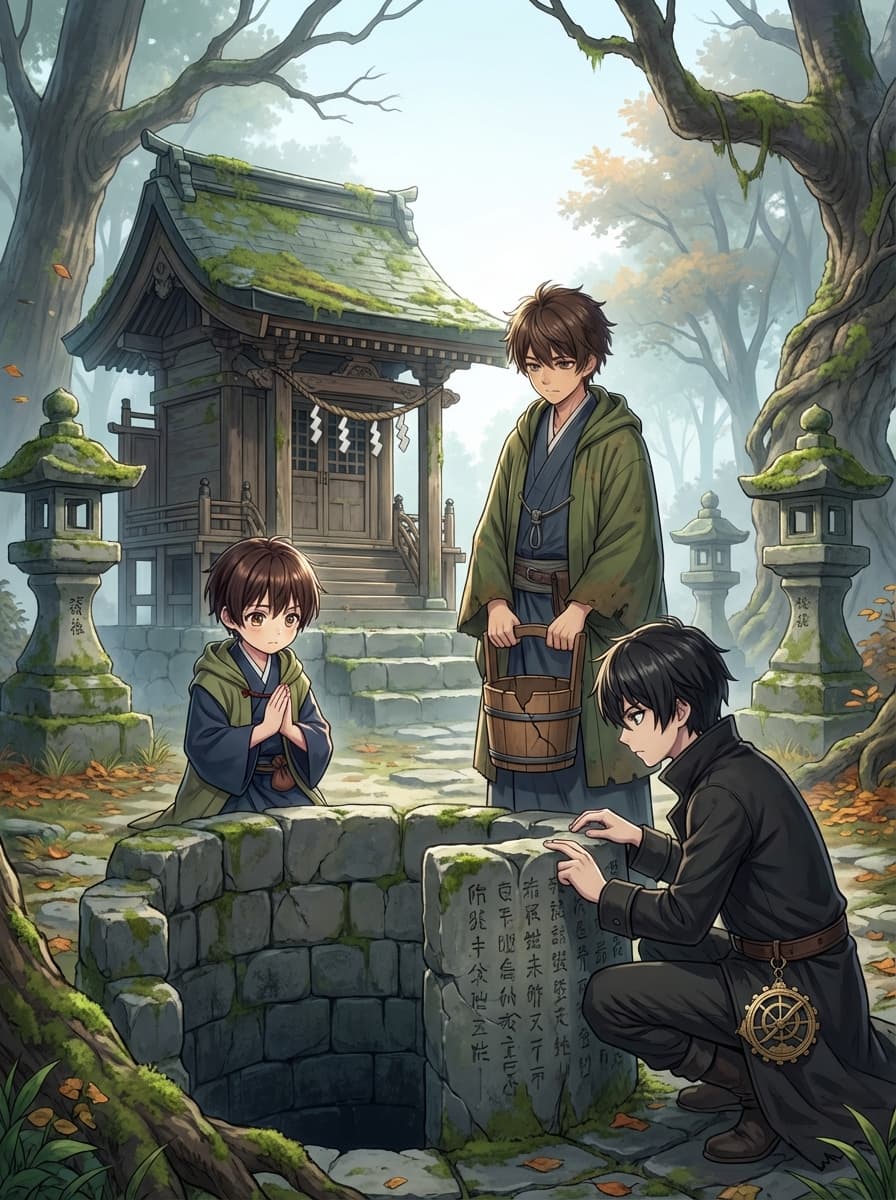
At the end of the sandy path stood a small shrine.
In front of the shrine was a well. Its rim was parched, the wooden bucket was spider-webbed with cracks, and the rope had been cut halfway through. A sign stood nearby, its characters faded and blurred.
“The God of Thirst”
Koyoi peered into the well. The bottom was lost in shadows, but there wasn't even a hint of moisture in the air. Asahi lifted the bucket.
"It’s empty. The offerings stopped a long time ago."
Kuon traced the engravings on the inner wall of the well. "It isn’t that the god is thirsty. The flow has stopped because no one calls its name anymore."
Koyoi touched the droplet charm on his pouch. "Will it return if we add water?"
"Water alone isn't enough," Kuon replied. "We need the right name and the right order."
In Shiori’s notebook, a single line of an ancient ritual procedure remained: ‘First, apologize. Next, call the name. Finally, the water.’
Asahi raised an eyebrow. "Apologize first, huh?"
Koyoi knelt before the shrine and spoke softly. "I’m sorry for leaving you alone for so long."
A single gust of wind shook the shrine’s bell. No sound rang out, but the braided rope swayed.
Kuon spoke the name aloud. "God of Thirst. Please, come back."
Finally, Koyoi let a single warm drop fall from the charm into the well. It wasn't even water, yet a tiny echo rippled from the depths.
After a moment, a cool breeze rose from the bottom of the well. Then, a single, transparent drop fell onto the bottom of the bucket.
Plink.
That was all it took for the air to shift. Their dry throats felt a momentary, phantom relief.
Asahi grinned. "Even a single drop... a god is still a god."
"It’s only just beginning to recover," Kuon said cautiously. "Without a steady supply, it will wither again."
Koyoi tied a wooden tablet to one of the shrine’s pillars. ‘Apologize, then call.’
A short instruction. A note for whoever came next.
As they turned to leave, another drop fell from the well. This time, it was followed by a second. The thirst wasn't over, but it was beginning to recede.
The three offered a bow to the shrine and returned to the sandy path.
Once they began this cycle, their journey started to change. Before, they would end each day simply judging whether things had "gone well." Now, they recorded everything, separating what worked from what was just luck.
They had learned that in this era of "Cascading Collapse," turning coincidence into procedure was the most effective weapon they had.
Whenever Koyoi opened the notebook, he found himself tracing Shiori’s handwriting. But instead of stopping at the memories, he chose to fill the blanks. A blank space was proof of absence, but it was also room for succession. By honestly recording that someone was gone, they decided what needed to be left behind. The process was painful, but the more they put that pain into words, the more precise their movements became the following morning.
Kuon developed a format to handle the accuracy of the inventory and field uncertainty at the same time. He separated columns for "urgent conclusions" and "pending items," which drastically reduced accidents caused by false certainty. Defining "pending" not as a weakness, but as a technical safeguard against misjudgment, made a massive difference—especially in places previously destroyed by people who insisted on definite answers.
Asahi made sure not to record sword techniques in vague, sensory terms. He documented the placement of the feet, the width of the gap, the timing of the breath, the height of the gaze. He used short, repetitive words for the physical skills that were hardest to verbalize. As a result, even with a chipped sword, his options increased, and he relied less on desperate, all-or-nothing strikes. By prioritizing preservation over winning, the survival rate of the group climbed steadily.
That night, before the campfire, the three decided on the single line to pass on next. The discussions were short, and the conclusions were always modest. But it was the modest sentences that proved most useful in the field. Flashy slogans could lift the spirit, but procedures saved lives. The line they chose would become a wooden tablet by morning, tied to a gate, a shelter, or a trackside shelter.
Finally, Koyoi added a small note in the margin of the notebook: “What we learn here is used not to blame someone for their lateness, but to absorb that delay.”
Beside that sentence, Kuon added the date and their current location. Asahi nodded silently and threaded a cord through a hole in a wooden tablet.
The next morning, the tablet swayed in the wind, coming to rest at an angle that was easy to read. Seeing it, the three decided to measure their day not by whether they succeeded, but by whether they could continue.
Their aim was not only to break the chain of collapse, but to keep a path open for those who came after. This quiet, grueling work was the true heart of their journey. They confirmed this to each other without needing to say a word.
They decided to always leave at least one unresolved item in their records. A log that makes everything look perfectly solved is a trap for the next person; it invites complacency or confusion. Showing the unresolved as it is was not a mark of defeat, but a mark of handover.
Koyoi placed a small mark at the edge of the notebook, creating a column for things to be re-verified the next day. Kuon defined the meaning of that mark, and Asahi re-hung the wooden tablet in a position where the mark could be easily seen on-site. By simply repeating these three humble steps, the recurrence of the same mistakes dropped visibly.
The record didn't have to be perfect. It just had to be left in a way that the next person wouldn't get lost. Once they reached that agreement, they began walking toward the next sector.
Dividing the responsibilities for supplies and recording also stabilized the latter half of their journey. If one person handled judgment, transport, and documentation alone, a delay in decision-making was inevitable. Instead, they switched to a system where they re-declared their roles before moving and briefly cross-checked results afterward.
This procedure wasn't glamorous, but it accelerated their initial response in the next crisis. And more than anything, it meant that even if one of them was lost, the remaining two could keep the bare minimum functioning.
True strength for continuing the journey, they realized, lay not in the breakthrough power of an individual, but in a design that kept moving even when someone was missing.