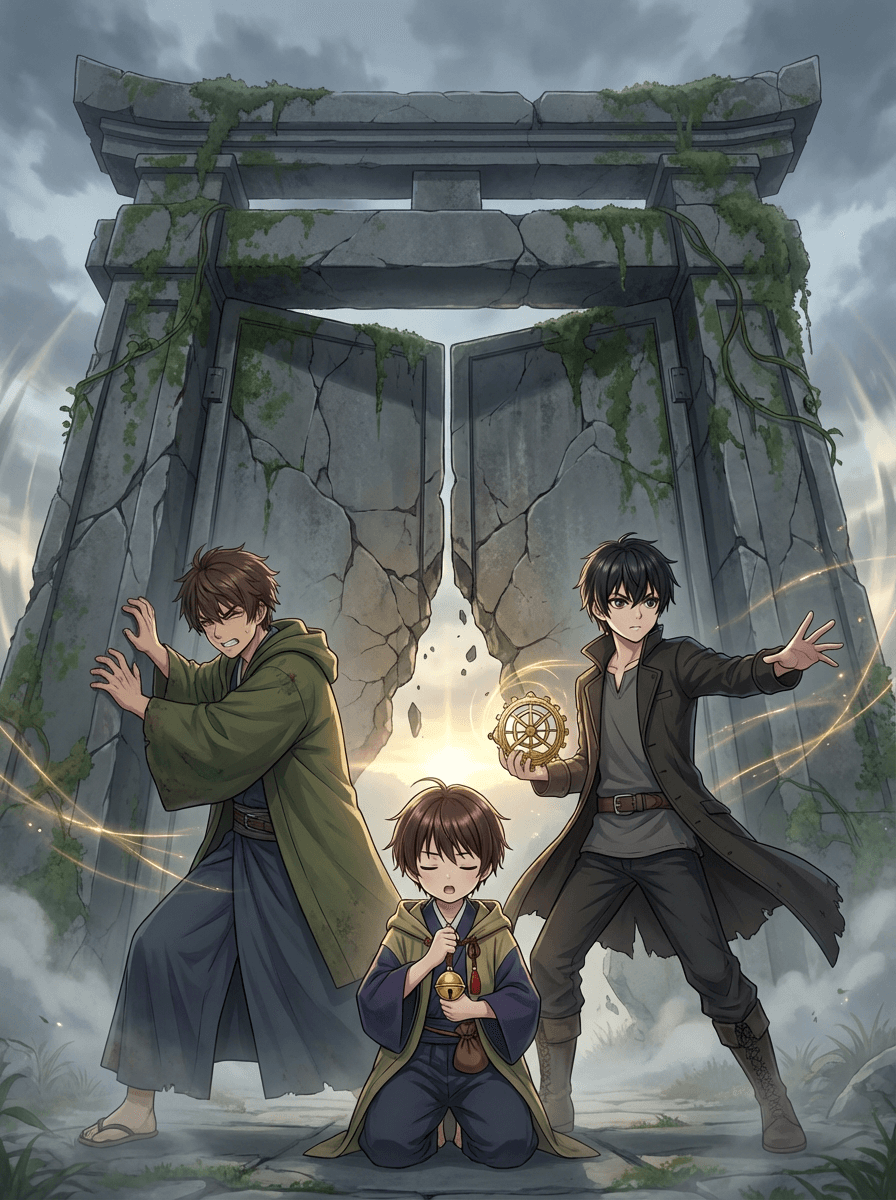
When they reached the Gate to Churyo, the pre-dawn sky was just beginning to pale into a faint gray.
The stone gate remained shut. The central ring-link was shattered, and the left and right pillars were etched with diverging formulas. Here, the end of the Chain had come to a physical halt.
Kuon opened the Catalog, cross-referencing the scripts on the gateposts.
“The scars from where the old Chain was severed are still here. It’s not in bad shape. The problem is how to forge the next link.”
Asahi pressed a hand against the crack in the gate.
“Feels like it would open if we just gave it a good shove.”
“Force it open, and we’ll just loop back into the same Chain,” Kuon warned.
Koyoi pulled out a new journal—one that had belonged to Shiori. He turned to the procedure written on the final page.
“Three to end it. Three to begin it.”
Koyoi looked at the other two.
“Let’s feed our inputs into the gate at the same time. I’ll handle Temperature, Kuon takes Coordinates, and Asahi provides Physical Anchoring.”
Kuon nodded. Asahi tightened his sword belt.
They took their positions.
Koyoi opened his pouch, letting the temperature of the Droplet flow into the ring-link. Kuon unified the formulas on the pillars, suppressing the fluctuations in the Coordinates. Asahi wedged his dagger into the crack, anchoring the path for the energy to escape.
At first, there was no reaction. Then, a dull thud echoed from deep within the gate. The Chain advanced a single notch.
“One more beat!”
At Kuon’s signal, the three synchronized their output.
The fracture in the ring-link sealed shut, and the gate began to groan open. The dust-laden winds of Churyo blew through the narrowing gap toward them.
Asahi let out a short laugh.
“So, there really was a ‘next’ after the end.”
Koyoi closed the journal.
“The end of the Chain, the continuation of the journey. That’s exactly what this is.”
Kuon etched a new seal onto the inner side of the gate.
“Reconnected: No deletion mechanism detected.”
It was a note for whoever might pass this way in the future.
The three stepped through the gate. Behind them, the stone doors came to a rest, left slightly ajar. Neither fully closed, nor fully open.
That ambiguity suited the world as it now was. Not completion, but continuation.
The journey went on.
Since they had started this cycle, the nature of their travels had slowly changed. Before, they would end each day judging it solely by whether things had "worked out." Now, they recorded their progress by distinguishing between "why it worked" and "where we were saved by luck."
They had learned that in an era of Chain Collapse, turning coincidence into procedure was the most effective way to survive.
Every time Koyoi opened the journal, he found himself looking for Shiori’s quirks in the handwriting. But rather than stopping where the old writing ended, he chose to fill the blanks. A blank space marked an absence, but it also made room for what came next. He wrote honestly about who was no longer there, and because of that, he decided what to leave behind. The work was painful, but the more he put that pain into words, the more precise their movements became the following morning.
Kuon developed a format to handle the precision of the Catalog and the uncertainty of the field simultaneously. By separating columns for things that required "Immediate Action" and things to be "Deferred," accidents caused by false certainty decreased. It was a significant breakthrough to codify that "Deferred" was not a sign of weakness, but a technique to avoid misjudgment. This "Deferred" column proved most effective in places where previous Observers had destroyed everything by making "Anchoring" their only virtue.
Asahi made sure not to record his sword techniques in vague, sensory terms. The placement of the feet, the width of the interval, the beat at which to relax his strength, the height of his gaze. The more difficult a physical sensation was to verbalize, the more he recorded it in short, repetitive words. As a result, even with a chipped blade, his options increased, and the number of times he had to rely on a desperate, all-or-nothing strike decreased. His approach—prioritizing "preservation" over "winning"—certainly boosted their chances of survival.
That night, sitting before the campfire, the three decided on the single line they would pass on next. The discussion was brief, and the conclusion was, as always, plain. But the plainer the sentence, the more useful it was in the field. Flashy slogans might lift the spirit, but procedures saved lives. The line they chose would become a wooden tag by the next morning, tied to a gate, a shelter, or a signpost by the tracks.
Finally, Koyoi added a small note in the margin of the journal. “What we learn here is used not to blame someone for falling behind, but to absorb their delay.”
Beside that sentence, Kuon added the date and their current location. Asahi nodded silently and threaded a cord through the hole in the wooden tag.
The next morning, the tag swayed in the wind, coming to rest at an angle where it could be read. Seeing it, the three decided to measure their day not by whether they succeeded, but by whether they could continue. To not just break the Chain, but to maintain the path beyond it in a way that others could follow. They confirmed it in the same words: that this quiet, long-term work was the heart of the journey itself.
They decided to leave one unresolved issue behind. A record that makes everything look solved can lead the next person into error. To show the unresolved as unresolved was not a mark of defeat, but a mark of handing over the torch.
Koyoi made a small mark at the edge of the journal, creating a column for re-checking the next day. Kuon defined the meaning of that mark, and Asahi re-hung the wooden tag at the site where it could be easily read. By simply continuing these three plain steps, the recurrence of the same failures dropped visibly.
The records didn't have to be perfect. They just had to be left in a way that wouldn't confuse the next person to touch them. Once they confirmed this agreement, the three began walking toward the next sector.
Dividing the responsibilities for supplies and recording also stabilized the latter half of their trek. When judgment, transport, and recording are concentrated on one person, a delay in decision-making is inevitable. So, the three switched to a procedure where they re-declared their roles before moving, and briefly cross-referenced the results after arriving.
This procedure wasn't flashy, but it quickened their initial response in the next phase. And above all, it meant that even if someone was missing, the remaining two could keep essential routines running. The strength required to continue the journey, they shared, was not the power of a single breakthrough, but a design that kept moving even on the assumption of loss.