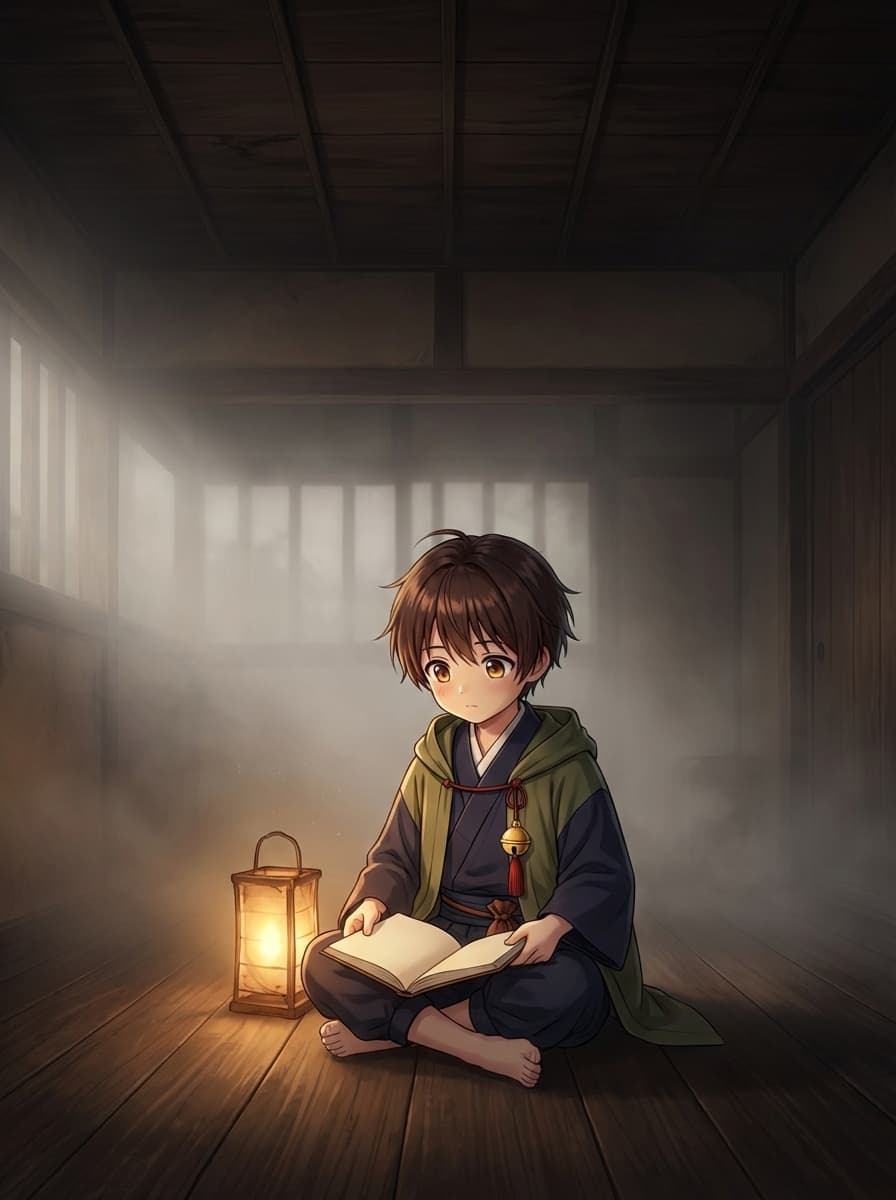
Just before they left the Guardian’s hut, the girl called out to Koyoi.
“Wait—I want you to keep this.”
She held out a light-brown notebook. Its corners were rounded and frayed with wear, the string binding carefully repaired.
Koyoi opened it. On the first page, in tiny script:
‘Shiori’s New Notebook.’
Koyoi felt a lump in his throat.
“Where did you…?”
“I found it in the eastern Margins,” the girl replied. “It seems to continue an older notebook. The handwriting changes halfway through.”
Kuon leaned in to confirm. The first half bore the distinct quirks of Shiori’s hand. The second half was written by someone else, yet it followed the same recording rules.
“A passed-down log,” Kuon noted. “Shiori’s format has been adopted by others.”
Asahi crossed his arms. “Is it readable?”
Koyoi flipped through a few pages. Maps, observation times, snippets of dialogue. Every entry was practical, stripped of sentiment.
Only in the margins did the emotions remain.
‘If you cry here, you’ll lose your footing.’
‘Laugh while you still can.’
‘Shiori’s rules still work.’
Koyoi pulled the notebook to his chest. Even if some pages weren't in Shiori’s own hand, they were proof that her work lived on.
Kuon examined the binding thread. “This repair thread… it’s a North Gate weave. We can narrow down our next destination.”
Asahi pointed to a mark on the map. “And this symbol. It’s not a standard rail line. It’s a Margin Line.”
Koyoi sat at the hut’s desk to make a transcription before closing the original.
“I’ll take the original and leave the copy with the Guardian. That way, if one is lost, the other remains.”
The young Guardian nodded happily. “Shiori-san wrote the same thing. ‘Records must always be duplicated.’”
Night deepened. The three of them gathered around the hut’s brazier for a brief strategy meeting.
At the very end of the notebook, they found a landmark for the next leg of their journey: ‘The Gate to Churyo, Sand Path side. Past the three missing lights.’
“The record says the gate was closed once,” Kuon observed. “We’ll need a reactivation procedure.”
Asahi looked at the chipped edge of his blade and sighed. “Let’s try a procedure that doesn't involve breaking things this time.”
Koyoi tucked the notebook into the side of his drawstring bag.
“We’ll move without breaking anything. I think that’s why Shiori’s new notebook found its way to us.”
Before setting out, Koyoi added a short postscript to the final page.
‘Received. Continuing.’
The notebook’s journey continued, passing from hand to hand.
Since they had begun this cycle of record-keeping, the nature of their journey had shifted. Before, they would end each day simply judging whether things had gone well. Now, they meticulously separated why something worked from where they had been saved by mere coincidence.
In an era of Chain Collapse, they had learned that turning luck into a procedure was the most effective way to survive.
Every time Koyoi opened the notebook, he found himself searching for Shiori’s habits. But instead of stopping where Shiori had left off, he chose to fill the blanks. A blank space was proof of an absence, but it was also room for someone to continue.
By honestly recording who was no longer there, they decided what needed to be left behind. It was a painful process. But the more they put that pain into words, the more precise their movements became the next morning.
Kuon refined a format to handle both the accuracy of a catalog and the uncertainty of the field. He separated columns for immediate conclusions from those for pending items. This reduced accidents caused by false certainty. He explicitly defined "pending" not as a sign of weakness, but as a technique to avoid misjudgment. This column proved most effective in places where previous observers had destroyed things by insisting that "fixing" everything was the only virtue.
Asahi stopped relying on sensory descriptions for his sword techniques. He recorded the placement of his feet, the distance of the engagement, the timing of relaxation, and the height of his gaze. The more difficult a physical skill was to verbalize, the more he recorded it in short, repetitive terms. As a result, even with a chipped sword, his options increased, and he relied less on reckless, singular strikes. His focus shifted from winning to preserving, which significantly boosted their survival.
That night, before the campfire, the three of them decided on the single line they would pass on next. The discussions were short, and the conclusions were always modest. But those modest sentences were the ones that helped most in the field. Flashy slogans might lift the spirit, but procedures saved lives. The line they chose would become a wooden tag by morning, tied to gates, shelters, or railway tracks.
Finally, Koyoi added a small note in the margin: ‘What we learn here is not to be used to blame someone for being late, but to absorb their delay.’
Beside that sentence, Kuon added the date and their current location. Asahi nodded silently and threaded a cord through the hole in the wooden tag.
The next morning, the tag swayed in the wind, coming to rest at an easy-to-read angle. Seeing it, the three decided to measure their day not by whether it was a success, but by whether they could keep going.
To not just break the chain of collapse, but to maintain the path so that those who followed could walk it—that quiet, grueling work was the true essence of their journey. They confirmed this with a shared understanding: they would leave one thing unfinished. A record that makes everything look resolved only misleads the next person. Showing the unresolved as it is isn't a mark of defeat; it is a sign of passing things on.
Koyoi made a small mark at the edge of the notebook, creating a column for "re-confirmation tomorrow." Kuon defined the meaning of that mark, and Asahi re-hung the wooden tag in a position where the mark could be read on-site. By simply continuing these three modest steps, the recurrence of the same mistakes dropped visibly.
The record didn't need to be perfect. It just needed to be left in a way that made it harder for the next person to lose their way.
Having confirmed this pact, the three stepped out toward the next sector.