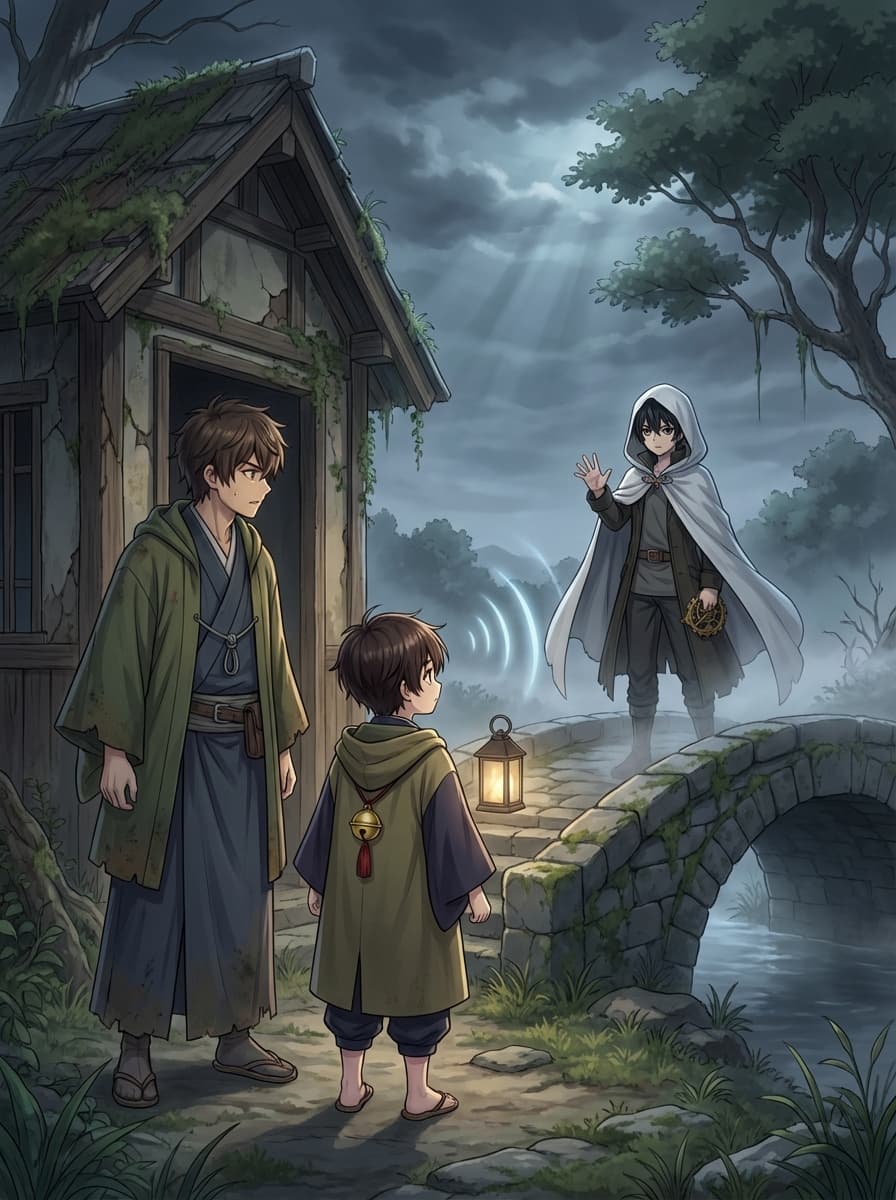
At the foot of the stone bridge on the outskirts of town stood a Keeper’s shack.
The walls were half-crumbled, and only three shingles remained on the roof. Yet, the brazier inside was still alive, sending a thin, straight ribbon of smoke into the air.
The old man sitting in the doorway looked up.
"I’d like to welcome you to the shack of the Keepers of the Margin," he said, "but the Margin I’m meant to guard is wearing thin these days."
Koyoi gave a slight bow. "Is this the bridge post?"
The Keeper nodded. "It’s a place that preserves just enough width for roads that have vanished from the registers to remain passable. Closing them off would be easier, but then the people trying to find their way back would die."
Kuon looked at the map pinned to the shack’s wall. It was not a map of rail lines or roads, but a series of fine white lines drawn by hand.
"A hand-drawn map of margin corridors," Kuon noted. "The kind that never makes it onto official blueprints."
Asahi asked, "Are you the only Keeper here?"
"There used to be six of us," the old man replied, adding charcoal to the brazier. "Now it’s just me. But if I can hold out until dawn, the next Keeper will be ready."
Just then, a bell chimed from across the bridge. It wasn't the wind. Someone was crossing.
A young girl in a white cloak appeared, a bundle of scrolls strapped to her back.
"Master, the eastern Margin is starting to close."
The Keeper stood up and looked at Koyoi and the others.
"Lend me a hand. We need to hold the watch for six hours."
Kuon nodded instantly. Asahi tightened his sword belt.
The eastern margin corridor looked like nothing more than a vacant lot at first glance. But the moment they stepped inside, the white lines on the ground began to flicker and shift. Every time they narrowed, they barely left enough room for a single person to pass.
Koyoi synchronized the Pulse of the Droplet to the corridor, slowing the frequency of the flickering. Kuon slid scroll charms into the white lines, delaying the phase of the collapse. Asahi cut away the crumbled masonry at the entrance, securing a path for the evacuees.
An hour later, a mother and child came running, pushing a cart. Then came an old man with a cane, followed by a bandaged soldier. All of them were people who had lost their official routes and drifted into the margins.
The young girl raised her voice. "Stay on the white lines! If you step off, you can’t come back!"
Koyoi took the mother and child by the hands, ushering them through the final gap. Behind them, the edge of the corridor snapped shut, dissolving into a white mist.
By the time the evacuation was finished, the white lines on the east side had vanished completely. The Keeper exhaled deeply and handed a scroll to the girl.
"Now it’s your turn to watch."
The girl nodded with a solemn expression. "Yes. I will memorize the Margin, so that it never closes."
Later, while warming his hands before the brazier, Koyoi asked the old man, "What is it exactly that a Keeper guards?"
The Keeper thought for a moment before answering. "It’s not the road itself. It’s the permission to return."
The night wind whistled through the gaps in the shack. The Margin was vast, and what protected it was painfully small. Yet that small protection had connected several people today to their tomorrow.
Since starting this cycle, their journey had begun to change. They no longer judged a day simply by whether things had "gone well." Instead, they recorded their progress by distinguishing between "why it worked" and "where we were saved by luck." They realized that in an era of cascading collapse, turning coincidence into procedure was the most effective way to survive.
Every time Koyoi opened his notebook, he still reflexively looked for the bookmark that was no longer there. But rather than stopping at that void, he chose to fill the blanks. A blank space was proof of absence, but it was also room for a handover. By honestly writing down who was missing, he could decide what legacy to leave behind. The process was painful, but putting that pain into words made their movements the next morning more precise.
Kuon refined a format to balance the precision of his catalogs with the uncertainty of the field. By separating columns for "urgent conclusions" from those "carried as pending," he reduced accidents caused by false certainty. He defined "pending" not as a weakness, but as a technical skill to avoid misjudgment. In places where others had destroyed everything by treating "fixed reality" as the only virtue, these pending columns proved invaluable.
Asahi stopped recording his swordplay in vague, sensory terms. Instead, he logged the placement of his feet, the spacing of the interval, the tempo of releasing tension, and the height of his gaze. He reduced the most complex physical techniques to short, sharp terms. Even with a chipped sword, his options increased, and he relied less on desperate, forced strikes. By prioritizing "preserving" over "winning," he steadily raised the survival rate of his companions.
That night, before the campfire, the three of them decided on the next line of instruction to pass on. The discussion was short, and the conclusion was understated. Yet these quiet sentences were often the most useful in the field. Flashy slogans might lift the spirit, but procedures saved lives. The line they chose would be carved into a wooden tag by morning and tied to a gate or a railway post.
Finally, Koyoi added a small note in the margin of his notebook: "The things we learn here are not to be used to blame someone for their delay, but to absorb that delay for them."
Beside that sentence, Kuon added the date and their location. Asahi nodded silently and threaded a cord through the hole in the wooden tag.
The next morning, the tag swayed in the breeze, resting at an angle where it could be easily read. Watching it, the three of them decided to measure their day not by whether they had succeeded, but by whether they could continue.
Their goal was not just to break the chain of collapse, but to keep open a space people could still walk through. That quiet, grueling labor was the true heart of their journey. They confirmed this to one another, using the exact same words.