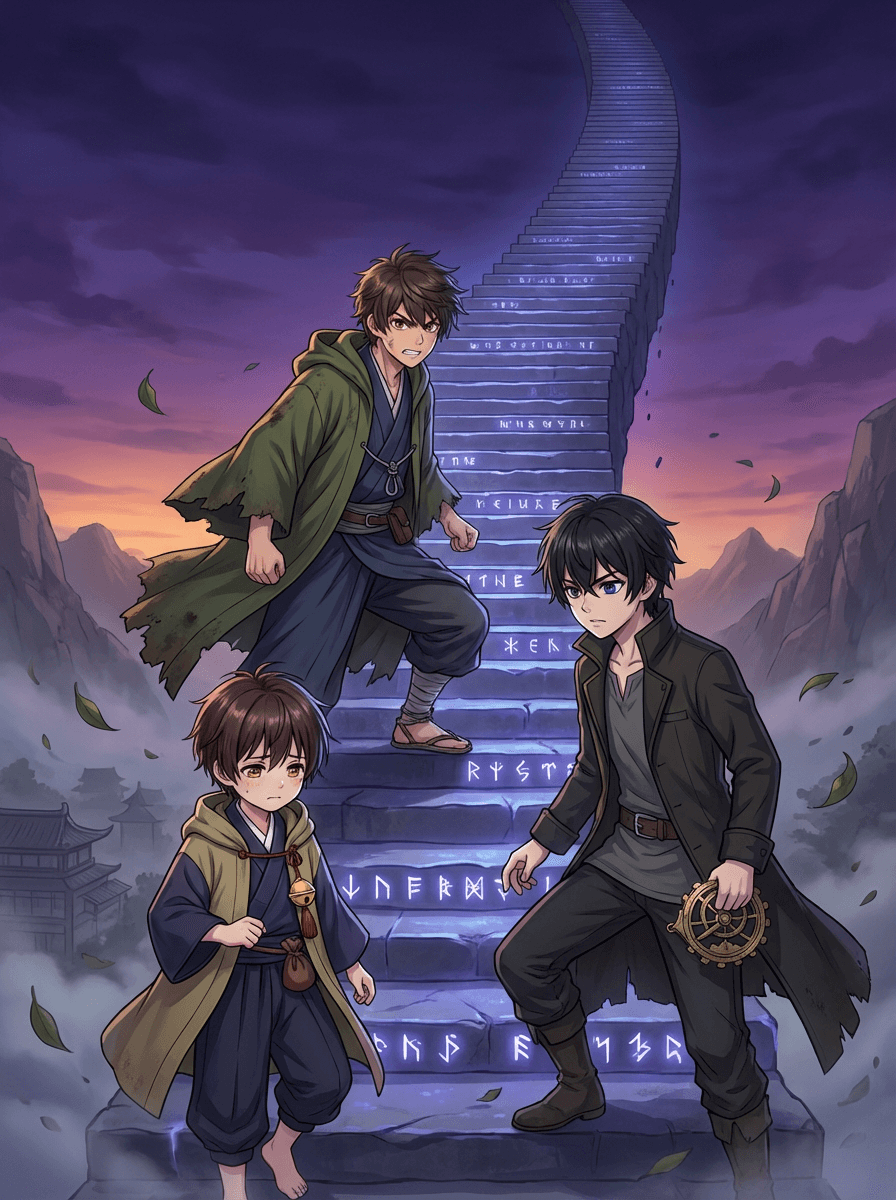
When they reached the edge of Tento, the sky screamed.
The district, meant to float serenely above the clouds, tilted slowly. Light leaked from the joints of the stone bridges, and the silhouettes of the buildings crumbled at the edges, shedding dust and debris.
"The Collapse has begun."
Kuon opened the Manifest.
"The pillar coordinates anchoring the structures are snapping one by one, caught in the aftershocks of the Chain Severance."
Asahi unsheathed his sword, gauging the direction of the wind.
"Evacuation route?"
"The West Corridor. But there are still residents trapped in the upper levels."
Koyoi squinted, spotting a cluster of white cloaks in the distance. Every face asked the same desperate question. They were paralyzed, staring at the city falling away beneath their feet.
"I’ll go call them!"
Koyoi broke into a run. Asahi moved to follow, but Kuon stopped him.
"You need to hold the fulcrum. The main beam is going to snap first."
Asahi hesitated for a heartbeat, then nodded sharply.
"Understood. Three hits, right?"
Clutching his cracked blade, he headed toward the principal girder.
Koyoi reached the upper plaza. Elders, children, merchants clutching their wares—everyone looked at him with the same silent plea.
Where do we run?
Koyoi shouted at the top of his lungs.
"To the West Corridor! Drop your gear! Just hold hands and run!"
The first few people moved, then the crowd surged. The sound of frantic footsteps hammered against the cobblestones.
Suddenly, Tento’s central spire tilted violently. A bridge snapped mid-air, plummeting into the void.
In the lower levels, Kuon pried open a control panel and wrenched an old transfer wheel, trying to restore a minimum current to a dead auxiliary line.
"Koyoi! Watch the corridor lights! When the third one goes out, get down!"
The shout was swallowed by the wind. Koyoi kept pushing the residents forward. One light went out. Then two. Then three.
The corridor went dark.
"Down!"
An instant later, an explosion of sound erupted behind them as the structure gave way. Stone fragments rained down like a storm.
Asahi drove his sword into the seam of the main beam, redirecting the shifting forces. One strike. Two strikes. The hairline fractures in his blade began to hum.
On the third strike, the sword let out a high-pitched shriek. It didn’t shatter completely, but the core ribbon tore, sending a spray of sparks into the air.
Still, the main beam held. The direction of the collapse shifted, and the West Corridor was spared.
By the time the evacuation was complete, half of Tento’s upper levels were gone. What was once a city in the clouds had sunk into a sea of white mist.
Koyoi leaned forward, hands on knees, gasping for breath. The cries, the angry shouts, and the prayers of the survivors all blurred together.
Kuon spoke quietly. "We only saved a fraction. But we avoided total annihilation."
Asahi looked at the chipped tip of his sword and gave a short, weary laugh.
"Three hits was enough."
Koyoi looked up at the broken sky. Tento had fallen. Yet, in the hands of the people who had descended, their names endured.
The Collapse wasn't the end. It was the beginning of a life that would continue on the ground.
Since they began this cycle of record-keeping, their journey had gradually changed. Before, they used to end each day simply judging whether things had "gone well" or not. Now, they recorded the why—distinguishing between "why it worked" and "where we were saved by luck."
They had learned that in an age of Chain Collapse, turning luck into procedure was the most effective tool they had.
Every time Koyoi opened his notebook, he found himself tracing the crease of the bookmark out of habit. But instead of stopping there, he chose to fill the blanks. A blank space was proof of an absence, but it was also room for a handover. He wrote honestly about who was no longer there, and because of that, he decided what needed to be left behind. The process was painful, but the more he put that pain into words, the more precise their movements became the next morning.
Kuon refined a format to balance the Manifest’s precision against field uncertainty. By separating the column for "urgent conclusions" from the one for "pending items," they reduced accidents caused by false certainty. They codified the idea that "pending" was not a weakness, but a technique to avoid misjudgment. In places where previous Observers had destroyed everything by making "Anchoring" the only form of justice, this "pending" column proved vital.
Asahi stopped recording his sword techniques in vague, sensory terms. Instead, he logged the placement of his feet, the width of his stance, the timing of his release, and the height of his gaze. The more difficult a physical skill was to verbalize, the more he relied on short, repetitive notes. As a result, even with a chipped sword, his options increased, and he relied less on desperate, all-or-nothing strikes. His new priority—preserving rather than winning—measurably improved the party’s survival rate.
That night, sitting before the campfire, the three of them decided on a single line to pass on. The discussion was brief; the conclusion was, as always, understated. But the most understated sentences often proved the most useful in the field. Flashy slogans might lift the spirit, but procedures saved lives. The line they chose would be carved into wooden tags the next morning and tied to gates, shelters, and roadsides.
Finally, Koyoi added a small note in the margin of his journal: "The things we learn here are not to blame those who arrive late, but to absorb the delay of those who follow."
Beside that sentence, Kuon added the date and their current coordinates. Asahi nodded silently and threaded a cord through the hole in a wooden tag.
By morning, the tag swayed in the wind, resting at an angle that made it easy to read. Looking at it, the three of them decided to measure their day not by whether they had succeeded, but by whether they could continue.
To not just break the chain of collapse, but to maintain the path so that those who follow can walk it. This tedious, long-term work was the true essence of their journey. They confirmed this with the same words, leaving one final unresolved mark.
Records that make everything look "solved" only lead the next person astray. To show the unresolved as unresolved is not a mark of defeat—it is the mark of a handover.
Koyoi placed a small symbol at the edge of the page, creating a column for re-verification the following day. Kuon defined the meaning of that symbol, and Asahi hung a wooden tag in the field where the mark could be easily found. By simply continuing these three quiet steps, the recurrence of the same failures began to visibly decrease.
The record didn't have to be perfect. It just had to be left in a way that wouldn't confuse the next person who touched it.
Having confirmed this agreement, the three of them began walking toward the next sector.