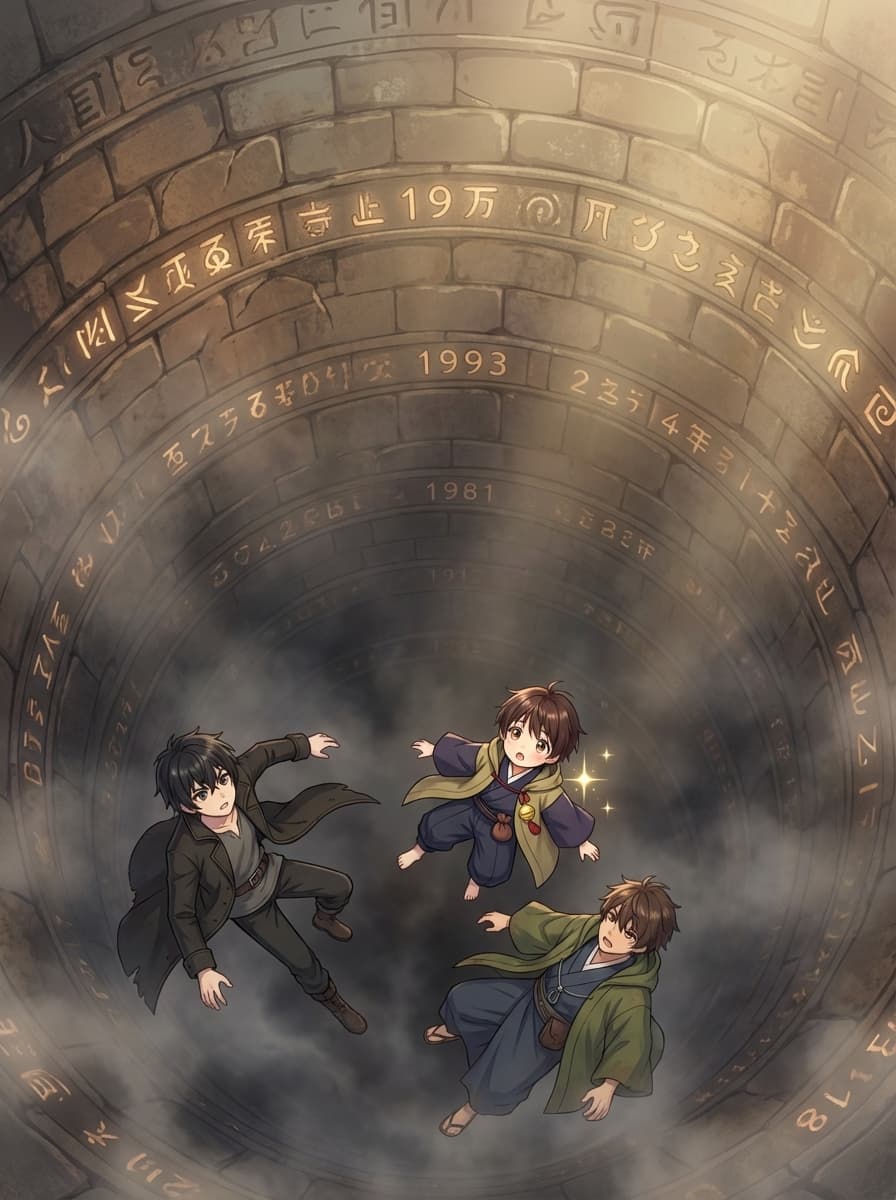
On the outskirts of Kasumidai, Asahi came to a halt.
He pressed the tip of his sword against a stone by the tracks and drew it slowly. A thin fissure ran down the center of the blade.
“...Since when?”
Kuon leaned in to take a look. Asahi shrugged.
“Likely when I took that hit at the Shadow’s center. When I parried that unseen weight, the shock must have reached the core.”
Koyoi caught his breath. “Will it break?”
“Not immediately. But the next heavy blow might do it.”
Kuon cast the light of his prosthetic eye onto the crack. Within the pale blue glow, the fracture revealed itself as something more than a simple wound.
“Wait. There’s an inclusion inside.”
Asahi furrowed his brow. “An inclusion?”
“A shard of an old engraving. A record forged into the core when it was tempered. That’s why it’s holding together—the core is resilient.”
Koyoi opened his pouch and released a drop of cold onto the steel. White steam rose, and tiny characters began to shimmer within the crack.
‘When crossing the threshold, do not forget your name.’
For a long moment, all three were silent.
Asahi gave a bitter smile. “That’s my old man’s handwriting. When he gave me this sword, all he talked about was the hilt. To think he’d hide something like this inside.”
Kuon spoke carefully. “A broken sword isn’t necessarily a weak one. There is an advantage to being able to see what’s inside.”
Asahi began to slide the blade back into its scabbard, then stopped halfway.
“Can it be fixed?”
“A full restoration would take more time than we have. But I can manage a field repair.”
Kuon tore a strip from the edge of his registry, turning it into a narrow band to wrap around the base of the blade. Koyoi layered the heat of his "drops" over it, setting the binding in place.
It was a makeshift reinforcement rite. It would hold for three heavy strikes at most.
When Kuon stated the condition, Asahi nodded.
“I’ll settle it in three. No wasted swings.”
Koyoi watched the blade return to its scabbard. The crack hadn't vanished, but the words remained clear.
There are truths that only become visible once things start to break, he thought. That goes for people, too—not just swords.
The departure whistle blew, and the three returned to the train.
Before sitting down, Asahi gripped the hilt just once and whispered under his breath.
“I won't forget.”
He didn't say who the words were for, but his voice surely reached the core of the blade.
Since they had begun this cycle of recording, their journey had gradually changed. Before, they would end their days simply gauging "whether things went well." Now, they painstakingly categorized their entries: "Why did it work?" and "Where were we saved by mere coincidence?"
In the era of Chain Collapse, they had learned to turn luck into procedure.
Every time Koyoi opened his ledger, he found himself looking for the familiar habits of a bookmark left by someone no longer there. But rather than standing still in his search, he chose to fill the blanks. A blank space was proof of absence, but it was also room for a legacy. By honestly recording who was missing, they could decide what needed to be left behind for those who followed. The process was painful, but the more they put that pain into words, the more precise their movements became the following morning.
Kuon developed a format to handle the precision of the registry alongside the uncertainty of the field. He separated the columns into "Immediate Conclusions" and "Pending Items." By allowing things to remain undecided, accidents caused by false certainty decreased. He made it a written principle: "Pending" was not a sign of weakness, but a technique to avoid misjudgment. This "Pending" column proved most effective in places where previous observers had destroyed everything by insisting on "fixing" reality into a single truth.
Asahi made sure his combat logs weren't just based on intuition. Foot placement, the width of the interval, the beat at which to relax, the height of the gaze—he recorded the physical techniques that were hardest to put into words using short, repetitive terms. As a result, even with a damaged sword, his options increased, and his reliance on desperate strikes diminished. His management of the blade prioritized "preserving" over "winning," which tangibly boosted the party's survival rate.
That night, before the campfire, the three decided on a single line to leave for the next group. The debate was short, and the conclusion was, as always, understated. But the plainest sentences were often the most useful in the field. Flashy slogans could lift the spirit, but procedures saved lives.
The line they chose was carved into a wooden tag the next morning and tied to gates, shelters, and railway markers.
Koyoi added a small note in the margin of his ledger: “What we learn here is not to be used to blame someone for their delay, but to absorb the delay of another.”
Kuon added the date and their current location beside his note. Asahi silently nodded and threaded the cord through the hole in the wooden tag.
The next morning, the tag swayed in the wind, coming to rest at an angle where it could be read. Watching it, the three decided to measure their day not by whether they had succeeded, but by whether they could keep going.
To not only break the chain of collapse but to maintain the path so that others could walk it—they confirmed in unison that this quiet, grueling work was the true heart of their journey.
They decided to leave one task unfinished. A record that makes everything look solved can lead the next person astray. Leaving the unsolved as unsolved was not a mark of defeat, but a sign of a hand-off.
Koyoi placed a small mark at the edge of the page, creating a column for re-verification the following day. Kuon defined the meaning of that mark, and Asahi re-hung the wooden tag in a position where it could be easily seen in the field.
By simply continuing these three mundane steps, the recurrence of the same mistakes dropped visibly.
The record didn't need to be perfect. It just needed to remain in a form that wouldn't leave the next person lost. Having reached that consensus, the three began walking toward the next sector.