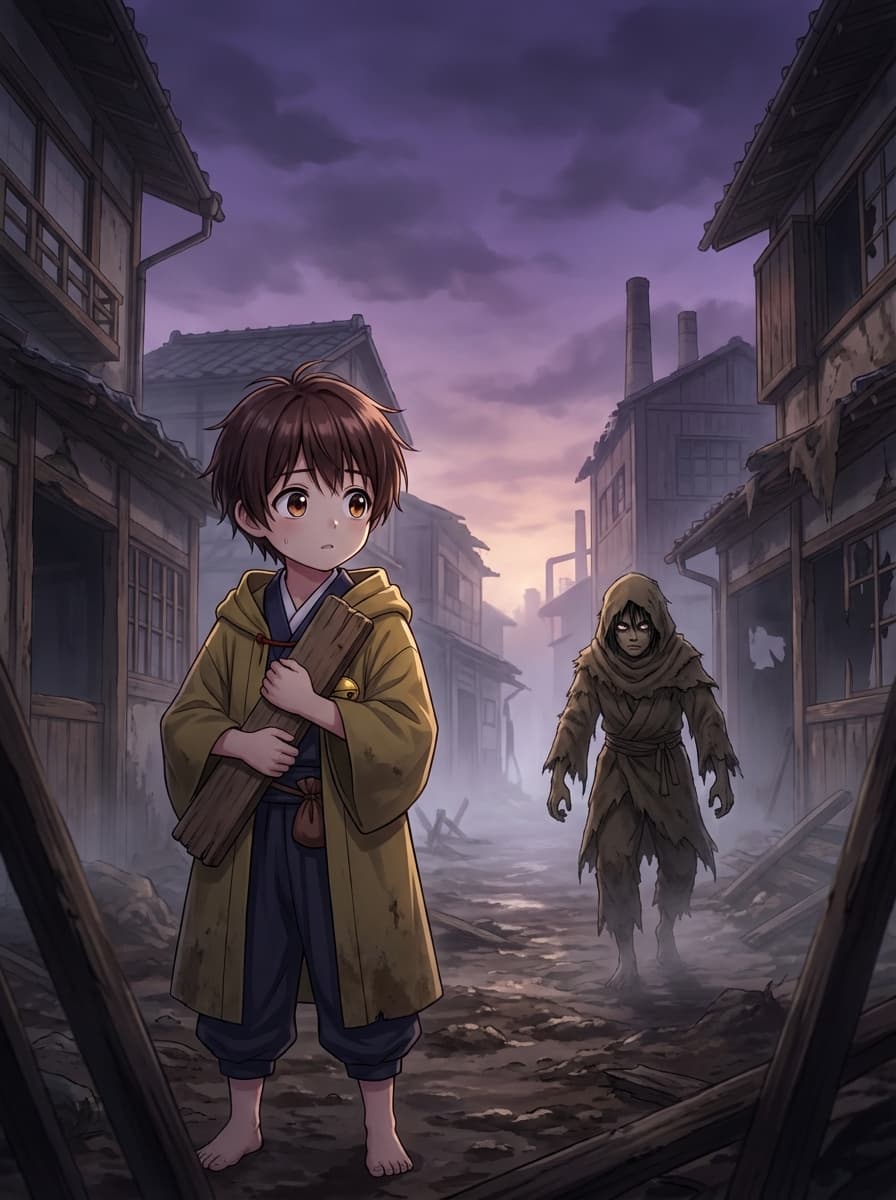
The lower levels of the collapsed Heavenly Capital were thick with the smell of silt.
It wasn't raining. Even so, mud welled up from the cracks in the cobblestones, clinging to the soles of their boots. It wasn't just dirt. It was mud mixed with the dissolved residue of records.
With every step, Koyoi felt as if something deep in his chest was being slowly shaved away.
“...I hate this mud,” Asahi muttered under his breath.
Kuon replied without lighting his prosthetic eye. “It diffuses if you shine a light on it. Don't stop walking. Take short, light steps.”
At the corner of an alley, Koyoi spotted a scrap of wood. It was half-buried in the mire. When he picked it up, it felt lukewarm.
Faded characters were scratched into the surface: ‘Koyo—’
The line broke off there. Koyoi’s breath hitched.
“Is this... my name?”
A voice drifted from across the mud. “I couldn't manage to write the rest.”
It was Suzune. Her overcoat was caked in filth, her sleeves were shredded, but her eyes held the same piercing strength as before. Koyoi stood frozen, clutching the wooden board.
“Suzune... You’re alive?”
Suzune gave a wry, pained smile. “I wouldn’t go so far as to say ‘alive.’ I can only hold this form while I’m here, digging through the mud.”
Kuon took a step forward. “A Mud Reunion Phenomenon. You’re temporarily stabilizing fallen records using your own voice, aren't you?”
Suzune nodded. “Without a voice to call them, they dissolve at once. But the more you call, the more it erodes the caller. So, we have to keep this short.”
“What are you digging for here?” Asahi asked, his eyes scanning the surroundings for threats.
Suzune pulled a small vial from the mud. Inside were a few black grains.
“Name-cores. Pieces that fell off during the bleaching process. If I gather enough, I might be able to restore them later.”
Koyoi opened his drawstring pouch, transferring the warmth of a ‘Droplet’ to the wooden board. The continuation of the faded characters shimmered into view.
‘Koyoi, don’t rush.’
Suzune laughed softly. “I’ve been wanting to say that to you for a long time.”
The flow of the mud suddenly accelerated. Suzune’s silhouette began to blur at the edges.
“Time’s up.”
Suzune pressed the vial into Koyoi’s hand. “Take this. Use it north of Churyo. And... Shiori’s traces haven’t vanished yet.”
“Where?”
Before Koyoi could ask, Suzune’s shoulders sank into the mire.
“Toward the darker side...”
The voice cut out. The surface of the mud rippled once, then returned to its stagnant turbidity.
Koyoi fell to his knees, gripping the vial. Asahi placed a steadying hand on his back.
“Let’s go. If we linger here, we’ll be pulled under to the other side.”
Kuon nodded silently. “This reunion isn’t the end. If we want to meet again, we must leave now.”
Koyoi stood up. He tucked the words from the wooden scrap into his heart and slipped the vial into his pouch. Reunions in the mud are brief. Yet, it is precisely because they are brief that you know they aren't a lie.
This realization marked a shift in their journey. Since they had begun this cycle, their daily records had gradually changed. Before, they would end each day simply judging whether things had "gone well" or not. Now, they recorded their days by distinguishing "why it went well" from "where chance saved them."
They had learned that in the Era of Cascading Collapse, the most effective tool was turning coincidence into procedure.
Whenever Koyoi opened his ledger, he found himself looking for Shiori’s habits. But instead of stopping where he searched, he chose to fill in the blanks. A blank space was proof of an absence, but it was also room for a handoff. He would honestly record that someone was missing, and because of that, decide what needed to be left behind. The work was painful, but by putting that pain into words, the next morning’s movements became more precise.
Kuon had refined a format to simultaneously handle the accuracy of the catalog and the uncertainty of the field. By separating columns for "immediate conclusions" and "pending items," he reduced accidents caused by false certainty. Labeling something as "Pending" wasn't a sign of weakness; it was a technical necessity to avoid misjudgment. This "pending" column proved most effective in places where Observers had destroyed everything by making "Solidification" their only virtue.
Asahi made sure not to record his sword techniques using vague, sensory language. Instead, he logged the placement of his feet, the width of his stride, the rhythm of releasing tension, and the height of his gaze. He left behind short, repetitive notes on physical techniques that were otherwise difficult to verbalize. As a result, even with a chipped sword, his options increased, and he relied less on reckless strikes. His focus shifted from "winning" to "preserving," which significantly boosted the party’s survival rate.
That night, huddled before the campfire, the three of them decided on the "one line" to pass on to the next person. The discussion was brief; the conclusion was always modest. But the most modest sentences were the most useful in the field. Flashy slogans might stir the heart, but procedures saved lives. The line they chose would become a wooden tag by morning, tied to gates, shelters, or the sides of railway tracks.
Finally, Koyoi added a small note in the margin of the ledger: “The things we learn here are not to be used to blame someone for being late, but to absorb the delay of another.”
Beside that sentence, Kuon added the date and their current location. Asahi nodded silently and threaded a cord through the hole in a wooden tag.
The next morning, the tag swayed in the wind, coming to rest at an angle where it could be read. Watching it, the three decided to measure their day not by whether they had succeeded, but by whether they could continue. To not only break the chain of collapse but to maintain the path beyond it so others could pass—they confirmed, in the same words, that this quiet, grueling work was the true heart of their journey.
They decided to leave one unresolved task behind. A record that makes everything look "solved" only leads the next person astray. Showing the unresolved as it is was not a mark of defeat, but evidence of a handoff.
Koyoi made a small mark at the edge of the ledger, creating a column for re-verification the following day. Kuon defined the meaning of that mark, and Asahi re-hung the wooden tag in a position where the mark could be easily read in the field. By simply continuing these three modest steps, repeat failures dropped noticeably.
Records don't have to be perfect. They just need to be left in a way that the next person to touch them can still find their way. Having confirmed this agreement, the three began walking toward the next sector.