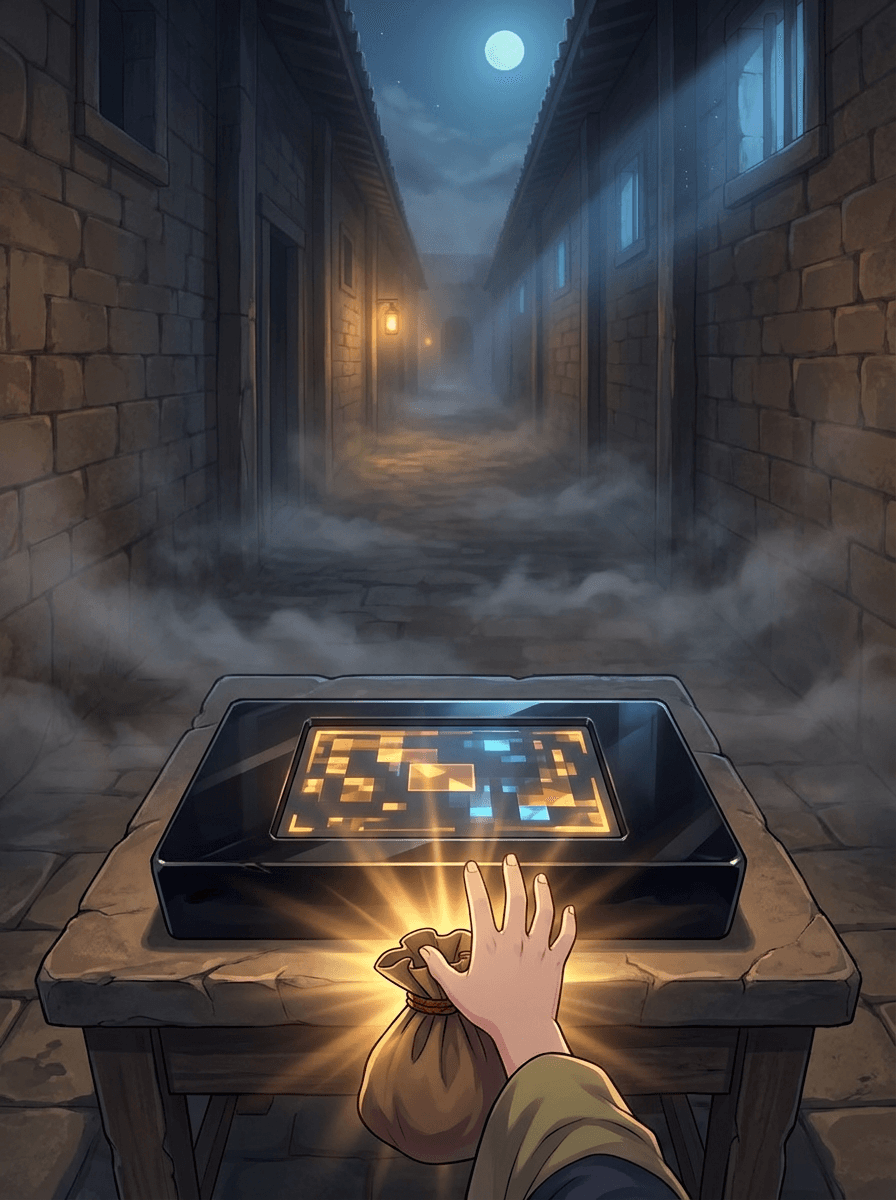
At the far end of the stone corridor, a single desk stood alone.
On the desk sat a black box. No lid, no keyhole. Only a small window on its surface, as dark as night.
Kuon stopped.
“...It’s the Observer’s auxiliary console.”
Asahi cracked his shoulders.
“Should we smash it and move on?”
“Read it before you break it. Some information can’t be recovered once it's destroyed.”
Koyoi pulled his drawstring pouch close and approached the desk. His fingertips brushed the box and felt a slight numbness—cold, with a lingering static-like sting.
As the blue light from Kuon’s prosthetic eye fell upon the window, white characters flickered to life in the dark.
`ERROR CODE: HOPE`
Koyoi read it aloud instinctively.
“‘Hope’... is an error?”
Kuon let out a dry laugh.
“To the Observer’s instruments, hope is a deviation. Behavior outside its predictions.”
Asahi tapped the hilt of his sword.
“Then we’ll just have to push through with that deviation.”
Kuon felt along the side of the box and found a thin slot. He slid a fragment of the Ledger into it.
The box responded at once. The text in the window changed.
`INPUT SOURCE UNKNOWN` `ALLOW TEMPORARY OVERRIDE?`
Koyoi looked at Kuon.
“Is it a trap?”
“Probably. But if we don’t pass through here, we can’t get the next coordinates.”
Asahi spoke curtly.
“If we do this, we do it now. Indecision will kill us faster.”
Kuon nodded and increased the light from his prosthetic eye. The blue glow traced the edges of the window, peeling away the formulae of ancient firewalls.
Koyoi opened his pouch and matched the rhythm of the 'Drops.' With a steady beat, he supported Kuon’s processing.
A final confirmation appeared in the window:
`HOPE DETECTED` `CLASSIFY:` `[ ] FAILURE` `[ ] NOISE` `[ ] UNRESOLVED`
Kuon chose the third option without hesitation.
“The moment you mark it ‘Resolved,’ it becomes fixed. We’ll carry it forward as ‘Unresolved.’”
The window went dark, then displayed thin mapping lines—a hidden route leading to the northern edge of Churyo. It was a line that didn't exist on any official transit map.
Asahi let out a whistle.
“Useful thing, that ‘Hope Error.’”
Kuon powered down the box and copied the coordinates onto the Ledger.
“We probably only get one shot. The Observer’s side will have logged this as an anomaly by now.”
Koyoi took one last look at the window. The text was gone. Now, deep within the dark screen, he could see a faint reflection of his own face.
If hope was an error, they would proceed as an error. That way, no one could get ahead of them.
The three of them left the desk and began walking deeper into the corridor. Behind them, after a slight delay, the black box emitted a single, soft chime.
Since they had begun this cycle, their journey had changed little by little. Before, they would end each day merely judging whether things had "gone well" or not. Now, they recorded "why it went well" and "where they were saved by coincidence" as separate entries.
They had learned that in the era of the Cascading Ruin, turning coincidence into procedure was the most effective way to survive.
Every time Koyoi opened his ledger, he found himself looking for the familiar creases of the bookmark. But instead of stopping where he had searched, he chose to fill the blanks. A blank space was proof of an absence, but it was also room to pass things on. By honestly recording that someone was no longer there, they decided what to leave behind in their stead. The process was painful, but the more they put that pain into words, the more precise their movements became the following morning.
Kuon refined a format to balance Ledger precision against field uncertainty. By separating the columns for 'Immediate Decisions' and 'Pending Items,' accidents caused by false certainty decreased. He even codified the idea that 'Pending' was not a sign of weakness, but a technique to avoid misjudgment. This 'Pending' column was most effective in the very places the Observer had destroyed by making 'Fixed' the only form of justice.
Asahi made sure not to record his sword techniques in vague, sensory language. The placement of his feet, the width of the gap, the beat at which he relaxed his strength, the height of his gaze—the physical skills that were hardest to verbalize were recorded repeatedly in short, punchy words. As a result, his options increased even with a chipped blade, and the number of times he relied on a desperate, all-or-nothing strike decreased. Prioritizing 'Preservation' over 'Victory' surely raised their chances of survival.
That night, in front of the campfire, the three of them decided on the single line to pass on. The discussion was short, and the conclusion was always plain. But the plainer the text, the more useful it was in the field. Flashy slogans lift the spirit, but procedures save lives. The line chosen here would become a wooden tag by morning, tied to gates, shelters, or the sides of the tracks.
Finally, Koyoi added a small note in the margin of the ledger: “What we learn here is used not to blame someone for their delay, but to absorb the delay of another.”
Next to that sentence, Kuon added the date and their current location. Asahi nodded silently and threaded a cord through the hole in the wooden tag.
The next morning, the tag swayed in the breeze, coming to rest at an angle where it could be read. Seeing this, the three of them decided to measure today not by whether they succeeded, but by whether they could keep going.
To not just break the chain, but to maintain the space beyond the break in a form that people could pass through. This plain, long labor was the heart of their journey, and they reaffirmed it in the same words each time.
They decided to leave one thing 'Unresolved.' A record that makes everything look 'Resolved' only leads the next person astray. Presenting the unresolved as unresolved is not a mark of defeat; it is a mark of succession.
Koyoi made a small mark at the edge of the ledger, creating a column for re-confirmation the following day. Kuon defined the meaning of that mark, and Asahi re-hung the wooden tag in a position where the mark could be read in the field. By simply continuing these three plain steps, the recurrence of the same failures decreased visibly.
A record doesn't have to be perfect. It just needs to be left in a form that makes it harder for the next person to lose their way.
After confirming that agreement, the three of them walked toward the next sector.