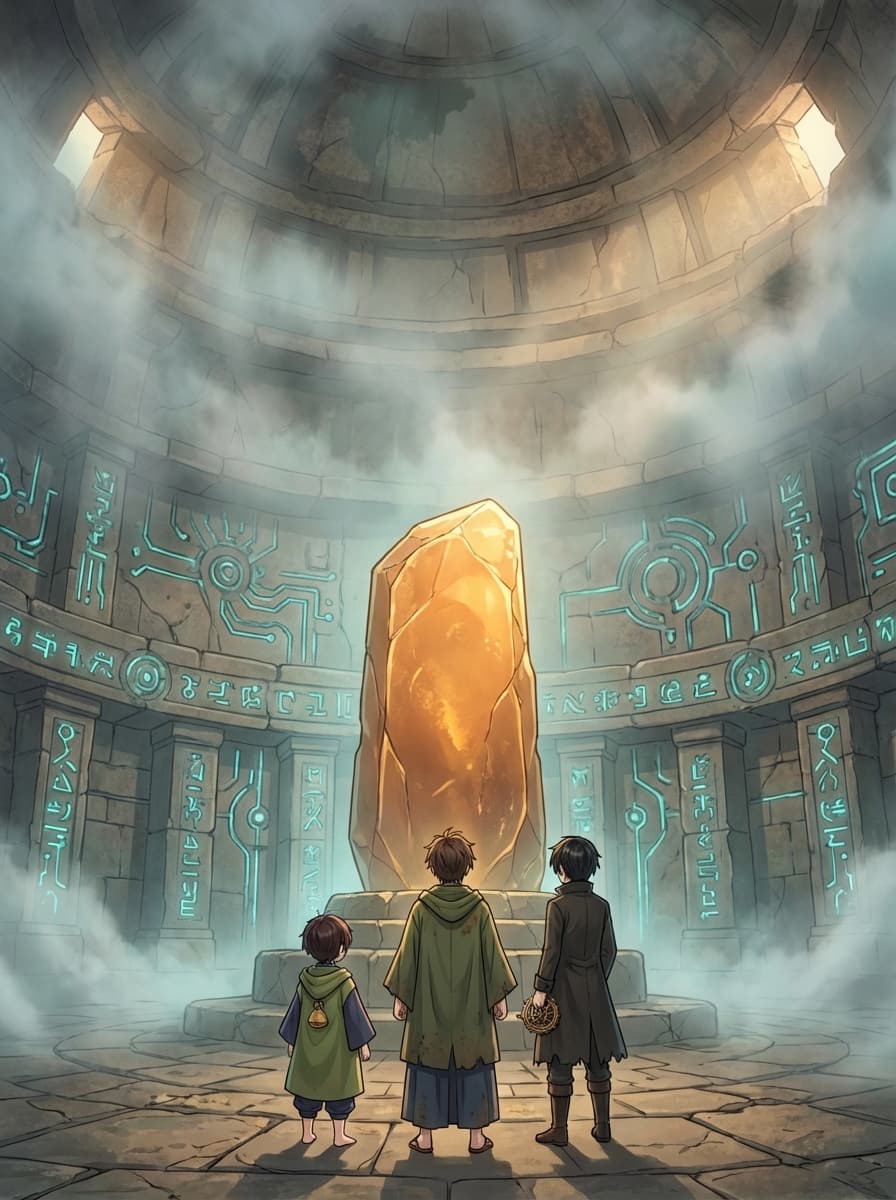
From the outside, the terminal station looked like nothing more than a warehouse.
Upon opening the heavy doors, however, the interior revealed countless control panels lined up in rows. Copper wiring, paper tape, stone tablets, and oil lamps—devices from vastly different eras all hummed and flickered within the same room.
"The Observer’s Console..."
Kuon’s breath hitched.
On the central desk, the status of each sector was displayed in cryptic symbols: Toumi-machi, the Moon Canyon, the Upside-down Town, the Cathedral, and the Labyrinth. They were all interconnected by a single, sprawling schematic.
Asahi spoke in a low, grim voice. "So, this is where they’ve been meddling with everything."
Koyoi kept his distance, careful not to touch the panels. The pulse of the Drop in his hand was restless; the room itself felt like a massive, living observation instrument.
In a chair at the far end of the room, a figure sat. White gloves, a frayed uniform, and a face of indeterminate age.
"You finally arrived."
The man spoke without standing up.
"I am the Deputy Administrator. This is the control room designed to delay the Collapse."
Kuon stepped forward. "And how many names did you have to erase to 'delay' it?"
The man didn't even twitch an eyebrow.
"I haven't counted. If I counted, I would stop."
Asahi moved his hand toward the hilt of his sword. "So, you just kept erasing them so you wouldn't have to stop."
The man nodded. "Localized deletion was the optimal method to prevent a chain-reaction collapse. Sentimentality only interferes with optimization."
Koyoi took a step forward, his voice quiet but firm. "It wasn’t sentimentality. It was the lives of the people who lived there."
For the first time, the man looked directly at Koyoi.
"Lives can be restored. The System cannot."
Kuon checked the side of the desk, whispering quickly. "Main control is split into three systems: Observation, Overwrite, and Erasure. They’re all still active."
Asahi asked, "Do we break it?"
Kuon shook his head. "If we destroy everything, we trigger an immediate collapse. We have to strip the permissions away in stages."
The man stood from his chair and placed his hands on the desk. "You cannot operate this. This device does not run on ideals."
Koyoi opened his pouch and let the Drop rest in his palm. Its warmth seeped into the edge of the desk, and the harsh, clinical light of the console softened slightly.
"We don't intend to run it on ideals. We’re just going to factor in 'those who are erased' from the very beginning."
Kuon overlaid his ledger onto the desk, beginning to rewrite the authorization formulas. Asahi blocked the man’s path, standing his ground without even drawing his blade.
The man reached for a control lever. Asahi swiped his wrist away. Even in that brief struggle, the lights on the panel pulsed fitfully.
Koyoi synchronized the rhythm of the Drop with the desk, slowing down only the lights of the Erasure system. Timing it to that delay, Kuon isolated the deletion permissions.
Phase one complete. The Erasure function went dead.
For the first time, the man’s composure crumbled.
"Fools. Do not think you can maintain this world without deletion."
Kuon replied coldly, "We aren't maintaining it; we're redesigning it. It will take time, but we won't build a future that assumes someone must be missing."
Asahi added in a low growl, "Your shift is over. We’re taking over from here."
The man stopped resisting and sank back into his chair. His expression wasn't one of defeat, but of profound exhaustion.
The flickering of the panels gradually settled. The sector displays remained unstable, but the red "Erasure Warning" had vanished.
Koyoi placed the bundle of papers he had received from the Old Scribe onto the desk.
"In here are the records of those who were erased. We won't decide on the next redesign until we've read every word."
Kuon nodded deeply. Asahi finally took his hand off the hilt of his sword.
The Observer’s Console was still running. But it would never run the same way again.
Koyoi returned the Drop to his pouch and let out a quiet sigh. A long journey had finally reached a tangible milestone.
Just before dawn, a pale light filtered through the windows of the console room.
The panels were still erratic, but the red warning lights did not return. Kuon sat in the chair, beginning the sketches for a total rewiring.
Asahi kept watch at the entrance, while Koyoi began sorting the bundle of papers into chronological order. The work left after a battle is often plain and tedious. But it was exactly this tedium that would truly delay the next collapse.
Koyoi looked out at the white sky through the window and whispered softly.
"From here on out, our job is not to erase."
Kuon and Asahi nodded in unison. The journey wasn't over. The way they walked it had simply changed.
In that moment, what they protected was not blind momentum, but a careful process. Kuon began by verbally separating the confirmed items from the unconfirmed ones.
As he read out the structure, Koyoi mirrored the same divisions in his ledger. Asahi kept his blade sheathed until the records were settled, securing their exit route first.
The greater the crisis, the more important it is to clarify the first step rather than simply adding more tasks. That was what kept them together.