# Chapter 198: Asahi’s Phantom
The mist-train slowed its pace.
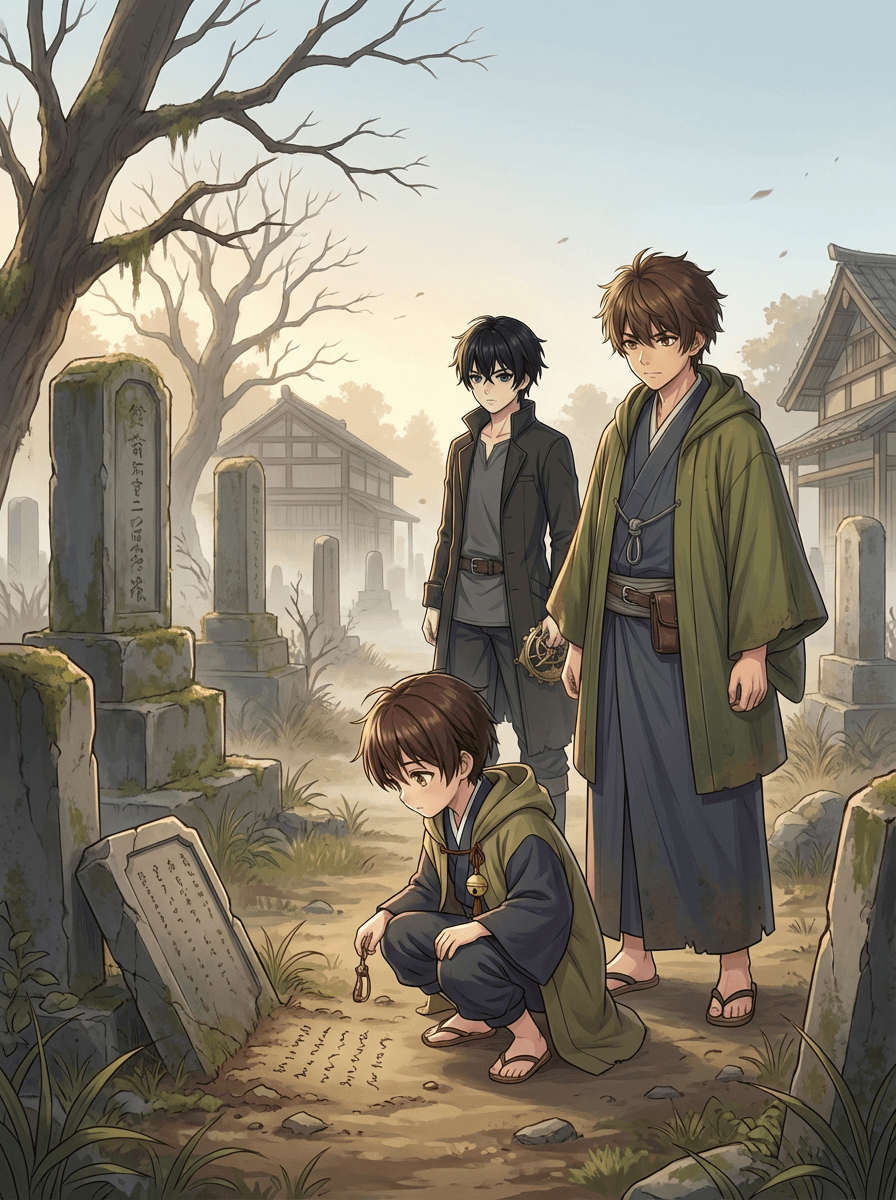
The grating of the wheels crawled through the floorboards, reaching the soles of Koyoi’s feet. Outside the window, a gray platform rose from the depths of the fog. Stone pillars stood in a silent row. No moss grew upon them; instead, they were coated in years of accumulated, bone-dry dust. The station roof had partially collapsed, leaving the steel girders exposed like skeletal ribs.
There was supposed to be no one here.
The train came to a halt. The doors slid open, allowing a rush of cold air to flood the carriage. It carried the scent of gravel and rusted iron. Koyoi instinctively pulled his collar tight.
At the far end of the platform stood a single figure.
“...Someone’s there.”
Asahi stood up. With his hand resting on the hilt of his sword, he stopped before the open door and narrowed his eyes.
The figure was small. A child. A boy of about ten years old stood at the edge of the platform, staring down the tracks into the distance. He wore a thin kimono and was barefoot, his toes gripping the gravel. Though a wind was blowing, the hem of his garment did not stir.
Koyoi caught his breath.
The way the child stood—the stance of his feet, the angle of his shoulders, the slight tilt of his head. It was a sight he saw every single day. He was the image of Asahi, right down to the way he carried his weight.
“Asahi... look.”
His voice didn't seem to reach him. Asahi stepped down onto the platform, moving toward the boy one slow step at a time. The sound of his boots crushing the gravel was the only thing that broke the oppressive silence. Koyoi gripped the doorframe. Beside him, he sensed Kuon closing his record book.
The child turned around.
He had a face. He had eyes. But there was nothing reflected in them. The depths of his pupils were hollow, dark pits that simply swallowed the light. His mouth moved, but no voice came out. His lips formed the shape of a word, only to stop halfway. A mouth without vocal cords, searching for a sound it could not produce.
Asahi stopped.
Five paces remained between them. He was close enough to reach out and touch him.
The child closed his mouth. He simply looked at Asahi with those hollow eyes, staring straight through him. Then, he turned on his heel and began to walk toward the back of the platform. His stride was perfectly measured, fluid as if rehearsed thousands of times. Though his bare feet trod upon the stones, there was no sound of footsteps.
“Wait.”
Asahi’s voice was hoarse. He reached out a hand. Just as his fingertips were about to graze the boy’s shoulder, the silhouette unraveled.
The boy’s form crumbled from the shoulder down, dissolving into grains of sand. His legs vanished, then his arms, then his torso. Finally, for a fleeting moment, only the hollow eyes remained suspended in the air before they, too, scattered.
Nothing remained on the gravel but a thin layer of fine dust. There were no footprints. The stones were smoothed flat, as if no one had ever been there at all.
A gust of wind blew. The powder swirled upward and dissolved into the mist. Nothing was left.
Asahi did not lower his reaching hand. His fingers remained open, grasping at the empty air. He stood there for a long time before slowly curling his hand into a fist and returning it to his side. He did not turn back. The tendons in his shoulders were taut.
Still clutching the doorframe, Koyoi found himself unable to move. He watched Asahi’s back. His shoulders weren't moving. He realized then that he was holding his breath.
—Asahi had a childhood, too.
It was an obvious truth, but for the first time, Koyoi felt the crushing weight of that reality. He had passed through this place before. So strongly that it left a record, so deeply that it played back through the ages—he had passed this station. Barefoot. Alone. Unable to make a sound.
“A residual record.”
Kuon’s voice came from behind him, low and deliberately flat.
“This area doesn't preserve words; it saves the trajectories of motion. A way of walking, the angle of a gaze, a posture. Those repeated actions simply happened to coalesce into a human shape.”
The explanation was precise, but Koyoi knew Kuon was being intentionally clinical. Asahi could hear him. That was why Kuon stripped the emotion from his voice.
Asahi returned from the platform to the train. He said nothing. He took his seat and placed his sword across his knees.
The fingers of his right hand, gripping the hilt, were white. He was holding it so hard his knuckles protruded. His left hand was a fist in his lap, trembling almost imperceptibly.
Koyoi started to say something, then stopped. There were no words for this. Instead, he sat back in his own seat and straightened his posture. He said nothing, letting his quiet presence tell Asahi he was there.
Kuon opened his record book again, his artificial eye glowing with a steady blue light as he began to write. The light did not flicker. He was the same Kuon as always. That, perhaps, was his own way of showing concern.
The doors slid shut. The train began to move. The wheels bit into the tracks, and the familiar vibration returned to the seats.
Asahi did not look out the window. The platform was swallowed by the fog. The collapsed roof, the layers of dust, the powder on the stones, and the hollow eyes—all of it was gone.
Koyoi clutched the drawstring pouch against his chest. The drop of liquid inside felt faintly cold.