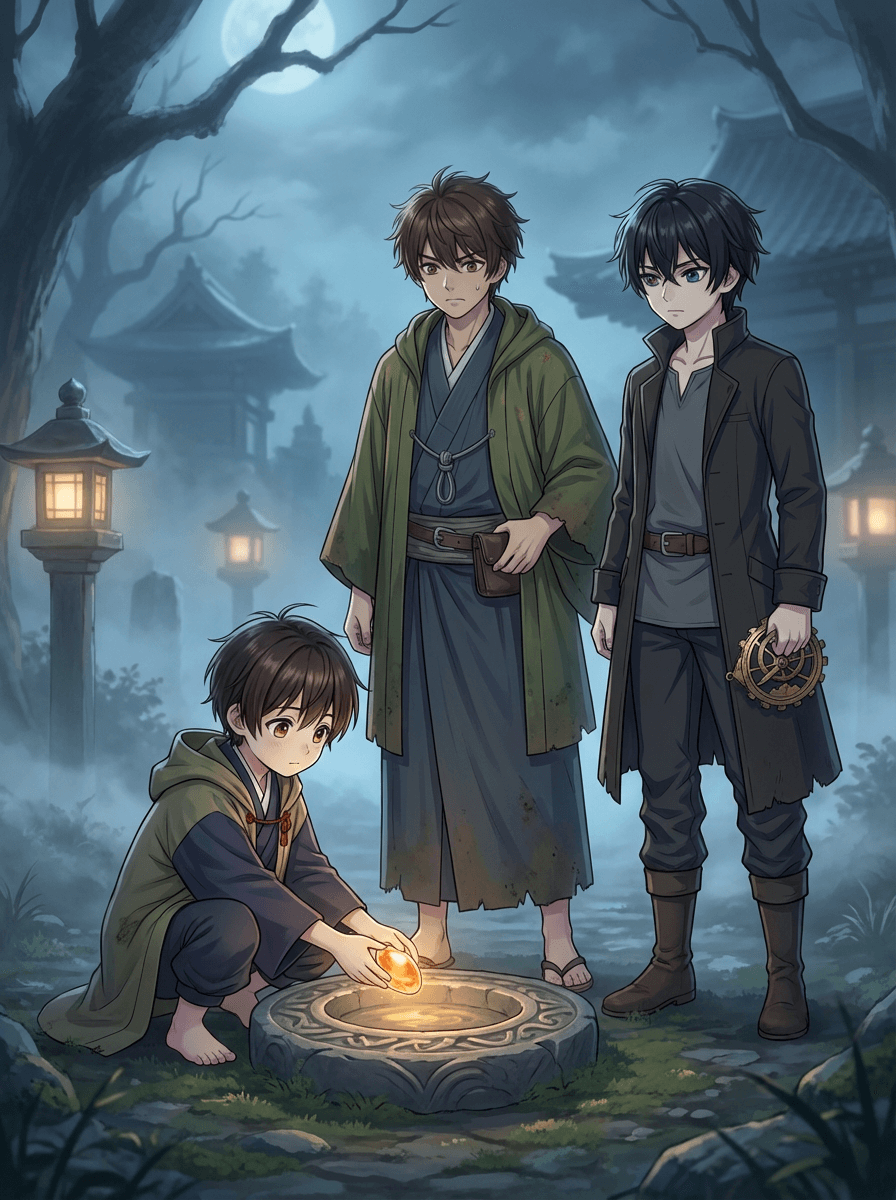
As the Mist Train began to move, the world outside the window began peeling away.
First came the colors. The reddish-brown paint on the building walls paled, turned to gray, and eventually faded into white. Next were the shapes. The outlines of roofs blurred, window frames melted, and the walls themselves dissolved into the mist. First the color, then the form—leaving only shadows behind. And by the time the train had fully passed, even those shadows had vanished.
"It’s bleaching," Kuon said, his eyes fixed on the window. His voice was devoid of emotion. "It’s stripping away old records. The entire town... it’s being scrubbed clean. To the Observers, I suppose this is nothing more than a simple chore."
Grains of light flowed past the glass—the debris of stripped records. They were neither letters nor sounds, merely dust motes of radiance. Things that had once been someone’s name, someone’s life, now drifted aimlessly, stripped of all meaning.
Koyoi pressed his forehead against the windowpane. The glass was cold. Every time a grain of light swept past, he felt as if he caught a fleeting glimpse of something within it—the suggestion of a face, the shape of a house. But they vanished into the stream before his eyes could focus.
The train was now racing across a blank plain. This was where a town had once stood. The ground had been leveled perfectly flat; not even the foundations of buildings remained. There was only an expanse of white sand, marked only by wind-carved ripples. Those ripples were not records. The wind created them, and the wind erased them. This was a place where nothing remained.
Asahi sat deep in his seat, arms crossed and eyes shut. He wasn't sleeping; he was simply forcing himself not to look outside.
"If you watch it, it pulls at you," Asahi said, his eyes still closed. "If you keep staring at things as they disappear, you start to feel like your own outlines are fading away, too."
Kuon opened the ledger on his lap. He turned a page. His finger stopped. He turned another. He stopped again.
Koyoi looked at Kuon’s hands. His fingertips hesitated over the page—a movement uncharacteristic of his usual composure.
"…What’s wrong?"
"It’s thinning."
Kuon lifted the page. When held up to the light, characters were visible, but they overlapped with the text on the reverse side, making them unreadable. The paper itself was losing substance. A single sheet was now half as thick as before.
"Every time the train passes through this sector, the recorded information is shaved away. It’s not that the paper is getting thinner—it’s that the layers of information fixed to the page are being peeled off, one by one."
Kuon turned the page again. The next one was thinner still. And the one after that...
It was blank.
Kuon’s hand went still. The page that had been filled with lines of text only moments ago was now as white as if nothing had ever been written there. Kuon traced the page with his finger. No indentations. No trace of ink. Just perfect, total whiteness.
"…This was the page with the map of the Shimozato underground aqueduct."
Kuon’s voice was low and steady. It wasn't anger; it was the voice of someone confirming a loss.
"It’s gone."
Koyoi looked at Kuon’s profile. The blue light of his prosthetic eye flickered. Kuon stared at the blank page, remaining motionless for a long time.
The train jolted. Outside the window, more grains of light flowed by. Stripped records. Stripped names. Stripped maps. Everything became the same dust of light, scattering into the wind.
Koyoi placed his hand on the window. Beyond the glass, the particles of light brushed past his fingertips. He couldn't feel them. He couldn't catch them. They simply flowed away.
"It’s not that they’re making us forget," Koyoi whispered. "They’re making it so it never existed in the first place. The town, the roads… the maps."
Kuon did not close the ledger. He kept it open on his lap, staring at the blankness as if trying to sear the shape of the lost map into the back of his mind.
Asahi opened his eyes.
"The next town… is it still there?"
Kuon didn't answer. It wasn't that he couldn't—it was that the answer was changing with every passing second.
The train surged forward. Outside the window, the world grew thinner, layer by layer. The dust of light mingled with the mist, the mist dissolved into the wind, and the wind carried nothing at all. Koyoi gripped his drawstring pouch. Only the warmth of the Droplet remained unchanged. The vibration of the train traveled up through the soles of his feet, and the wheels’ steady rhythm was the only sound left.