Beyond the Resonator, a sloping shaft appeared, plunging into the earth.
Words were carved into the stone lintel at the entrance: ‘To the Heart of Churyo.’
Asahi stepped to the front.
“Is it a straight shot from here?”
Kuon shook his head.
“There are multiple vessels. Take the wrong one, and we’ll be spat back out to the outer shell.”
Dark red streaks ran along the walls of the shaft, throbbing like veins. It was the Main Vein of the Principle.
Koyoi pressed a hand against his drawstring pouch, syncing his breath to the rhythm. Whenever the beating of the ‘Drop’ interfered with the pulse of the Main Vein, his head swam with vertigo.
“Let’s keep our distance as we walk. If you get too close to the walls, the current will pull you in.”
The three of them kept strictly to the center line as they advanced. Along the way, numerous side tunnels branched off, each exhaling a faint, ghostly breeze.
Kuon did not consult his Catalog; he chose their path by ear.
“The paths to the Heart have a low beat. The high beats lead to the shell.”
Asahi gave a clipped nod.
“Lately, it seems we’re always choosing our way by sound.”
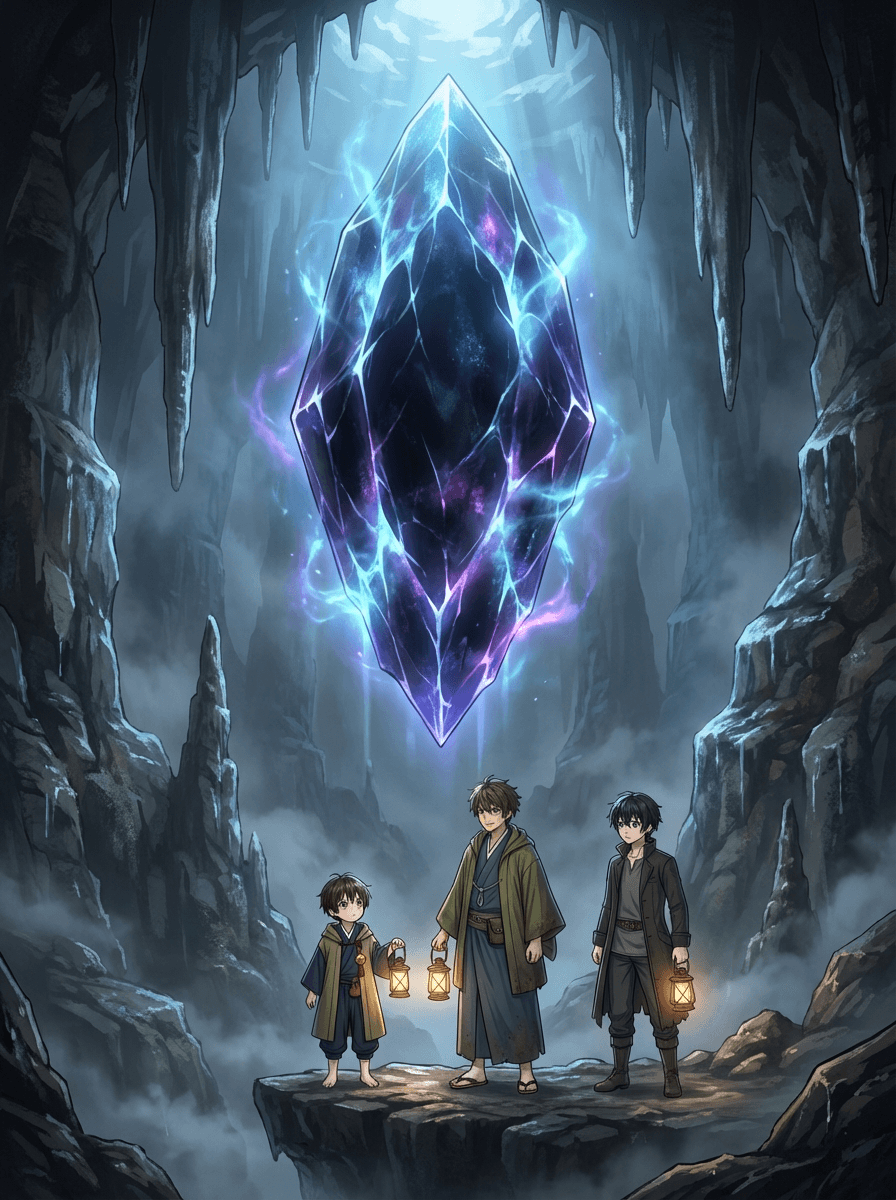
Half an hour later, the shaft opened into a gargantuan cavern. At its center sat a black crystalline mass, slowly contracting and expanding.
It was the Heart of Churyo.
Overwhelmed, Koyoi came to a halt. Countless names—fading, nearly gone—raced across the crystal’s surface, rising and sinking with every rhythmic throb.
Asahi spoke in a low voice.
“There’s bound to be a guardian watching over this.”
Kuon nodded, his light illuminating the footprints around the crystal. They were fresh.
“There is. And likely more than one.”
Koyoi took a deep breath.
“We aren’t stopping the Heart; we’re correcting the flow. That’s still the plan, right?”
Kuon answered instantly.
“Exactly. To stop it is to invite total collapse.”
Asahi drew his sword halfway from its sheath.
“Then we negotiate if they’re the negotiating type. If not, we neutralize them with minimum force.”
The crystal’s pulse deepened. The entire cavern resonated, and from the distance, the sound of footsteps echoed back.
The guardians were coming.
The three took their positions. They had reached the final threshold before the Heart.
Since they had begun this cycle, their journey had slowly transformed. In the beginning, they would end each day simply judging whether things had "gone well." Now, they recorded their progress by distinguishing why it had gone well from when they had been saved by mere coincidence.
They had learned that in this era of Cascading Failures, the most effective tool was turning luck into method.
Every time Koyoi opened his notebook, he found himself tracing the creases in the bookmark, searching for a sign of what was lost. But rather than standing still in his search, he chose to fill the blank spaces. A blank space was proof of an absence, but it was also room for a legacy. By honestly recording that someone was gone, he could decide what to leave behind in their stead. The process was painful, but as he put that pain into words, their movements the following morning became more precise.
Kuon had refined a format to handle the Catalog’s precision alongside the uncertainty of the field. He separated columns for "Immediate Decisions" from those for "Pending Variables." He made it clear that "Pending" was not a sign of weakness, but a technical safeguard against misjudgment. In places where previous "Observers" had destroyed the world by obsessing over "Fixing" things as the only truth, these pending columns proved vital.
Asahi made sure his records of swordplay were not limited to mere sensory descriptions. Foot placement, the width of the interval, the beat on which to release tension, the height of his gaze. He left repetitive, concise notes on the physical techniques that were usually the hardest to put into words. As a result, even with a chipped blade, his options increased, and he relied less on desperate, all-or-nothing strikes. By prioritizing "surviving to leave a record" over "winning at any cost," he had effectively pushed the team's survival rate higher.
That night, before the campfire, the three of them decided on the "single line" of wisdom to pass on to the next person. The debate was short; the conclusion was always modest. But the most modest sentences were often the most useful in the field. Flashy slogans might lift the spirit, but procedures saved lives. The line they chose would be carved onto a wooden tag by morning and tied to a gate, a shelter, or a railway track.
Finally, Koyoi added a small note in the margin of his notebook: “The things we learn here are not to be used to blame someone for their delay, but to absorb the delay of another.”
Beside that sentence, Kuon added the date and their current location. Asahi nodded silently and threaded a cord through the hole in the wooden tag.
The next morning, the tag swayed in the wind, coming to rest at an angle where it could be read. Seeing this, the three decided to measure their day not by whether it was a success, but by whether they could keep going.
Not only to break the chain of collapse, but to keep the path open so that those who followed could walk it—that quiet, grueling labor was the true soul of their journey. They confirmed this to one another, using the same words.
They decided to leave one thing unresolved. A record that makes everything look "solved" will only lead the next person astray. To show the unresolved as unresolved was not a mark of defeat, but a sign of the hand-off.
Koyoi made a small mark at the edge of the page, creating a column for "Re-verification Tomorrow." Kuon defined the meaning of that mark, and Asahi re-hung the wooden tag at the site so that its message could be clearly seen. By simply repeating these three modest steps, the recurrence of the same failures dropped visibly.
The record did not have to be perfect. It just had to be left in a way that made it hard for the next person to lose their way. Having confirmed this agreement, the three walked forward into the next sector.
Dividing the responsibilities of supplies and recording had also stabilized the latter half of their journey. If judgment, transport, and recording are concentrated in one person, a delay in decision-making is inevitable. So, they switched to a procedure where they declared their roles before moving, and briefly cross-referenced the results afterward.
This procedure was not flashy, but it sharpened their initial response in the next crisis. And above all, it ensured that even if one of them was lost, the remaining two could keep the minimum operations running.
The strength they needed to continue was not an individual’s power to break through, but a design that kept turning even when someone was missing.