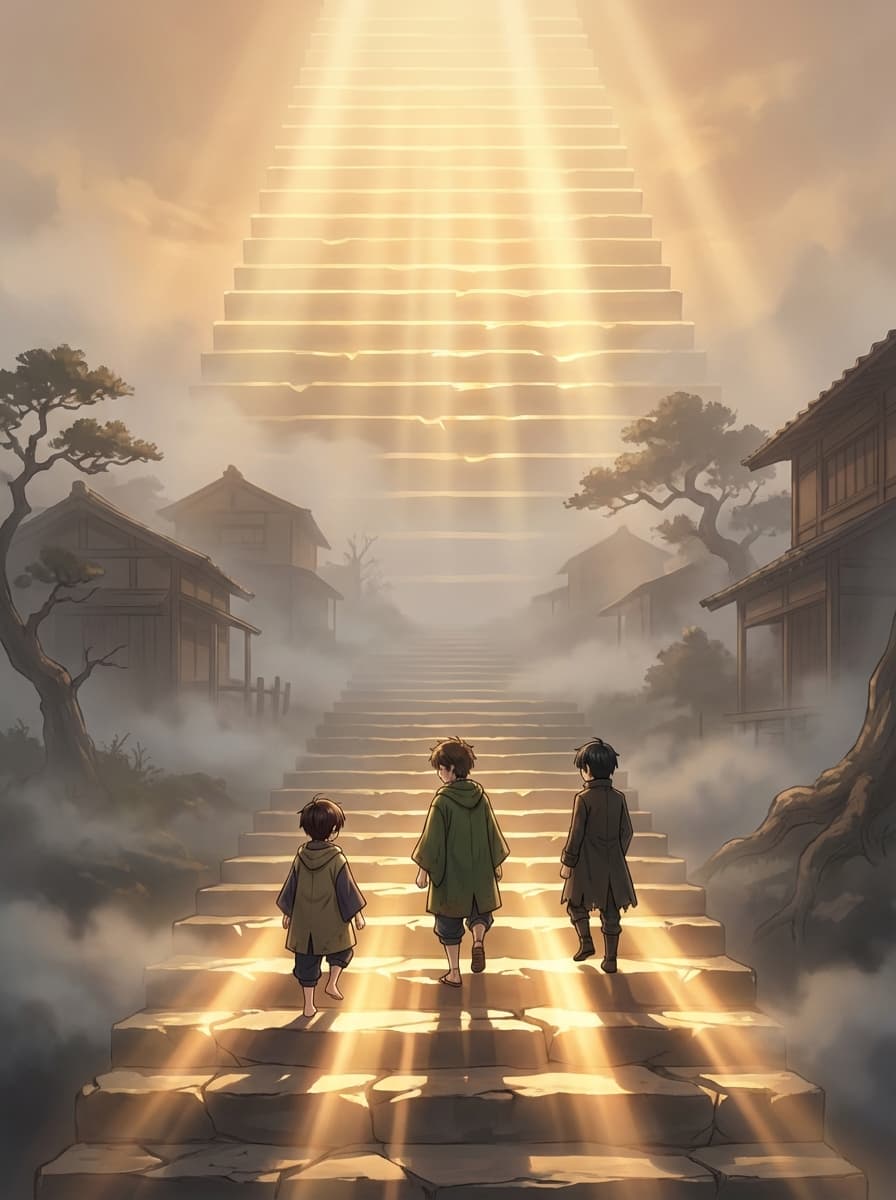
Just before they reached Churyo’s depths, the pouch began to quiver.
Koyoi came to a halt. It was a hard, sharp vibration—distinct from the steady pulse of the Shizuku. It was the bead’s resonance.
"…It’s singing again."
Kuon scanned their surroundings. "An identical structure is nearby. Closer than the last one."
Asahi pressed an ear to the ground. From beneath the stone came a rhythmic, metallic hum, like the ringing of a distant bell.
"Right under us."
The three of them brushed away the sand, revealing the seams of a stone slab. The joinery formed the shape of a square lid. Kuon attempted an unlocking formula, but the stone remained inert.
"The key isn't a formula," Kuon observed. "It’s the resonance itself."
Koyoi carefully drew the bead from his pouch. It was cold to the touch, yet it throbbed against his palm like a living heart.
"Should I bring it closer?"
"Carefully," Kuon warned. "If you strike it too hard, the anti-phase will shatter it."
Koyoi eased the bead toward the slab. When only a few inches remained, the resonant hum spiked in pitch, and a circular crest flickered into view at the center of the stone.
Asahi wedged a dagger into the seam and pried. The lid groaned open.
Inside sat a small vessel. At first glance, it appeared empty, but a faint, ethereal light pooled at the bottom.
"This is where it returns," Kuon said softly.
Koyoi placed the bead into the vessel. The sound died instantly. A moment later, a second glimmer rose from the bowl’s bottom.
It was the resonance, reflected back to them.
"…So, it’s not over yet," Koyoi murmured.
Kuon nodded. "The bead isn't an artifact to be stored. It’s a component in a circulatory system. Returning it unlocks the next gate."
Ancient characters shimmered along the rim of the vessel: 『North Main Vein: One activation condition met.』
Asahi let out a short laugh. "Finally. We’re actually getting close to the heart of this place."
Beside the vessel, Koyoi left a single page—a transcription from the Gate volume. It was a concise summary of the resonance protocol.
『Do not strike. Place gently to return.』
As they slid the lid back into place, the sound of the resonance receded, sinking deep into the earth.
The resonance of the bead had returned. This time, it wasn't a warning; it was proof the connection had been made.
Since they had begun this cycle of retrieval and return, their journey had taken a fundamental turn. Previously, they had ended each day simply asking, "Did we succeed?" Now, they meticulously recorded why things worked and identified exactly where they had been saved by sheer luck.
They had learned that in the Age of Cascading Collapse, nothing was more effective than turning a coincidence into a procedure.
Every time Koyoi opened his ledger, he found himself reflexively looking for the familiar handwriting of a bookmark that was no longer there. But rather than stopping at the point of loss, he chose to fill the empty spaces. A blank space was proof of an absence, but it was also room for an inheritance. He wrote honestly about who was missing, and because of that, he could decide what needed to be left behind. The work was painful, but the more he gave that pain a vocabulary, the more precise their movements became the following morning.
Kuon developed a format to balance the rigidity of a catalog with the uncertainty of the field. By separating the ledger into columns for "Immediate Decisions" and "Pending Observations," they reduced accidents caused by false certainty. Kuon’s insistence that "Pending" was not a sign of weakness, but a technical skill to avoid misjudgment, proved vital. In places where previous observers had destroyed everything by insisting on "Fixing" the world as the only truth, this "Pending" column saved them.
Asahi made sure to stop recording sword techniques in vague, sensory terms. Instead, he logged the placement of feet, the width of the interval, the beat of a release, and the height of the gaze. The more difficult a physical skill was to verbalize, the more he distilled it into short, repeatable instructions. As a result, even with a chipped blade, his options increased, and the need to rely on desperate, heavy strikes diminished. His doctrine of prioritizing "Enduring" over "Winning" significantly raised their chances of survival.
That night, huddled before the campfire, the three of them decided on the single line they would leave for the next group. Their discussions were brief, and their conclusions were always understated. But they knew that the most plain-faced sentences were the ones that proved most useful in the field. Flashy slogans might lift the spirit, but procedures saved lives. The line they chose would be carved into a wooden tag by morning and tied to a gate, a shelter, or a signpost by the tracks.
At the very end of his ledger, Koyoi added a small note in the margin: "What we learn here is not to be used to blame someone for their delay, but to absorb that delay for them."
Kuon added the date and their current coordinates beside the sentence. Asahi nodded silently, threading a cord through the hole in the wooden tag.
The next morning, the tag swayed in the wind, coming to rest at an angle that was easy to read. Watching it, the three of them decided to measure their day not by whether they succeeded, but by whether they could continue.
To not just break the collapse, but to maintain the path so that others could walk it afterward—they confirmed, in the same words, that this quiet, grueling work was the true heart of their journey.
They chose to leave one unresolved point in the record. A report that made everything look perfectly "solved" would only mislead the next person in charge. To leave unresolved points plainly marked wasn't a mark of defeat; it was the mark of a handoff.
Koyoi made a small mark at the edge of the page, creating a column for re-verification the following day. Kuon set the mark’s operational meaning, and Asahi re-hung the wooden tag in the field where the mark could be easily spotted. By simply continuing these three mundane steps, the recurrence of the same mistakes dropped visibly.
The record didn't need to be perfect. It just needed to remain in a form that wouldn't leave the next person wandering in the dark.
Once that agreement was settled, they began the walk toward the next sector.
Dividing the responsibilities of supply, transport, and recording also improved their stability in the latter half of the trip. If a single person tried to handle the judgment, the hauling, and the documentation, a delay in decision-making was inevitable. Instead, they re-declared their roles before moving and performed short, concise cross-checks of the results after arriving.
The procedure wasn't flashy, but it accelerated their initial response in the next phase. Above all, it ensured that even if one of them were lost, the remaining two could keep their essential routines running. They shared the understanding that the strength needed to continue the journey lay less in individual breakthrough power and more in a design built for the day one seat might be empty.