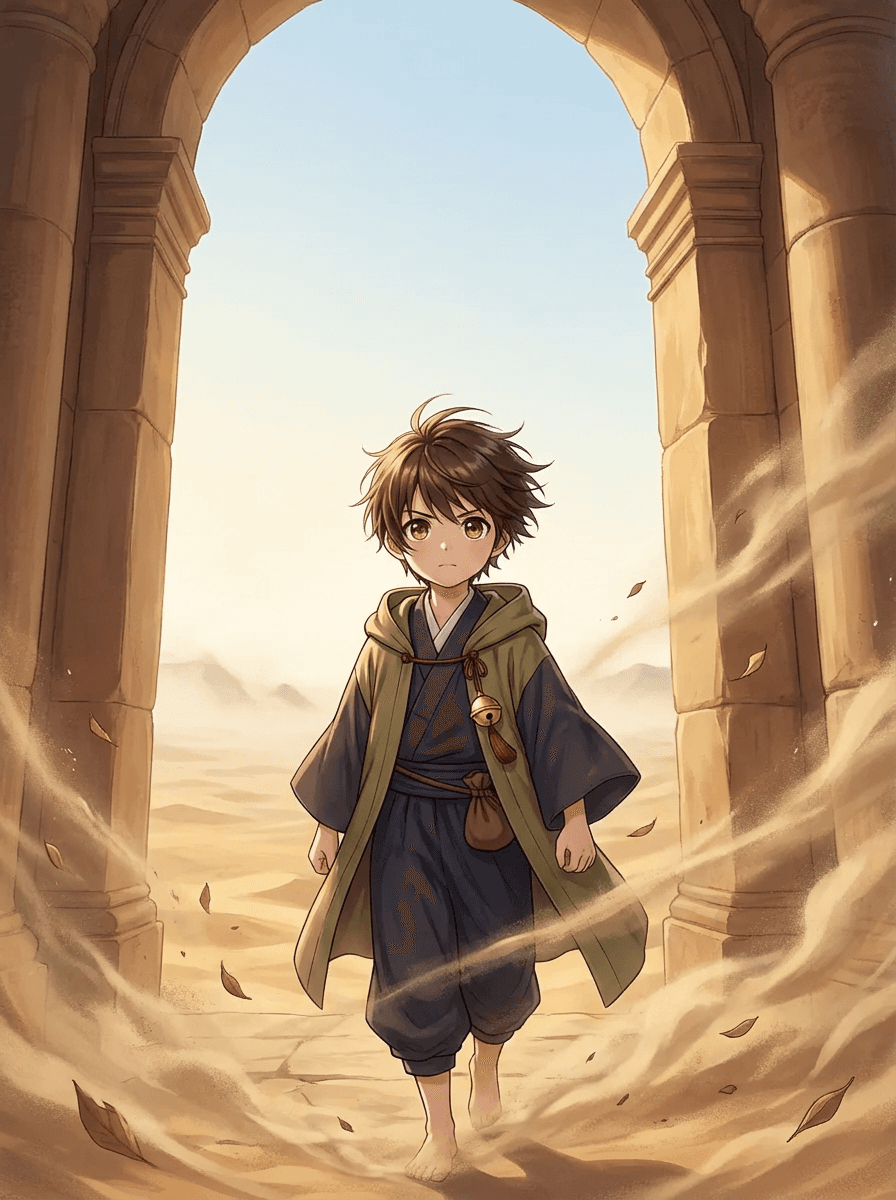
The scent of the salt spray cut off abruptly.
In its place, a wind laden with dry grit stung my nostrils. The moment I stepped off the train, the sound beneath my feet shifted. It was no longer the hard, rhythmic echo of cobblestones, but a soft, crumbling whisper. Every place I stepped immediately lost its shape, yielding to the weight.
"The South," Asahi muttered. He rested a hand on the pommel of his greatsword, his eyes scanning the horizon.
Kuon closed his Index and looked up. The sky felt lower here, the clouds thinner. The wind blew in a straight, relentless line. Back on the coast, the wind had been a tangled vortex of salt and spray; here, it streamed in only one direction.
At the far edge of the station stood a gate.
It was made of neither wood nor stone. Two pillars of what looked like petrified sand rose from the earth, their surfaces strangely smooth. Countless grooves, polished by centuries of wind, ran along their length—ancient history etched directly into their skin. There was nothing between the pillars. No doors, no crossbeams. And yet, the very air seemed to hold a different temperature within that empty space.
Koyoi came to a halt before the gate.
He felt the droplet inside his drawstring pouch grow slightly heavier. The pulse radiating through the cloth quickened, if only for a heartbeat.
"An entrance?" he asked.
Kuon nodded. "The gateway to the South. Beyond this point, cardinal directions cease to be words."
"What do you mean?"
Kuon scooped up a handful of sand and let it trickle through his fingers. The wind snatched it away, scattering it in an instant.
"At sea, the salt leaves trails. It crystallizes history, solidifies records. But the sand erases as quickly as one can write. The wind carries the concept of 'direction' away with it."
Asahi pressed his palm against one of the pillars. "It’s hot."
It wasn't the heat of the midday sun. It was an ancient, trapped heat—a warmth with no exit that had been stored there since time immemorial. It felt like a dull fever seeping up from deep within the earth.
"The shadows are getting shorter," Asahi said, pulling his hand away. "That means there's nowhere left to hide. Brace yourselves."
Koyoi looked back one last time.
The Mist Train stood motionless at the edge of the platform, its hull still crusted with the white salt of the sea. Those pale particles were no longer falling here. Instead, microscopic grains of sand rode the wind, peppering their skin with a thousand tiny stings.
The sea was gone. The sound of the tide was gone. The very air whispered a finality: there was no turning back.
Koyoi clutched the pouch to his chest and took a single step between the pillars.
In the empty space where a door should have been, the wind coiled around his ankles. Sand swirled upward, turning his vision white for a fleeting second. He didn't even have time to blink before the temperature shifted against his skin.
When the white haze cleared, the world was parched.
The sand beneath his feet was tinged with red. The ridgelines of distant hills rose and fell like low waves, their crests shimmering with heat hazes. The sky was blue, but different from the sky over the ocean—more distant, more ethereal.
His body knew it before his mind did: they had crossed the threshold of the South.
"The air is so dry," Koyoi said, licking his lips. They were already beginning to chap.
"Low moisture. It’s a poor environment for preserving names, but the Bleaching progresses more slowly here," Kuon said, opening his Index. The azure glow of his artificial eye scanned the pages. "Aridity can act as a seal for records. At sea, the salt preserved them; here, the dryness keeps them locked away."
The three of them began to walk.
As they trudged through the shifting sands, they encountered their first signpost: a wooden post with a thin board nailed to it. The wind had scoured the wood until the characters were nearly gone, but two remained, barely legible.
Sunamine.
"The name of the next town," Kuon said, turning his artificial eye toward the post. The blue light captured the linguistic ghosts of the faded characters. "The writing is fading from weathering, not the Bleaching. That means this post has stood here since before the Observers took control."
"So, the old names still remain?"
"Yes. The South is a laggard in the Great Bleaching. We might still find names here that haven't been erased."
The pouch gave a sudden pulse.
Small, sharp. Koyoi stopped and looked down at his chest. Through the fabric, he could feel the presence of the names. The twenty-two names of the Nijyuuni-Sora—so quiet by the sea—were stirring.
"They’re reacting," Koyoi whispered. "The names in the pouch... they're responding to the air of the South."
Kuon narrowed his eyes. "The roots of the earth. The roots of names stretch beneath our feet even here. The names in your pouch are sensing the names of the South through the ground."
They reached a second signpost.
This one was in better condition. Fine script had been carved into the board, marking directions and distances. Half a day to Sunamine. Two days to Nagisawa. Four days to Tsuyuno. Seven days to Kazasato.
Below the directions, there was a different set of marks. In a hand unlike the one that had built the sign, small names had been etched into the wood. Some were illegible, but they were unmistakably names.
"Travelers' names?" Asahi asked, leaning in.
"No," Kuon said, shaking his head. "Gods. The gods who passed through here carved their own names into the post. To ensure they wouldn't be forgotten."
Koyoi touched his fingertips to the grain of the wood. Deep within the parched fibers, he felt a faint, lingering warmth. It was the residual heat of a name. The pulse of the pouch quickened in rhythm with the warmth beneath his fingers.
"This name... it's still alive," Koyoi’s voice trembled. "The carved name hasn't vanished yet."
Kuon flipped through the pages of his Index, recording the characters with his azure eye. "There are names in the South that we can still reach in time. This signpost is the proof."
The wind rose again.
Sand danced low across the ground, slowly filling in their footprints. When they looked back, the gate was already lost in the haze. The shadow of the station and the silhouette of the train had dissolved into the shifting red dust.
There was only one way to go: forward.
Koyoi tightened his grip on the pouch and turned toward the direction the signpost pointed. Sunamine. The first town was half a day ahead.
Asahi took the lead, the steady, rhythmic crunch of his boots the only sound in the vast silence. Kuon walked beside him, his Index tucked under his arm, holding the pages down against the wind.
To Koyoi, it sounded as if the old names on the signpost were whispering in the wind.
Names sealed within parched wood, calling out to the pouch as it passed by. I am here, they seemed to say. I have not been erased.
The pouch grew warm, as if in answer.
Koyoi adjusted his stride and followed the path south through the sand. Their shadows were short, but all three pointed in the same direction. And that was enough to keep his feet moving.