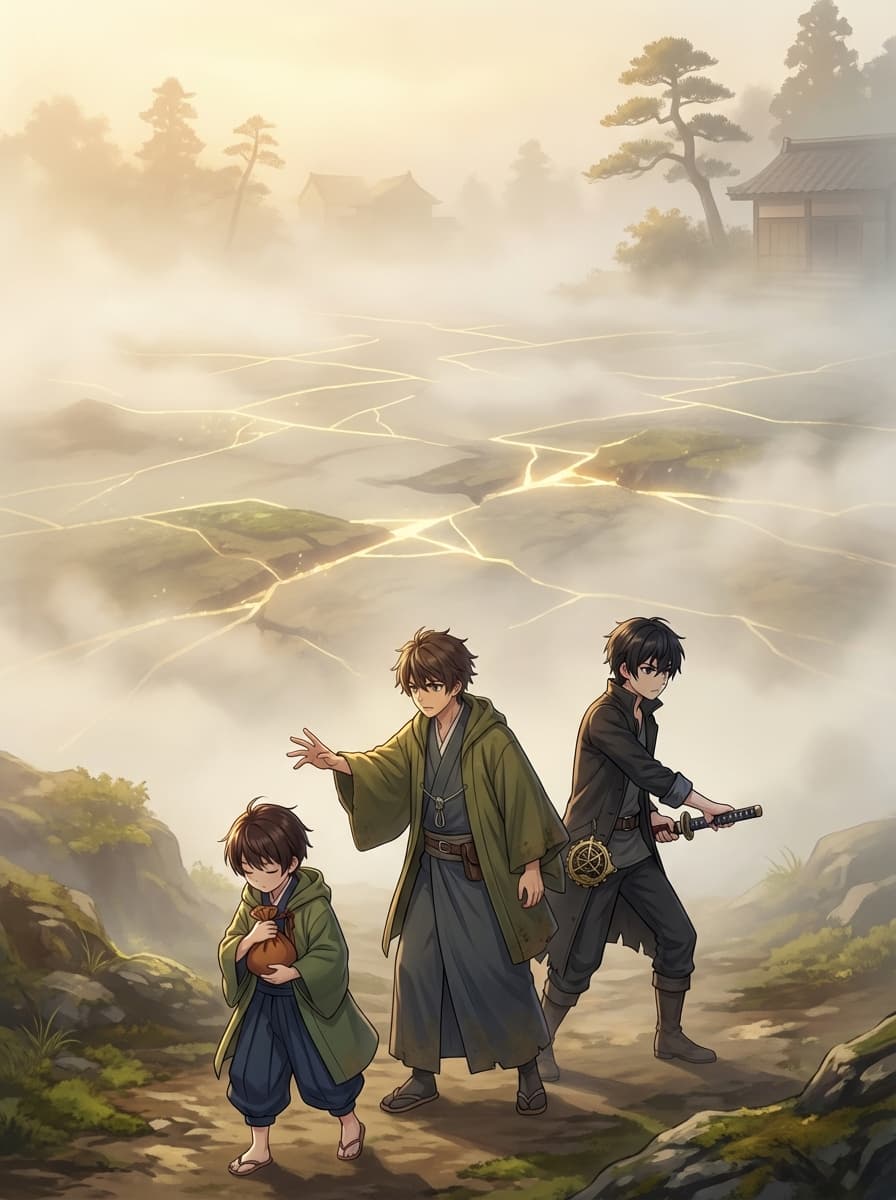
The sand moved.
There wasn't even a breeze. The grains on the shore were shifting positions of their own accord. At first, it was only a few. Then dozens, until finally, a corner of the beach began to undulate in a silent swell.
Koyoi came to a halt.
At the tips of his shoes, the sand parted to the left and right. He hadn't stepped on it; rather, the sand itself had moved to avoid his feet.
"It’s like it’s alive."
"It isn’t."
Kuon scooped up a handful of sand. As it sat in his palm, the grains crawled between his fingers. He leaned in, observing them through his prosthetic eye.
"It’s stone. Or rather, what used to be stone."
Under the pale blue light, faint lines were visible on the surface of the grains. Traces of engravings. They had been ground down so small that the naked eye couldn't perceive them, but when he dialed up the magnification of his prosthetic eye, fragments of characters were etched into every single grain.
"These are the remnants of steles. Stones engraved with names were shattered until they became sand."
"Like the stone walls we saw during the Time of the Unreturning Tide?"
"The very same."
Kuon nodded.
"Those walls were broken, weathered, swept into the sea, and polished by the waves into sand. It took thousands of years. But the grooves of the letters—only those would not vanish. Even when the stone becomes powder, the memory of the grooves remains."
The movement was spreading. The entire surface of the beach was slowly writhing. Grains gathered, scattered, and gathered again. About five paces from the water's edge, the sand began to form shallow trenches.
Koyoi knelt down.
The trenches were characters. The grains were creating hollows of their own volition, sketching lines. One stroke at a time, slowly. Sand for the horizontal strokes moved from left to right; sand for the vertical strokes fell from top to bottom.
"It’s writing a name."
Koyoi’s voice was a rasp.
The sand was spelling out a name using its own body. Stones that had been ground to dust were trying to give form once again to the characters once carved into them.
Asahi looked around the shore. There wasn't just one name in the sand. All across the beach, the sand was carving hollows. Characters of all sizes were lined up along the tide line.
"There are dozens of them."
"Hundreds."
Kuon scanned the entire beach with his prosthetic eye.
"There are as many fragments of names as there are grains of sand on this beach. If enough of them gather, they can reconstruct a single name. That is what’s happening now."
A wave came. A small surge washed over the sandy letters, breaking their shape. But as the water receded, the sand returned to the exact same positions. It was rebuilding the characters.
No matter how many times it was broken, the sand wrote the same name.
Koyoi gripped his drawstring bag. The warmth of the "Drop" within was radiating toward the letters in the sand. As he brought the bag closer, the sand’s movement quickened. The outlines of the characters grew vivid.
"The Drop is helping."
"Name is calling unto name," Kuon said.
"The Drop in that bag is a collective of names. Its warmth stimulates the sand's memory. The memory of the grooves left in the grains is reacting to the names within the Drop, trying to reclaim its original shape."
Koyoi pulled out his manuscript. He began to transcribe the names written by the sand onto the paper, one by one. But there was no need for ink. When he placed the manuscript over the characters, the grains clung to the paper of their own accord, transferring the shapes of the letters.
The names of the sand became names on the page.
"Twenty-five," Kuon counted.
A train whistle echoed in the distance. The low tone reverberated across the beach, and the names in the sand trembled all at once.
The train was coming. It was the southbound line.
Asahi stood up.
"It’s time."
"But the names..."
"There will be more at the next stop."
Asahi tapped Koyoi on the shoulder.
"It’s not just here. Everywhere there is sand, they remain."
Koyoi looked down at the characters in the sand. Names he hadn't been able to copy yet were still lined up across the shore. The waves came, broke them, and the sand wrote them again. Over and over.
The train whistle blew a second time.
Kuon closed the catalog and stood.
"The records for the coastal region end here. The rest of the names are to the south."
The three of them left the beach and walked the path along the tracks. The station house was small, its wooden roof faded white by the salt air. There wasn't even a turnstile. They stood directly on the platform and waited for the train.
The tracks began to hum. The vibration reached the soles of their feet, followed shortly by the sound. A black locomotive approached, trailing a shroud of white steam.
The train came to a halt. The doors opened. The carriage was empty.
Koyoi turned back one last time.
On the beach, the sand was still moving. It was still writing names. Even after they left, even when the waves broke them, the sand would continue to spell out names with its own body.
Even if stone is shattered into sand. Even if sand is washed by the waves. The memory of the grooves that carved those names would never vanish.
Koyoi stepped inside. Asahi followed, and Kuon climbed in last. The doors slid shut.
The train began to move. Outside the window, the white beach flowed backward. Eventually, the shore turned into pine groves, and the groves turned into rolling hills. The scent of the sea grew faint, replaced by the smell of earth and grass.
Koyoi spread the manuscript across his knees. The names transferred by the sand were drying on the paper. When he touched them, the tactile grit of the grains still remained.
The drawstring bag pulsed gently. The warmth of the Drop was welcoming the new names into the fold.
Outside the carriage window, the sun was sinking. The shadow of the southbound train stretched long over the tracks.
The coast was now far behind. But the memory of the sand remained within the manuscript.