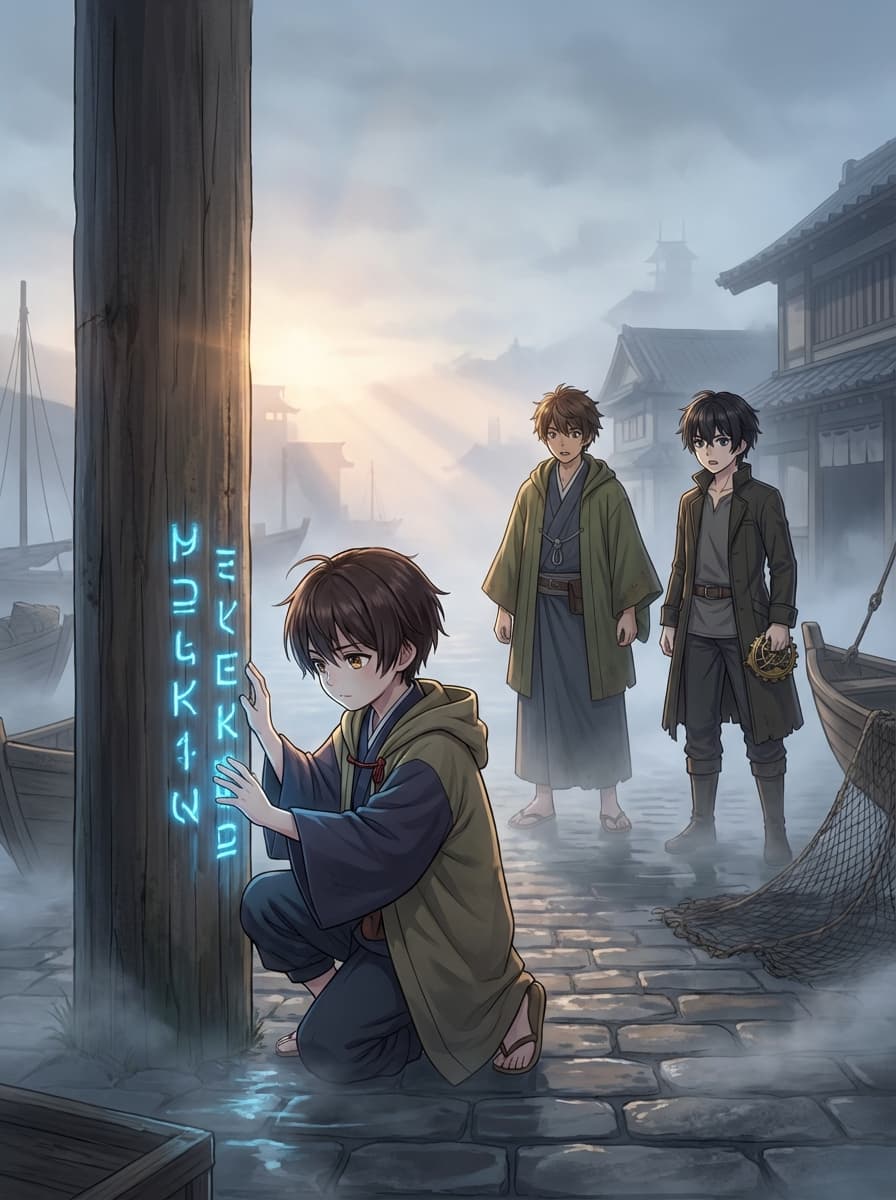
At the far edge of the port stood an ancient wooden signpost.
Upon its tide-worn surface, a few characters barely clung to life. Though slick with moisture, they did not peel or blur; they remained tenacious, as if someone had obsessively repainted them time and again.
Koyoi traced them with a finger. The moment he touched the wood, the characters shuddered with a cold, rhythmic pulse.
“...Can you read this?”
Kuon narrowed his glass eye.
“I can. But the moment they are read, they ‘become.’”
“What do you mean?”
Kuon pointed toward the marker.
“In the Port of the Chart, the port itself is the map. The roads, the waves—everything is merely a line. And lines require names. A line without a name simply vanishes.”
Koyoi caught his breath. The inscription was brief, but its brevity was chilling. It was Asahi who spoke first.
“...A name is an anchor.”
As the words left his lips, the mist clinging to the signpost receded. Beneath their feet, the cobblestones reclaimed a fraction of the solidity expected of a true port.
Koyoi stared at the characters in silence. To speak the name was to fix the path in reality. To leave it unspoken was to let the world be bleached away.
“...Then, if we want to move forward...”
“Yes,” Kuon said, his gaze unwavering. “We must carry the name with us.”
He tore a scrap from the edge of his ledger and transcribed the characters from the post. The moment the ink dried, the paper grew heavy. It wasn't an unpleasant weight, but rather the sudden, sinking gravity of a responsibility finally accepted.
“...Is this the name of the Chart?”
Kuon shook his head at Koyoi’s question.
“No. This is only the name of the port. The name of the Chart... lies elsewhere.”
He stroked the leather cover of the ledger. Deep within the binding, the paper seemed to groan. Asahi shouldered his sword.
“If there’s a name, it means it can be summoned. And if it can be summoned, it can be returned.”
Returned. To whom? And what?
Koyoi gripped his drawstring pouch, searching for an answer in the faint warmth of the droplet within.
Kuon reopened the ledger. On the reverse of the page where he had copied the port’s name, new characters began to surface. They were faint, flickering on the edge of extinction. But the moment the pale blue radiance of his glass eye caught them, Kuon’s fingers froze.
“...I know this.”
“What?”
“This name... I know it.”
His voice was brittle. The usual irony and cold analysis were gone, replaced by a stark, rigid tension. Kuon remained motionless, pinning the page down with his fingertip as the blue light in his eye trembled over the text.
Koyoi leaned in to look. There were three characters. He couldn’t read them, yet Kuon’s artificial eye seemed to be devouring them.
“...It is the name of the one who first drew the Chart,” Kuon whispered. “Not the Observer, nor the primordial gods. The one who first struck the path to allow names to escape into the depths. I—I have read this record somewhere before.”
“Where?”
“I can’t remember. But the moment I see these characters... my hand remembers.”
Kuon looked down at his right hand. Not at his eye, but at his flesh. His fingertips were vibrating with a fine tremor. His mind held no memory, yet his body was reacting. Such was the power of a name.
Asahi moved silently to Kuon’s side. He didn't touch him, but stood like a bulwark, shielding him from the wind.
“You don’t need the memory,” Asahi said shortly. “You only need to carry it.”
Kuon closed his eyes for a long moment, then slowly shut the ledger. The name of the one who drew the Chart sank beneath the leather cover. It had not vanished; it had been put away.
Koyoi pulled his pouch close to his chest. The droplet inside pulsed—a long, weak rhythm in sympathy with the characters on the signpost.
The three began to walk, leaving the marker behind.
The mist had thinned. The road felt firmer for the weight of the name they now carried. Kuon’s right hand continued to shake, but no one pointed it out. Only the salt wind was there to press against their backs.