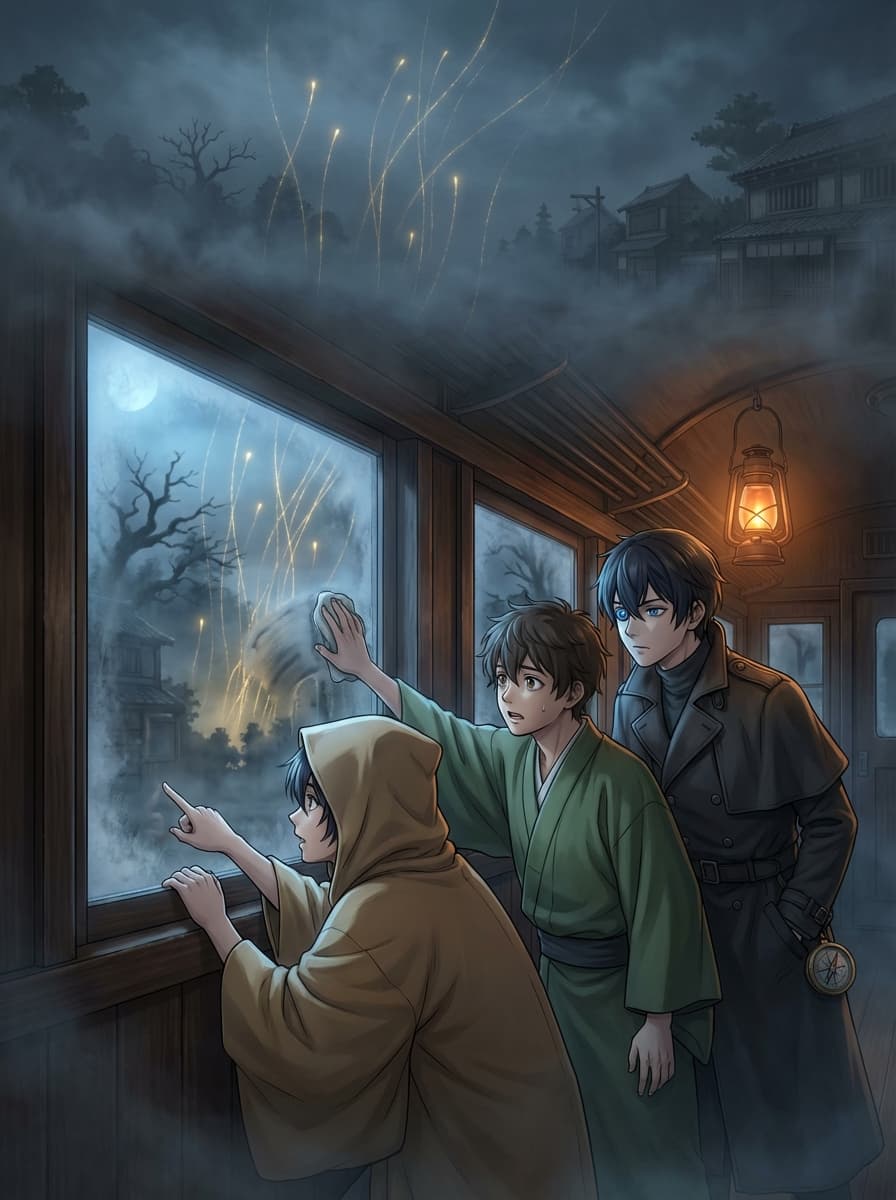
Asahi fished a scrap of paper out from the crack in the seat.
“What’s this?”
The paper held between his fingertips was the shape of a ticket. It had rounded corners and a notch at the edge—the mark of a conductor’s punch. But the entire thing was waterlogged, limp and warped.
A droplet fell from Asahi’s finger.
“It’s wet. Seawater.”
Koyoi leaned in. The scent of the tide drifted from it. There was no reason for seawater to be inside the train. The windows were shut; no rain was falling.
“Where did it come from?”
Kuon reached out. “Let me see.”
Asahi handed over the ticket. Kuon cast the blue glow of his prosthetic eye over it. Upon the damp paper, blurred characters began to surface.
It was a name.
The name of a single deity, written in ink. But the water had caused it to run, and the outlines were dissolving. The strokes on the far right were already illegible. Only the radical on the left barely managed to hold its shape.
“A bleached name,” Kuon said, his voice dropping an octave. “A ticket belonging to someone whose name was stolen by the Observers. After the name was washed away, only the ticket remained here. …There was a passenger. Someone here before us.”
Koyoi caught his breath.
There had been someone on this train before them. Someone who had a name. They had bought a ticket and boarded at some station, only to have their name stolen—bleached—mid-journey, leaving nothing but this ticket dropped in the gap of a seat.
“Where did that person go?”
“Nowhere, likely. Once the name is lost, the ticket becomes void. This train does not carry the nameless. They were either cast off mid-journey… or erased.”
Kuon flipped the ticket over. There was text on the back as well. This wasn’t ink, but an engraving—characters pressed with a stone die that wouldn’t fade, even when drenched.
It was the destination.
“Hoshino,” Koyoi read aloud.
This person, too, had been heading for Hoshino. Clutching a ticket, carrying a name, riding this very same train.
The drawstring pouch pulsed. Faintly, mournfully.
Shizuku was reacting to the name on the ticket. Perhaps it was someone they knew. A fifty-second name, one not included in the fifty-one manuscripts.
“This name isn’t in the manuscripts.”
Koyoi spread the bundles of manuscripts across his lap. Thirty-seven deities and fourteen deities. Fifty-one in total. He checked them one by one.
Nothing. The name on the ticket was recorded nowhere in the collection.
“A name that didn’t exist in the archives or the markets remains only upon this ticket,” Kuon said, holding the paper up to the light. “Which means this name wasn’t completely erased from existence. It was bleached, but its trace survived in the form of a ticket. A ticket isn’t a vessel for a name—it’s proof that a name passed through. Proof is a difficult thing to erase.”
Asahi crossed his arms. “And what do you plan to do with that proof? You can’t even read the name anymore. More than half of it is washed out.”
“I might not be able to read it, but I might be able to call it.”
Koyoi spoke with a voice that was surprisingly steady.
“Even if I don’t know the whole name, if I call out to the part that’s left, the name itself might answer. That’s how it was with Shizuku. When I first found Shizuku, I didn’t know their name. But when I spoke to them, they came to me.”
Kuon narrowed his eyes. “This is different. Shizuku was alive. The owner of this ticket is—”
“We don’t know if they’re alive or dead, do we?”
A certain hardness crept into Koyoi’s voice.
“If we don’t know, then the only thing to do is try calling. If I call and there’s no answer, then I’ll give up.”
Kuon started to say something, then closed his mouth.
Asahi gave a short, dry laugh. “Getting quite the backbone for a brat, aren't you?”
Koyoi took the ticket. The wet paper was cold, and the scent of the tide clung to his fingertips. He stared at the dissolving characters. Half a name, nothing but a radical.
Was the owner of this name out there somewhere in the mist? Alone, having lost their name and dropped their ticket?
The pulsation of the pouch synchronized with the dampness of the ticket. Shizuku’s warmth and the ticket’s chill—the two temperatures collided in the palm of his hand.
Koyoi tucked the ticket between the bundles of manuscripts. Fifty-one manuscripts, and one wet ticket.
Fifty-two.
“There’s one more now,” Koyoi whispered to the pouch.
Shizuku pulsed with a warm, responding rhythm.
Outside the train window, it felt as though the mist had thinned, just a fraction.