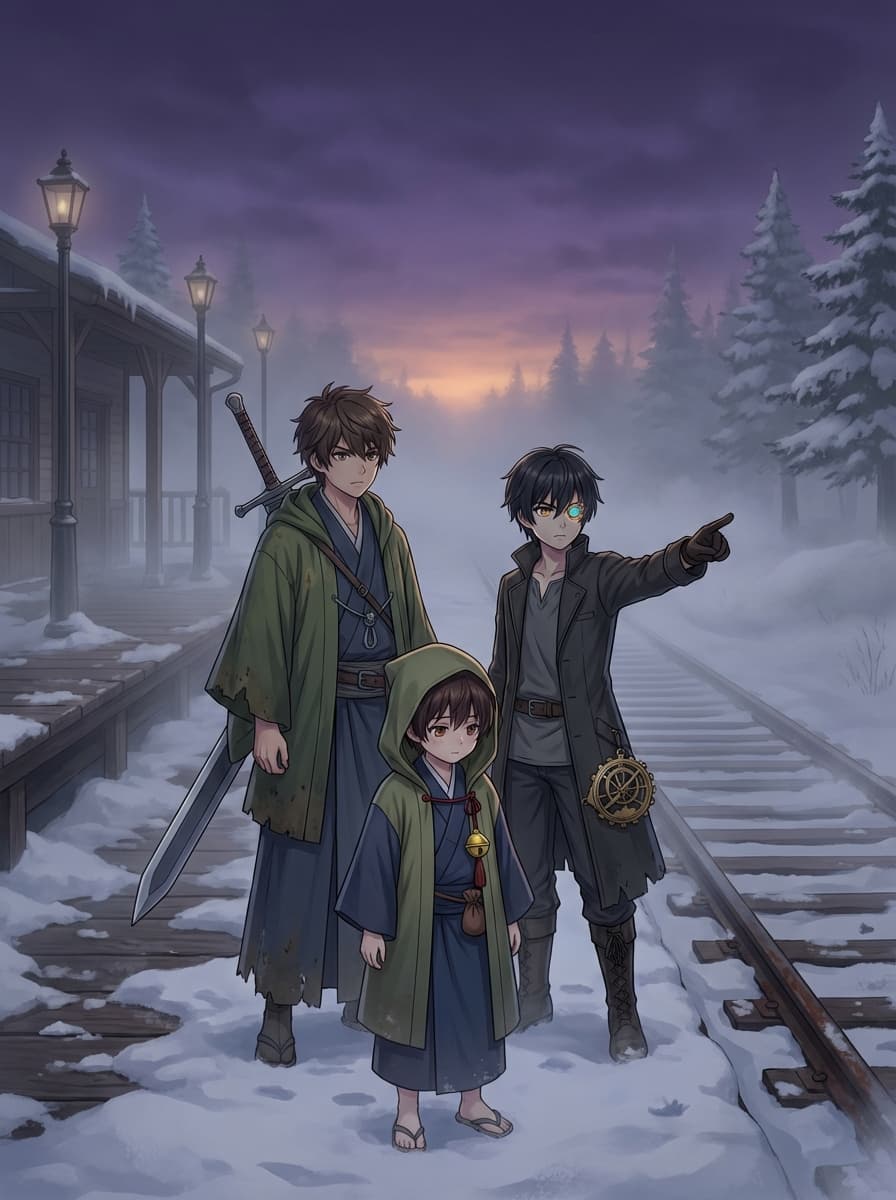
In the deepest reaches of the archive, separate from the official record shelves, lay a small niche.
Tucked behind the stacked stone wall, in a gap no wider than three fingers, was a leather cover. Had Kuon not cast the azure light of his prosthetic eye upon it, it would have surely been mistaken for nothing more than a stain on the wall.
“...It’s hidden.”
Kuon slid his fingers into the gap and carefully pulled the object out. It was a thin notebook—spineless, bound by leather cords that were fraying at the ends. Its appearance was markedly different from the formal, rigid format of the official records.
As he opened the pages, rows of slender handwriting met his gaze. This was no official log. There were wide margins and uneven line spacing, with traces of corrections scattered throughout. The size of the script varied; one could tell by the shifting pressure of the brush where the writer had hurried and where they had paused, lost in thought.
“It’s a journal. A personal one.”
Kuon held the page down, the blue glow of his eye illuminating the characters. Koyoi peered over his shoulder at the pages, while Asahi leaned against the wall, listening. Kuon began to read aloud.
— I have been ordered to increase the precision of the measurements. Converting the structure of Names into numerical values, detecting deviations through the differences. The procedure is correct. The theory is sound. And yet, with every measurement, the Name grows faint.
Kuon’s voice was low, his emotions held in check. The light from his eye remained steady on the page, picking out each character with unwavering precision.
— At first, I thought it was my imagination. I was taught that measurement is observation, and that observation does not change the subject. But on the thirty-seventh measurement, the final stroke of the Name vanished.
Koyoi caught his breath. He pressed his pouch against his chest, feeling for the warmth of the Droplet. Measurement breaks Names. Here, before his eyes, were the words of someone from the very side that had built that mechanism.
— I reported the missing stroke. My superior reviewed the records and said it fell within the margin of error. It was processed as a discrepancy. But my hands remember. The stroke that was there until the thirty-sixth time was gone by the thirty-seventh. It was no error.
Kuon turned the page. On the next, the handwriting was frantic. The characters slanted sharply to the right, the ink uneven. Koyoi could tell that the hand writing them had been trembling.
— To measure a Name was to whittle it away. The more we increased our precision, the more we increased the amount we carved out. Like sharpening a blade. A sharp blade cuts deep. I realized it too late.
Asahi pushed off the wall and looked at Kuon’s hands. His expression remained unchanged, but the muscles in his jaw tightened.
— I attempted to protest. I proposed a review of the measurement methods. It was not accepted. I was told the system was already complete, and that to review it would mean denying the system as a whole. A system that cannot be denied is no longer a tool.
The bottom half of the page was blank. A single, unfinished sentence sat there, cut short.
— I shall hide this notebook behind the wall—
That was all. The sentence never finished; the trail of the brush died at the edge of the page. There was a smear of ink, as if the notebook had been slammed shut in haste, or perhaps snatched away. The end of the last character had scratched the paper fibers, leaving a faint, jagged groove.
Kuon closed the notebook, stroking the leather cover with his thumb.
The silence was heavy. The cold air of the archive flowed between the three of them, dampness seeping from the depths of the niche.
Koyoi was the first to speak.
“...This person knew. They knew they were destroying the Names. But they couldn't stop it.”
His voice was trembling. His grip on his pouch tightened, wrinkling the fabric.
“It’s so tragic. They noticed, they spoke up, and yet nothing changed. And then it just… ends, right in the middle of a sentence.”
Kuon placed the notebook on his lap, staring at the knot in the leather cord.
“The Observers were not a monolith. There were those who doubted the system. Those who tried to break it from within.”
“But they failed,” Asahi said. His voice was toneless—a dry statement of fact. “Even if they noticed, they couldn't stop it. Because the system was bigger than any one person.”
Koyoi looked up at Asahi.
“But there’s meaning in understanding it. If we know that not everyone was doing this gladly, it changes how we have to fight.”
“It changes nothing,” Asahi’s voice was hard. “The feelings of the people inside don't matter when it comes to stopping a machine. Whether they're full of regret or joy, as long as the system runs, Names are whittled away.”
Koyoi didn't argue. Asahi was right—systems don't stop for emotions.
But after a short pause, Asahi continued.
“...Though, when you can see the face of the one you're fighting, your strike becomes more honest.”
Kuon looked up, his brow twitching slightly as he watched Asahi's profile. “An honest strike, hm?”
“Striking because you hate is different from striking because you must. You don't need me to tell you which blade lasts longer.”
Kuon returned the notebook to the niche. He left it as it was, in its hidden place. There was no point in taking it; its very existence here was the writer's final act of resistance.
Koyoi pressed his hands together before the niche. It wasn't a prayer, but a recognition. A recognition that someone had been here. That they had noticed, suffered, and still chose to leave a record behind.
“...Let’s go.”
Kuon stood up. The azure light of his eye illuminated the niche one last time—the edge of the leather cover caught the glow for a heartbeat before sinking back into the darkness.
The three of them returned to the corridor.
Their footsteps echoed off the stone walls, swallowed by the depths of the archive. In Koyoi's mind, that final unfinished sentence repeated. It felt as if the unspoken words were still hovering in the cold, stagnant air.
Deep inside the niche, the leather cord swayed almost imperceptibly. The archive's breath had reached even there.