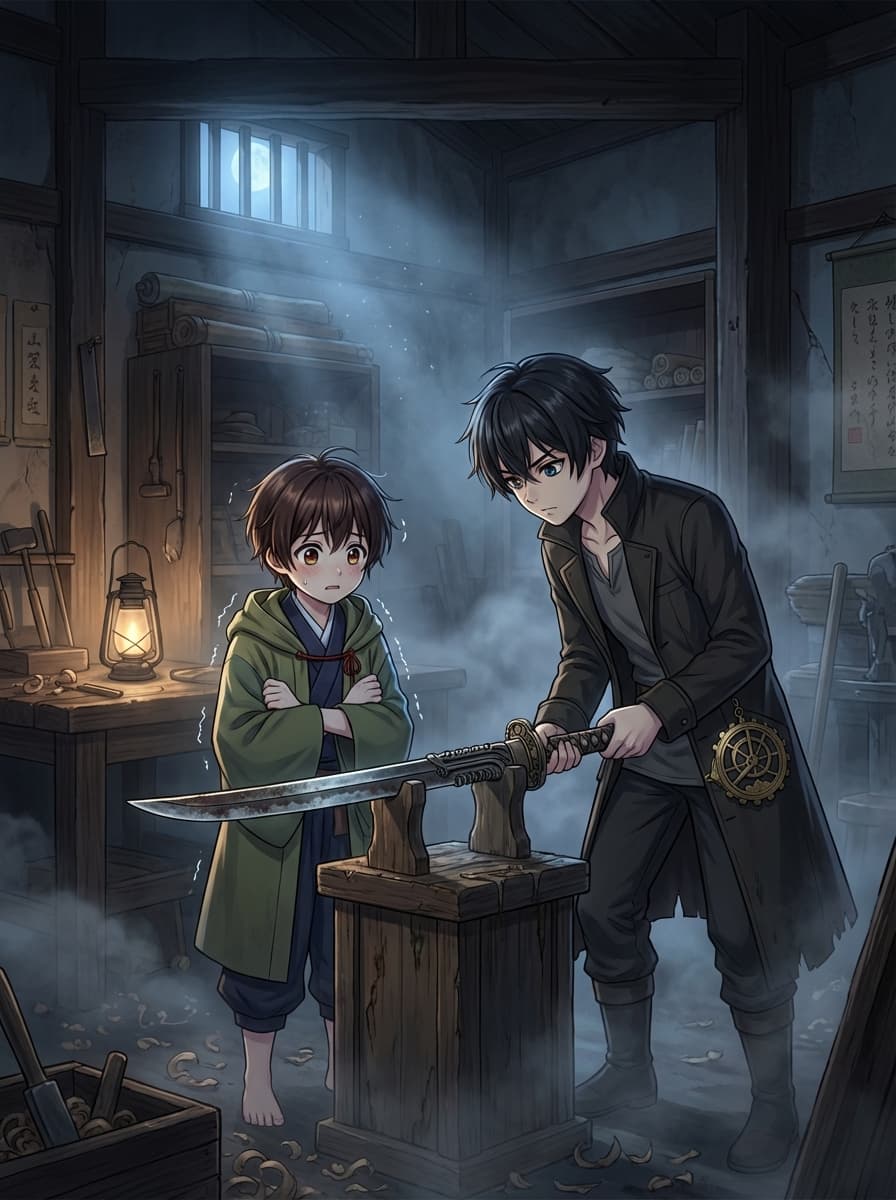
Deep within the Heart Cavity, a narrow workshop lay hidden.
Blades lined every wall, their tips an unnervingly pristine white. They were blades meant for scraping.
In the center of the workshop stood a single sword, fixed to a pedestal. It bore no maker’s mark—only an inscription carved into its side:
The Blade That Shaves Names
A chill ran down Koyoi’s spine.
“So this is how they stripped the names clean.”
Kuon inspected the pedestal.
“It’s not a weapon. Originally, it was a rescue tool—an Exfoliation Blade. A tool meant to strip away excessive aliases.”
Asahi looked on, unimpressed.
“The tool itself is neutral; it’s how it’s used that makes it hell. Same old story.”
The pedestal featured three operational grooves: Peel, Compress, and Erase.
Peel and Compress were worn with age. Only the Erase groove was fresh and deep.
“Proof that its function was altered halfway through,” Kuon said. “The Observer made the Erase groove the primary function.”
Koyoi opened Shiori’s notebook. In a blank margin, a hurried scrawl read:
‘The blade isn’t at fault. The settings are.’
Asahi looked at his own chipped sword.
“Can you restore the settings?”
Kuon nodded.
“I can. But if I do it here, the defense protocols will react.”
A moment later, the workshop floor glowed a sudden, angry red. They were too late; the intrusion detection had tripped.
The blades on the walls rose in unison. Autonomous defense.
Asahi stepped forward.
“Kuon, fix the settings. We’ll buy you time.”
Koyoi used the temperature of his Shizuku to dull the red glow of the floor, disrupting the tracking accuracy of the defensive blades. Asahi struck only at the hilts of the floating weapons with the blunt side of his sword, neutralizing them in mid-air.
Kuon overlaid his catalog onto the pedestal, rewriting the priority of the operational grooves.
Erase → Peel. Compress: Auxiliary.
Finally, he signed the management key.
‘Restoration Protocol.’
The defensive blades froze. The red light on the floor flickered out.
Asahi laughed, catching his breath.
“That worked.”
Kuon wrapped the blade in cloth and returned it to the pedestal.
“We won't take it with us. We leave it here and only fix the way it's used.”
Koyoi hung a wooden tag at the workshop entrance.
‘Peel before you shave.’
The Blade That Shaves Names did not need to be destroyed. It needed to be rescued from its settings.
The three left the workshop and returned to the Heart Cavity. Behind them, the light of the pedestal shifted to a calm, steady blue.
Since they began this cycle of restoration, their journey had gradually changed.
In the beginning, they ended each day merely asking if things had "gone well." Now, they recorded the why—distinguishing between what worked by design and where they had been saved by mere coincidence.
They had learned that in this era of Cascading Ruin, the most effective tool was turning coincidence into procedure.
Every time Koyoi opened the notebook, he found himself looking for the traces of Shiori’s habits. But instead of stopping where Shiori had left off, he chose to fill the blanks. A blank space was proof of an absence, but it was also room for a handover. He wrote honestly about who was no longer there, and because of that, he decided what to leave behind. The process was painful, but as he gave that pain words, his movements the following morning became more precise.
Kuon refined a format for handling the precision of the catalogs alongside the uncertainty of the field. By separating the columns for "Immediate Decisions" and "Pending Items," he reduced accidents caused by false certainty. Defining "Pending" not as a weakness, but as a technical safeguard against misjudgment, had been a breakthrough. In places where the Observer had broken the world by making "Fixity" the only virtue, these "Pending" columns were where the healing began.
Asahi stopped relying on vague intuition for his combat records. Foot placement, the width of the engagement, the beat at which to relax his strength, the height of his gaze—he transcribed even the most wordless physical techniques into short, repeatable phrases. As a result, his options increased even with a chipped sword, and he relied less on desperate, all-or-nothing strikes. By prioritizing "preserving" over "winning," he steadily pushed up the survival rate of his companions.
That night, before the campfire, the three decided on the single line they would pass on next. The discussion was short, and the conclusion was, as always, modest. But the modest sentences were the ones that helped most in the field. Flashy slogans lift the spirit, but procedures save lives. The line they chose would become a wooden tag by morning, tied to a gate, a shelter, or a railway siding.
Finally, Koyoi added a small note to the margin of the ledger:
“What we learn here is not to be used to blame someone for being slow, but to absorb the delay for someone else.”
Beside that sentence, Kuon added the date and their current location. Asahi nodded silently and threaded a cord through the hole in the wooden tag.
The next morning, the tag swayed in the wind, coming to rest at an angle that made it easy to read. Watching it, the three decided to measure their day not by whether it went well, but by whether it could be continued. To not just break the chain of collapse, but to maintain the path so that others could walk it.
That quiet, grueling work was the true heart of their journey. They confirmed this in the same words, deciding to leave one unresolved task behind. A record that makes everything look solved only misleads the next person in line. To show the unresolved as unresolved was not a mark of defeat, but a mark of transition.
Koyoi made a small mark at the edge of the notebook, creating a column for re-verification the following day. Kuon defined the meaning of that mark, and Asahi re-hung the wooden tag at the site where the mark could best be understood. By repeating those three unglamorous steps, the same failures became noticeably rarer.
The records didn't need to be perfect. They just needed to be left in a way that the next human to touch them wouldn't lose their way.
Having confirmed their agreement, the three began walking toward the next sector.