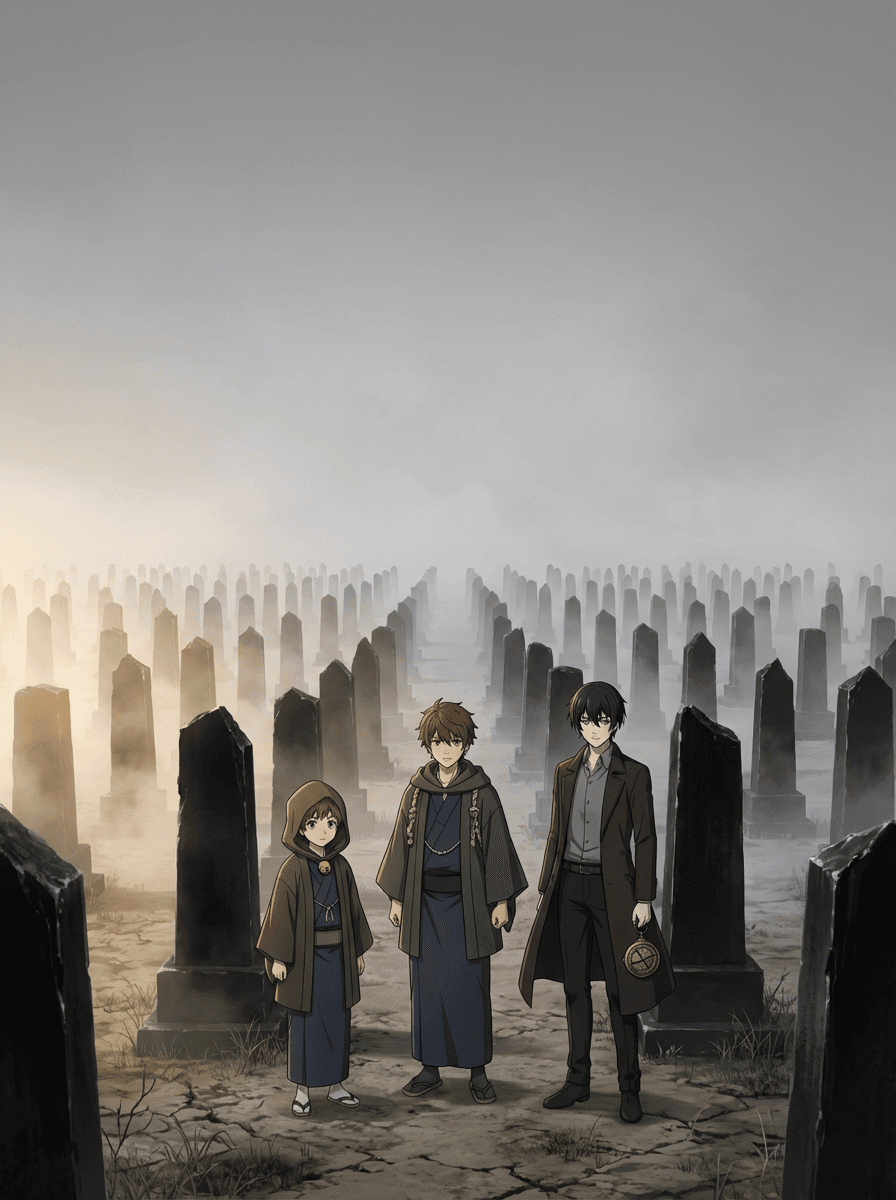
The narrow path opened onto a hill of stone monuments.
Identical grave markers stood in neat, even rows. There were no flowers, no offerings. Instead, only numbers and cryptic symbols were etched into the cold stone faces.
“The tombstones of the Observers...”
Kuon’s voice grew stiff. Asahi stepped closer to read the nearest stone.
“No names. Just unit numbers and processing dates.”
Koyoi traced the surface of the stone with his fingertips. It was freezing to the touch. But as his hand moved, he felt a slight roughness on the back—faint scratches in the rock.
He walked around to the rear and found a tiny, private inscription carved there.
‘Right-handed. Liked his tea sweet.’
Beneath the cold number, a trace of the person remained.
Kuon checked another marker and found a similar hidden inscription.
‘She sang on rainy days.’
‘Learned how to lie during training.’
They were all brief—simple sentences of a life lived, never meant for the official record.
“I wonder who carved these,” Koyoi whispered.
“A surviving colleague, most likely,” Kuon answered. “They couldn't put names on the front, so they left them on the back.”
In the center of the hill stood a particularly large monument. Its number was old. Kuon hesitated to read it aloud, but Asahi spoke first.
“Is that a number you recognize?”
Kuon gave a sharp nod. “My instructor. The person who taught me to 'erase the individual and become a function.'”
Koyoi waited in silence. Kuon walked to the back of the stone and felt the carvings with his fingers.
‘He was a man who remembered the names of flowers in the morning.’
Kuon let out a soft, shaky breath. “...A man who spoke only of functionality, and yet, he remembered the flowers.”
Asahi crossed his arms. “I guess it means people are more than just symbols.”
The wind on the hill grew stronger, whistling between the markers like a thin, ghostly flute. Koyoi opened his drawstring bag and released a drop of warmth onto the central monument. The stark white of the stone softened, just a fraction.
“Even if we can't give them their names back, we can choose how we remember them.”
Kuon closed his ledger and looked up. “True. It’s easy to discard the entire history of the Observers as evil. But taking the easy way out only recreates the same structures.”
Asahi bowed deeply before the grave. “Even an enemy deserves a way to end.”
As the three of them began to descend the hill, Koyoi stopped at the entrance to carve a short message into a stone by the path.
‘Read the reverse.’
So that the next person to come through wouldn't judge them by their numbers alone.
Since they had begun this practice of recording, their journey had gradually changed. Before, they would end each day asking only, "Did it go well?" Now, they recorded the why: why it worked, and where they had been saved by mere coincidence.
They had learned that in this era of "Cascading Collapse," turning coincidence into a procedure was the most effective way to survive.
Whenever Koyoi opened his notebook, he found himself looking for the quirks in his bookmarks. He chose to fill the blanks rather than simply stop at what was missing. A blank space was proof of absence, but it was also room for something to pass on. By honestly recording that someone was gone, they could decide what was worth leaving behind for those who followed. The work was painful, but giving words to that pain made their movements more precise the following morning.
Kuon had refined a format to handle both the accuracy of the archives and the uncertainty in the field. He separated the columns into "Immediate Conclusions" and "Pending Items," which significantly reduced accidents caused by false certainty. Defining "Pending" not as a weakness, but as a technique to avoid misjudgment, had been a breakthrough—especially in places the Observers had broken by making "Fixity" the only virtue.
Asahi stopped relying on vague, sensory language for his sword techniques. Foot placement, the width of the gap, the timing of a breath, the height of the gaze—he recorded these difficult physical skills in short, repeatable bursts of text. As a result, even with a chipped blade, his options increased, and he relied less on desperate, all-or-nothing strikes. By prioritizing "preserving" over "winning," he had steadily raised the group's survival rate.
That night, huddled before the campfire, the three of them decided on the next line of text they would pass on. The debate was brief, and the conclusion was, as always, understated. But it was the understated words that proved most useful in the field. Flashy slogans could stir the heart, but procedures saved lives. The line they chose would be carved onto a wooden tag by morning and tied to a gate, a shelter, or a railway post.
Finally, Koyoi added a small note in the margin of his journal. “The things we learn here are not to be used to blame others for their delays, but to absorb those delays for them.”
Beside that sentence, Kuon added the date and their current location. Asahi nodded silently and threaded a cord through the hole in the wooden tag.
The next morning, the tag swayed in the breeze, coming to rest at an angle that made it easy to read. Watching it, the three decided to measure their day not by whether they had succeeded, but by whether they could continue.
To not just break the chain of collapse, but to maintain the path so that others could walk it—that quiet, grueling labor was the true heart of their journey. They exchanged a quiet nod of understanding, choosing to leave one specific task unfinished. To present a record where everything is "resolved" is to mislead the next person in line. Showing the unresolved as it is was not a sign of defeat, but a sign of transition.
Koyoi made a small mark in the corner of his notebook, creating a column for things to be reconfirmed the next day. Kuon defined the meaning of that mark, and Asahi re-hung the wooden tag in the field where it could be best seen. By simply repeating these three understated steps, the recurrence of the same failures began to visibly decrease.
Records didn't need to be perfect. They just needed to be left in a way that made it harder for the next person to lose their way. With that agreement settled, the three stepped forward into the next sector.