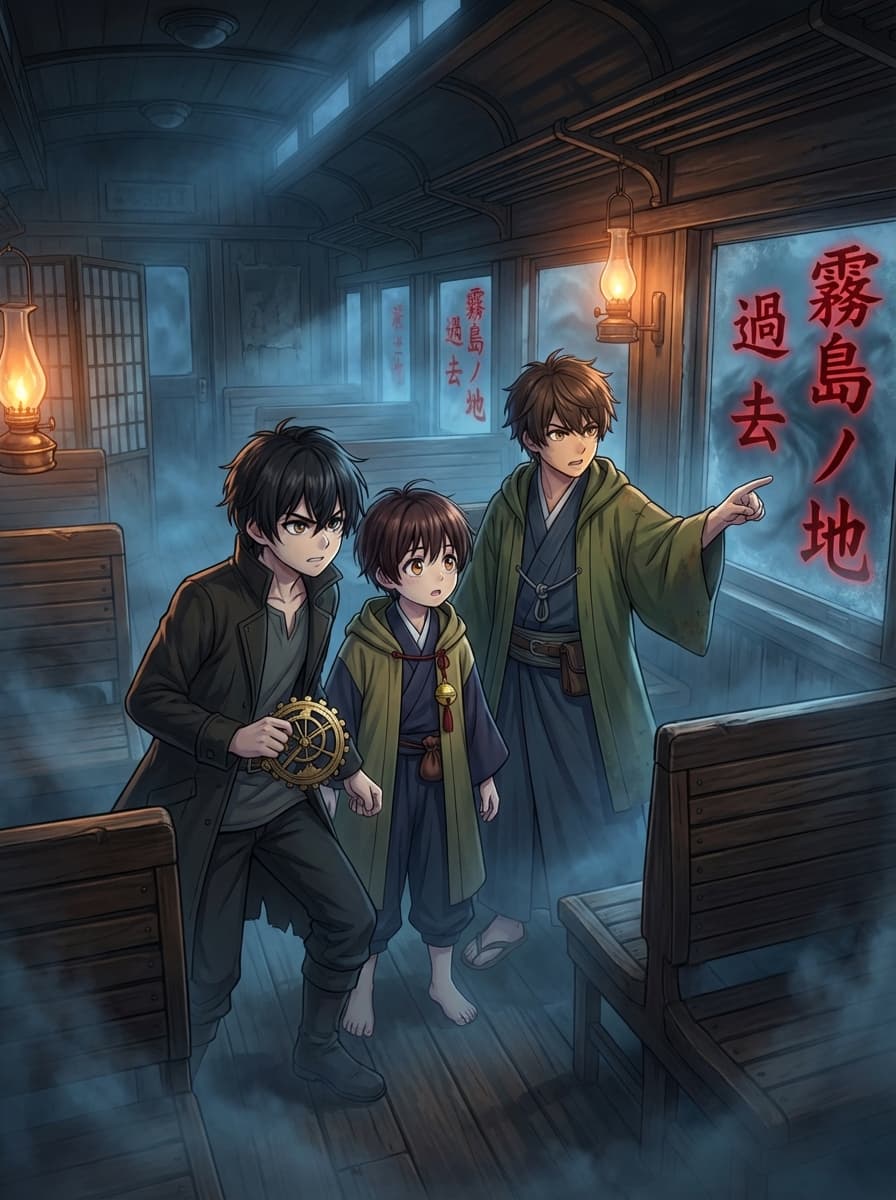
The train came to a halt at Labyrinth Station.
The station building was a simple square. Yet, the moment they stepped inside, the angle of the corridors shifted. Even while walking in a straight line, they found themselves looping back to the same pillar.
“It is the Labyrinth of Yae,” Kuon remarked, looking up at a directory where the same arrow pointed in all four directions.
Koyoi tightened his grip on the drawstring of his pouch. The pulse of the Shizuku thrummed against his palm, urging him to the right. But when he followed it, he was led straight back to the first ticket gate.
Asahi clicked his tongue. “If we try to solve this on foot, the sun will be down before we’re through.”
Kuon knelt on the floor, tracing the stone patterns with his fingers. The width of the joints was inconsistent. Only the narrowest rows emitted a faint warmth.
“The labyrinth itself is alive,” Kuon said. “It records the choices of its visitors and reconfigures the paths to match.”
“Is ‘Yae’ a person’s name?” Koyoi asked.
“Yes. One of the original designers. It wasn't built to keep people out, but to slow pursuers down.”
Asahi let out a short laugh. “Then the solution is simple. We just have to move like the ones being hunted.”
The three of them swapped positions. Koyoi took the lead, Kuon moved to the center, and Asahi brought up the rear. They moved not with the gait of those looking for an exit, but with the protective stance of those guarding a treasure.
Koyoi began choosing his path based on the echoes bouncing off the walls rather than the pulse of the Shizuku. The pulse was guidance; the echo was structure. By layering the two over each other, the false passages began to reveal themselves.
After twenty minutes of walking, they reached a dead end where a mirror stood. Eight doors were reflected in its silver surface, though in reality, only one door stood before them.
“This is the heart of it,” Kuon said in a low voice. “Yae’s final lock requires that you refuse to choose just one.”
Asahi raised an eyebrow. “If we don’t choose, how do we move forward?”
Koyoi took a deep breath before the mirror. Instead of looking at the eight doors one by one, he took all of them in at once. He blurred his focus, looking not for outlines, but for the variations in the light.
Suddenly, the darkness at the very center seemed to throb with a steady beat.
“It’s not a door,” he whispered. “It’s the space between the doors.”
Koyoi pressed his palm against the center of the mirror. The warmth of the Shizuku flooded outward, and the glass surface rippled like water.
Asahi steadied Koyoi’s shoulder while Kuon used his Catalog to anchor the shifting phases of the room. Together, the three of them stepped through at once.
Beyond the mirror lay a short gallery. At the far end, a single, weathered wooden plaque hung on the wall.
Do not forbid yourself from wandering.
Kuon noted that the calligraphy was Yae’s own. “A labyrinth isn’t a device meant to eliminate doubt. It was a training ground—a place to learn how to choose the best path over the shortest one, even while carrying that doubt with you.”
Koyoi touched the plaque and nodded silently. Asahi said nothing, only giving the hilt of his sword a light, contemplative tap.
Ahead, they could see the light of the exit at the end of the corridor.
The three of them moved forward without looking back. They understood now that advancing while embracing their hesitation was the only way out.
Just before the exit, Koyoi copied the words from the plaque into his notebook. Do not forbid yourself from wandering.
Asahi peered over his shoulder. “Man, I wish I could’ve shown that to the old me.”
Kuon gave a wry smile. “It’s enough that the current you remembers it. There is no need to rewrite the past.”
Beneath the quote, Koyoi added a single line of his own: Doubt is not a lack of speed; it is the time needed to choose.
After leaving this brief response in verse for the Labyrinth of Yae, the three finally stepped out of the station.
In this moment, they relied on deliberate procedure over raw momentum. Kuon began by verbally separating what was certain from what was not. Once shared, Koyoi recorded these distinctions in his notebook. Maintaining this order ensured they moved as one, stripping away the misunderstandings that might otherwise lead to conflict. In high-pressure situations, securing the first step does more to stabilize the whole than any number of frantic additions.