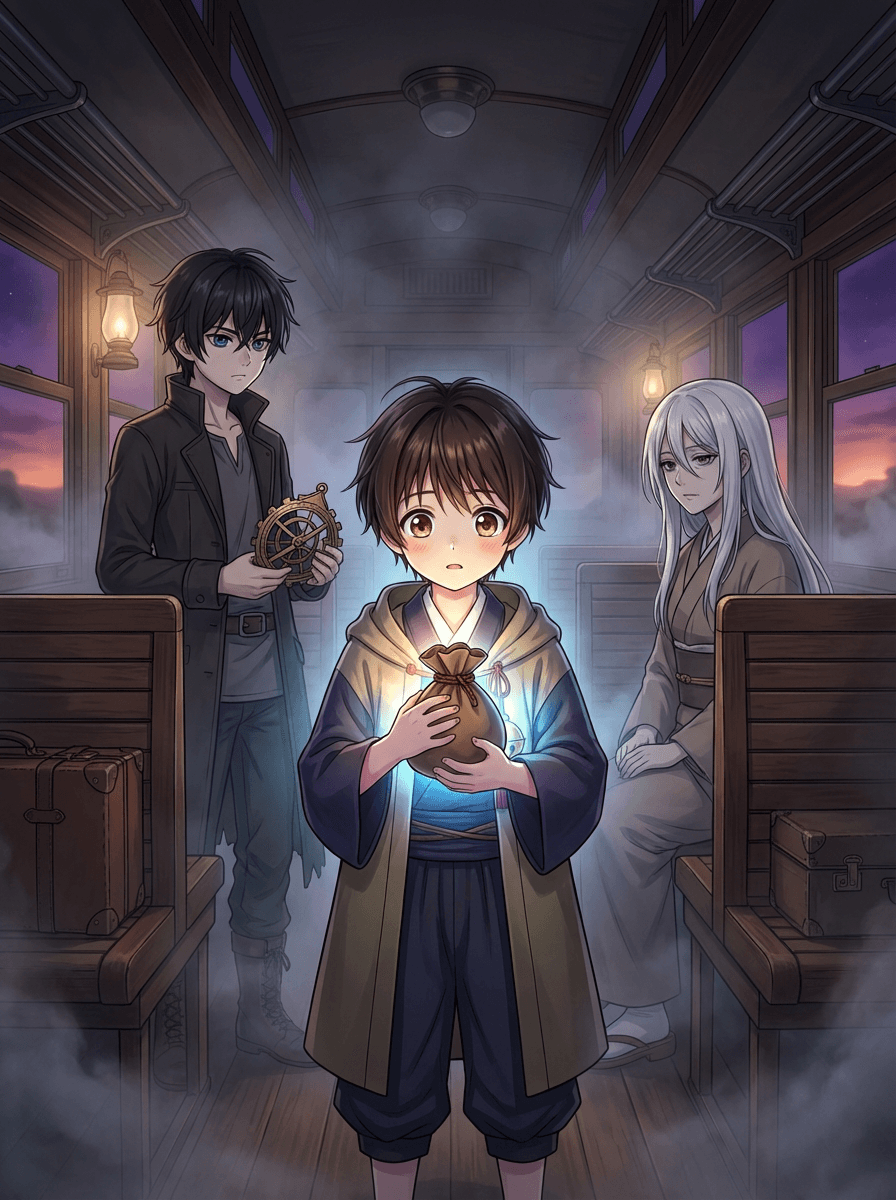
Past the town, the archive came into view, housed within the ruins of an old railway station.
The shelves were half-collapsed, with scrolls and ledgers strewn across the floor. The air was thick with the scent of paper and aged ink.
Kuon picked up a single volume, flipped it open, and snapped it shut just as quickly.
“The timeline has been rewritten.”
Koyoi looked at a nearby page as well. Layered over the same events were different dates and the names of the dead.
“A falsification of history...”
Asahi spoke as he kicked aside a shelf board to clear a path.
“Whose interests does this 'history' serve, anyway?”
Kuon didn’t answer. Instead, he held a sheet of paper up to the light, peering through the back. There were traces of erasure in the lower layers—not entirely vanished.
“It’s not just the Observers. The town itself is complicit in the cover-up. Whether out of fear or some kind of bargain, I can't say.”
Footsteps echoed from the back of the archive. An old scribe clad in grey robes emerged. One eye was stained with ink, and a worn-down brush was gripped in his hand.
“Do not read those as you please.”
The old man didn’t shout. He spoke in a voice heavy with exhaustion.
“If I hadn't rewritten it, this town would have vanished three times over by now.”
Koyoi took a step forward.
“But because you rewrote it, there are people who were erased.”
The old man’s fingers trembled.
“I am well aware. That is why, every night, I transcribe the names I had to strike out onto the backs of discarded sheets.”
He pulled a bundle from a desk drawer. The torn scraps were covered in dense, tiny script. These were the records from before the alteration.
Kuon’s expression shifted.
“With these, we can recover what was erased.”
The old man shook his head.
“There is no true restoration. Once facts are overwritten, they do not return. All we can do is record them side-by-side.”
Asahi asked, “Then what are you trying to protect now?”
The old man tightened his grip on his brush.
“Not to settle on a single truth. To ensure the victors' timeline isn't the only thing that remains. To preserve everything, contradictions included.”
Koyoi opened his drawstring pouch and let the droplet’s warmth fall onto the desk. The ink on the scraps didn't smudge; instead, the lines seemed to sharpen and set.
“With this warmth, we might be able to preserve these names.”
Kuon moved quickly to assist. He tore the margins from an index and layered protective charms over the pages.
Asahi stood by the entrance, keeping watch outside. If they stayed too long, pursuers would find them.
In the brief time they had, the three of them worked with the old scribe to bundle the scraps of paper. They left the falsified timeline untouched, choosing instead to carry away only the records of those who had been erased.
As they were leaving, the old man spoke to Koyoi.
“There is no such thing as a 'correct' history. But that does not mean you must stand by and watch in silence as history is being stolen.”
Koyoi bowed deeply.
On the way back to the train, Asahi muttered under his breath, “I guess fighting isn't just about swinging a blade.”
Kuon replied, “Keeping records is its own kind of battle. And often, it’s the one with the most lasting impact.”
Koyoi adjusted his hold on the bundle of paper. It should have been light, yet it felt strikingly heavy in his arms. It wasn't the weight of a burden, but a weight that told him he must never let it go.
On the way to the station, Koyoi’s eyes caught a small note written beside one of the erased names.
‘Their laughter was loud in the mornings.’
It wasn’t a birth year or an occupation. Just a tiny fragment of a life lived.
For some reason, that single line brought Koyoi a sense of peace. History isn't composed solely of grand events. It is the accumulation of daily habits, the proof that people truly existed.