Almost as soon as the train pulled away, Kuon’s fingertips stilled.
On the pages of his catalog, once-isolated symbols began to align into rows. Lines connecting distant sectors multiplied on their own.
“The chain has begun,” Kuon said, his voice low.
“Which one?” Koyoi asked.
Kuon gestured toward the window.
Beyond the glass, flickering station shadows surfaced through the rushing white blur. A track that should have been a single, straight line was splintering into branches with every passing second.
“Names, shadows, resonances… the elements we’ve gathered so far are pulling on one another. If even one link collapses, it will drag the others down with it.”
Asahi clicked his tongue. “So, if we mess up anywhere, it hits everything.”
“Exactly.”
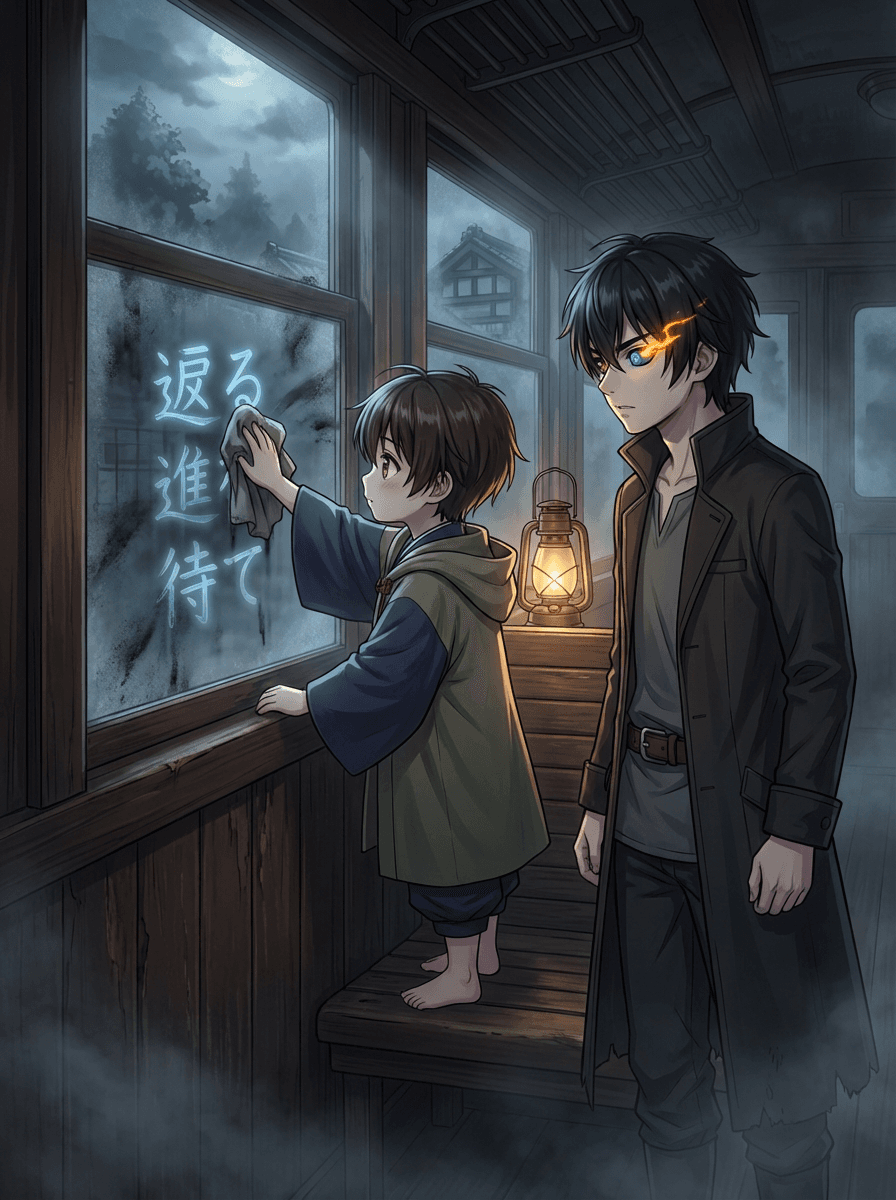
The lanterns inside the car dimmed. Then, faint characters began to surface on the windowpane.
Return.
Advance.
Wait.
The short commands overlapped, layering until they were nearly illegible. Koyoi narrowed his eyes.
“Whose voice is that?”
Kuon didn't answer immediately. Only the light from his prosthetic eye grew more intense. “It isn’t just one. Multiple records are fighting for control of the same pane.”
Asahi gripped the back of his seat, lowering his center of gravity. “Here it comes.”
A shockwave surged from beneath the floor. For a moment, it felt as if the train had leaped onto a different set of tracks entirely. A dull ache throbbed deep within their ears.
Koyoi opened his drawstring bag, focusing his consciousness on the Droplet. Its temperature was stable. That was his only reliable metric.
“Kuon. Which one is the main line?”
Kuon traced three lines into his catalog and pointed to one.
“The line where resonance afterglow is thinnest. This place is full of temptation; the louder the track sounds, the more likely it is a trap.”
Asahi gave a short, sharp laugh. “Cutting out the flashy stuff is what I do best.”
Ahead, the track switch groaned. Three successive metallic clangs were followed by a final, massive impact.
The car tilted violently to the left. Koyoi’s shoulder slammed against the handrail, but he did not let go of the Droplet.
The characters on the window crumbled all at once, washing away like ash. The lanterns regained their brightness.
Kuon exhaled. “We’re through. The preliminary phase is over.”
“But you look like the real show is only just beginning,” Asahi noted.
Kuon nodded grimly. “The chain hasn't stopped. We’ve simply seen how the links are forged. Next, we’ll be forced to choose whether to sever them—or rewire them.”
Koyoi placed a hand against the window. Beyond the cold glass, a slender light flickered back to life.
It wasn't telling them to return or to advance. It was simply a light that said, I am here.
“I’ll choose,” Koyoi said quietly. “Not a chain decided by someone else, but a chain we can carry ourselves.”
The train gathered speed. The presence of the next sector was already bleeding into the car.
After passing through the junction, the clocks inside the car began to show three different times: the wall clock, Kuon’s pocket watch, and the station clock reflected in the window. None agreed.
Koyoi stopped the hands of the wall clock.
“Even time is getting caught in the chain. We’ll keep the rhythm using the pulse of the Droplet.”
Kuon nodded. “Agreed. External time is no longer trustworthy.”
Asahi snapped his pocket watch shut and tucked it into his bag. “I didn't think I’d be throwing away my watch in the middle of a journey.”
Koyoi offered a small smile. “We aren't throwing it away. We’re just putting it aside until we can return to a time that fits.”
To sever a chain wasn't to destroy it. It meant letting go for a moment so that things could be reconnected properly. That realization was finally shared among the three of them.
In this phase, they chose precision over force, adding extra steps to their preparation rather than trying to rush through. Kuon took the first move, clearly defining the "stable zones" from the "unstable zones."
Following that distinction, Koyoi reflected those divisions into the ledger. Asahi kept his blade sheathed until the organization was complete, focusing instead on securing their line of retreat and locking down their sightlines.
The greater the crisis, the more important it was to clarify the first moves rather than piling on new tasks. It was this discipline that kept the whole operation stable.